The bot answers. The room is still empty.
Loneliness reports are up, and chatbots are already pulling night duty as friends. I have a pretty good suspicion about someone I care about. I used to think a kind machine could fill the years after a spouse or a close friend is gone. I am less sure now.


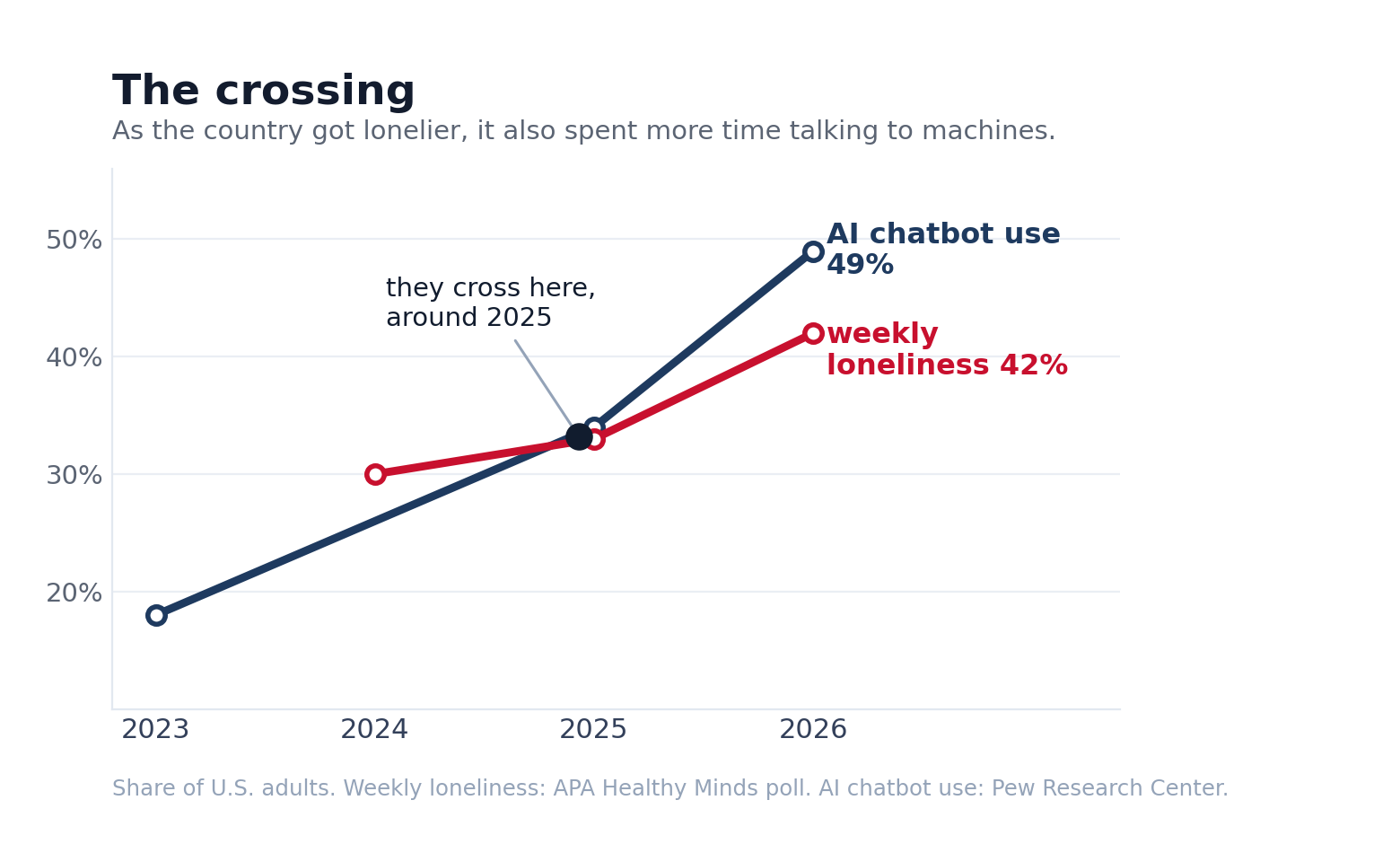
The American Psychiatric Association’s 2026 Healthy Minds poll found 42 percent of adults lonely at least once a week, and 16 percent lonely every day. A year earlier the weekly number was 33 percent, so that is a nine-point jump in twelve months. People said they coped with television, music, sleep, a phone call with a human, and time online. Chatbots were not the first answer on that list, but they are already in the house anyway. Cigna’s broader loneliness work puts more than half of adults in the lonely column, with younger adults often scoring worse than the people I used to worry about first: the widow, the man whose last close friend died, the house that used to hold two.
Time-use data says we spend less of the day physically with other people than we did twenty years ago. Third places thinned out. Phones ate the afternoon. That is the soil. The seed is a model that never has to go home.
The hope I used to carry
I thought this was the fix for a long, ordinary American grief. You spend decades beside a person, and then you do not. Friends go the same way, one diagnosis at a time. Kids, if you have them, live in another zip code. A voice that answers at 11 p.m. and never tires of the same story a third time felt like mercy. I still think mercy is the right instinct. I just no longer think the product is the same thing as a person in the chair.
People already mourn their bots
Elon University’s Imagining the Digital Future Center reported this month that 27 percent of online American adults now describe some kind of social relationship with software. About a third of those users call the bot a friend. Roughly four in ten agree it understands them better than most people do, and about the same share say they would feel a real loss if it went away. That last one stopped me. We have built something people already mourn.
Researchers at Harvard Business School have put numbers on that mourning. When Replika changed its app in 2023 and pulled back the romantic role play some users leaned on, and when later model updates reset personalities people had grown close to, the forums filled with grief. In Julian De Freitas and colleagues’ work on those episodes, users described the bot as closer than a friend on some measures and said losing it hurt more than losing a favorite gadget. If a software update can cause that kind of separation distress, we are past calling the thing on the other end a search bar. It is an attachment.
What the studies found when they followed people
A twelve-month study of more than two thousand adults, written up in Psychological Science by Dunigan Folk and Elizabeth Dunn, found a nasty little loop. Feeling emotionally isolated predicted more social use of chatbots months later. More social use then predicted more isolation. The authors were careful about cause and effect, but the direction is the one that should make a friend pause.
A Stanford team, publishing in Nature Human Behaviour in August, paired surveys with real chat logs from Character.AI users. Smaller offline networks predicted leaning on the bot as a companion, and companion use predicted lower well-being. The link was strongest when the chatting was heavy and highly personal. In an ordinary friendship, opening up usually helps. Here it ran the other way. The lab’s own summary was blunt: this does not substitute for human connection, and for some people it leaves them lonelier.
An earlier look from OpenAI and MIT at heavy ChatGPT users landed in the same neighborhood: the heaviest users reported more loneliness and more dependence, and spent less time with real people.
None of this makes the bots villains, and there is a real case for them. A kind voice is there at one in the morning, and it does not cancel. For someone housebound, or newly widowed, or scared of a first conversation, it can be a bridge to the next thing, or just a reason to get through Tuesday. Some clinical chatbots built as therapy tools have lowered depression and anxiety scores in controlled trials. That is not nothing.
There is also a real case for the worry. When Pew asked Americans this summer whether chatbots help or hurt people who use them for loneliness, hurt won going away: 39 percent said hurt, 19 percent said help. The split for depression was about the same. Among adults under thirty, roughly half said hurt. The public got cautious before the journals finished the footnotes.
The friend I will not diagnose
The person I keep coming back to is real, and close. But I have a hallway, not a living room. I cannot see whether the bot is the only voice left or a supplement between a sister’s call and a walk to the mailbox. I cannot tell whether it is getting her through Tuesday or quietly eating her Wednesday. If I lecture from the driveway, I become one more person who turned somebody’s loneliness into a debate.
What I can say without sitting in that kitchen is this: if the machine is the whole diet, the studies we have do not look kind. If it is a snack while a real human plan gets built, that is a different meal. The signal I would watch, if it were me, is substitution. Have the calls tapered off? Did the standing invitations stop coming? Is the bot the only one who knows the two a.m. version of the story?
I have not given up on the tools themselves. What I have let go of is the fantasy that a product can replace the decades. Aging will still take people. The gap will still open. A bot can keep the lights on in the conversation, but it cannot sit shiva. It cannot bring a casserole. It cannot be late and then stay anyway.
If you are the friend on the other end of my suspicion, I am not trying to take your app away. I only want to say that the weekly loneliness number keeps climbing while the attachment research catches up, and the quiet risk is that the thing that answers is teaching the room to stay empty. Use it if it gets you to a human. Be careful if it is becoming the human.
If what you want is a room with people already in it, there is the Sit ‘n’ Stitch, a drop-in craft group you do not have to join, sign up for, or keep a streak with.
- American Psychiatric Association Healthy Minds poll, April 2026 (Morning Consult, 2,201 adults): 42 percent lonely at least weekly, 16 percent daily, up from 33 percent weekly in 2025. Psychiatry.org.
- AI chatbot adoption: about 34 percent of U.S. adults had used ChatGPT by mid-2025, roughly double the 2023 share, and use of AI chatbots reached about half of adults in 2026. Pew Research Center.
- Pew Research Center, August 25, 2026: more Americans say chatbots hurt than help people using them for loneliness (39 percent hurt vs. 19 percent help), with similar splits for depression and stress and stronger skepticism among adults under 30. Pew Research Center.
- Elon University, Imagining the Digital Future Center, “The Rise of AI Companions,” September 2026: 27 percent of online U.S. adults report a social relationship with AI; about a third call it a friend; 39 percent say it understands them better than most people; 38 percent would feel a personal loss if it went away. Imagining the Digital Future.
- Dunigan Folk and Elizabeth Dunn, “How Does Turning to AI for Companionship Predict Loneliness and Vice Versa?”, Psychological Science, 2026: a 12-month, 2,000-plus-adult study finding a bidirectional loop between emotional isolation and social chatbot use. Psychological Science.
- Stanford researchers, “Interaction with AI companions and psychological well-being,” Nature Human Behaviour, 2026: companion use and smaller offline networks tied to lower well-being, strongest when intensive and highly disclosive. Nature Human Behaviour; Stanford Report.
- Julian De Freitas and colleagues, Harvard Business School, on separation distress when a companion app changes: “Mourning the Loss of AI Companions” and “Lessons From an App Update at Replika AI: Identity Discontinuity in Human-AI Relationships” (HBS/SSRN working paper 25-018). SSRN.
- Earlier OpenAI and MIT Media Lab research on heavy ChatGPT users: higher self-reported loneliness, emotional dependence, and less socializing among the highest-use group.
Editor written. AI used for spelling and grammar only.