Five a.m. is not a strategy
I do not know a person who has never lost a night. I have lost a lifetime of them. My mind will not clock out. It opens a new project or a fresh headline, and the next thing I know it is 5 a.m. Sleep is not a habit I failed. It is a health goal I have to treat like one.

I am writing this as a man whose brain treats bedtime like a second newsroom. The copy is never done. The next piece is always almost ready. That loop is how a calling becomes a 5 a.m. ceiling stain. If your version is money, or a sick kid, or a body that hurts, the machine is the same. The mind will not hand over the keys. The question is whether we treat that as a personality quirk or as a health file.
What the aging research is actually saying
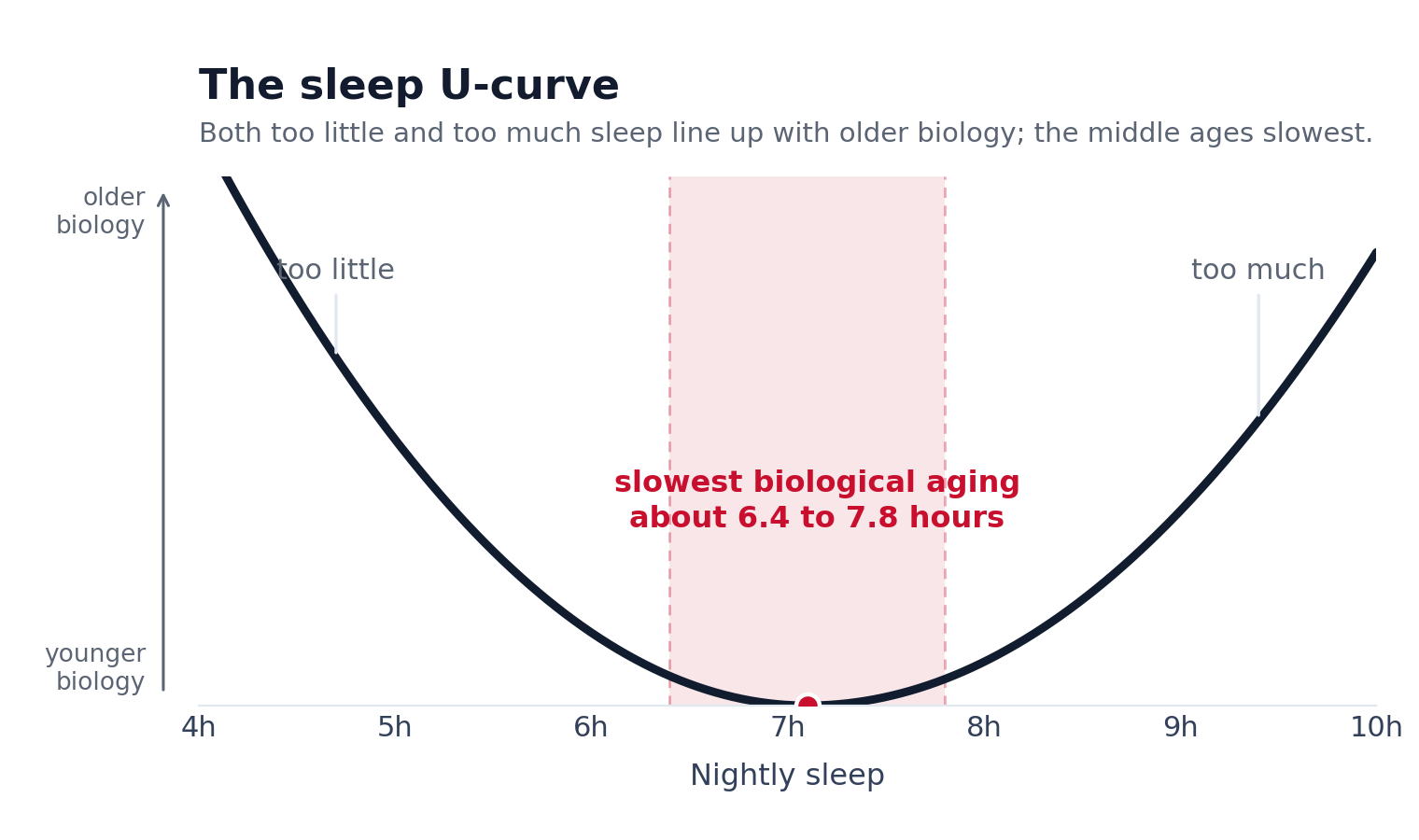
A 2026 analysis in Nature put sleep next to 23 biological-aging clocks, built from medical scans and blood work across seventeen organ systems, in about half a million adults. The pattern was a U. Too little and too much both lined up with older biology. The lowest age gaps sat roughly between 6.4 and 7.8 hours, drifting a bit by organ and by sex. Short of six hours and past eight both carried more disease and death risk in the follow-on work. None of that means you have to hit 7.1 hours on the nose. Call it a map, and the map says the middle of the night is not spare capacity.
Other aging work rhymes. Three big 2026 cohorts point the same way, one in China, one in England, one in India, with cognition best near seven hours and worse at four or nine. A U.S. sample of adults sixty-five and up did the same, seven to eight hours in the middle, five or fewer and nine or more off to the sides. Mortality work finds the shape can shift with age. Younger and middle-aged adults get hit harder by the short nights. The very old sometimes show more trouble on the long side, which may be illness talking more than a true need for sleep.
None of this proves that one bad Thursday ages you a year. It says something less dramatic and more serious: a lifetime of 5 a.m. ceilings is a risk factor you can work on.
The noisy mind is a known machine
Chronic insomnia is common. About one in eight American adults says they have been diagnosed with it, in a 2024 survey the American Academy of Sleep Medicine ran. The Academy does not point first to a new mattress. Its first-line treatment for chronic insomnia is cognitive behavioral therapy, or CBT-I. That carries the guideline’s single strong recommendation. Sleep hygiene on its own is not the treatment. The etiquette of the room helps. It does not rebuild the association between bed and sleep once your brain has decided the mattress is where the story meeting starts.
The useful pieces of CBT-I, in kitchen English:
- Stimulus control. If you have been awake about a quarter hour, get up. Dim light, something dull, back to bed only when you are actually sleepy. The bed has to stop meaning “office.”
- A wind-down that is a dump, not a pep talk. Write the headlines and the to-do list before the light goes off. I have started treating that page as the night editor. My desk is closed. The copy can wait in ink.
- A consistent window. Same-ish bedtime, same-ish rise, even after a wrecked night. Sleeping in to “catch up” often steals the next one.
- Less time in bed performing sleep. Restriction sounds cruel. Used with a clinician it can stop the six-hour lie-awake that teaches your brain the mattress is a trap.
- A quarrel with the catastrophe. The thought that one short night will wreck tomorrow is jet fuel for the racing. The body has survived worse Thursdays.
Bedroom etiquette that is worth practicing
None of these is a cure. They are the conditions that make a noisy brain less likely to win. Dark and cool. Quiet if you can get it. Phone out of reach, not face-down on the nightstand like a colleague. Caffeine with an afternoon deadline. Alcohol is a liar that knocks you down and then fragments the second half of the night, which is exactly when a racing mind loves to reopen the file.

Morning light matters more than any gadget. The body clock needs a sunrise more than it needs a wrist tracker. Walk the dogs. Open the blinds. I am not selling a lamp. And keep the work out of the bed, because if the story desk lives in the sheets, the sheets will never be off the clock. That one rule has cost me more almost-finished paragraphs than I want to count, and it has been the only rule that ever gave the next night a fair chance.
One caution that is not about willpower. If you snore, gasp, or wake unrefreshed after a full night, that is a medical file, not a manners file. Apnea and restless legs do not care about your gratitude journal, and no bedtime routine treats them. Those are worth a conversation with a doctor.
A wearable can show you the wreckage, but it will not sit down and negotiate with a brain that just thought of a better lede. The negotiation happens earlier, on paper, once my desk is shut for the night and the phone is across the room. Treat seven-ish hours the way you would treat blood pressure, a number worth minding now, because the body keeps the tab and it comes due as you age.
Everybody has had a sleepless night. The people I worry about are the ones who made a career of it and called it drive. Drive still needs a body that can stand up in the morning. The story can post after breakfast.
- MULTI Consortium, “Sleep chart of biological ageing clocks in middle and late life,” Nature, 2026. A U-shaped link between sleep duration and 23 organ-specific aging clocks in roughly half a million UK Biobank adults; the lowest biological-age gaps fell about 6.4 to 7.8 hours, with short and long sleep tied to more disease and mortality. Nature; Columbia University summary.
- Sleep duration and cognition in middle-aged and older adults across China, England and India, BMC Public Health, 2026: an inverted-U with cognition best near seven hours and worse at four or fewer and nine or more (25,783 adults aged 50+). BMC Public Health.
- Sleep duration and healthy aging in U.S. older adults, BMC Geriatrics, 2026 (BRFSS, 35,056 adults aged 65+): an inverted-U with the best outcomes around seven to eight hours. BMC Geriatrics.
- American Academy of Sleep Medicine, behavioral and psychological treatments for chronic insomnia: multicomponent CBT-I carries the guideline’s single strong recommendation, and sleep hygiene is not recommended as a stand-alone treatment. AASM.
- Roughly one in eight U.S. adults reports a chronic insomnia diagnosis, per a 2024 AASM survey. AASM survey.
Editor written. AI used for spelling and grammar only.