I Stand With Ukraine. These 12 Days in Washington Worry Me.
Missile warnings Ukraine says never came, a speed cap on Ukraine's drone links and Patriots left waiting came in the same 12 days as sanctions relief for Russian diesel. Here is the record, the administration's answers, a check of the bad-weather explanation against the data, and where I land.


Credit: U.S. Department of State / Freddie Everett
Opinion. The facts below link to their sources. The judgment at the end is mine.
Overnight from Tuesday, Oct. 13, into Wednesday, Russia fired 39 ballistic missiles and more than 120 drones at Kyiv, the region around it and Kharkiv, Zelensky said. Six people were killed and about 600,000 lost power, CBS News reported. Ukraine’s Air Force said no warning came from its partners before the first wave, though warnings did come for the waves after it, the Kyiv Independent reported.
I don’t want to point a finger at one person, and on several of the events below the public record won’t let anyone do that fairly. I do believe that when a bigger country invades its neighbor, the United States should help the people being attacked. That’s how I look at what follows, and over 12 days this month most of it pointed the same way.
Twelve days, in order
- Oct. 9. Following a call with Russian President Vladimir Putin, President Trump said Russia would supply U.S. and world markets with more than 300,000 metric tons of diesel right away and 500,000 tons in November, the Associated Press reported. The Treasury issued a temporary license that holds off U.S. sanctions until April 2027 on Russian diesel already loaded on tankers. That day in Miami, U.S. envoys pressed Ukraine over its strikes on Russian oil refineries, Reuters reported.
- Oct. 11. Trump announced an “energy ceasefire” between Russia and Ukraine. Zelensky said that Ukraine would stop hitting Russian refineries if Russia stopped hitting Ukraine’s power plants.
- Oct. 12. At about 10:10 p.m., Russia fired roughly six ballistic missiles at Kyiv, and the air-raid alert sounded only after the first explosions, the Kyiv Post reported. Politico, citing an official familiar with the matter, reported that the United States told Ukraine bad weather kept it from sending a warning, as relayed by The New Voice of Ukraine.
- The same week. A European official and a Ukrainian official said the administration had threatened to stop sharing intelligence and to halt Europe’s purchases of U.S. weapons for Ukraine unless the refinery strikes ended, CBS News reported.
- Overnight, Oct. 13 to 14. The big barrage hit. The Air Force said the first wave came unannounced and warnings arrived for the three after it. CBS News dated the barrage early Tuesday, while Ukraine’s Air Force and the Kyiv Independent put its first wave late on Oct. 13. CBS News reported that U.S. officials told Ukraine the launch-detection system had failed because of bad weather.
Oct. 13 to 20: the satellite cap and the Patriots
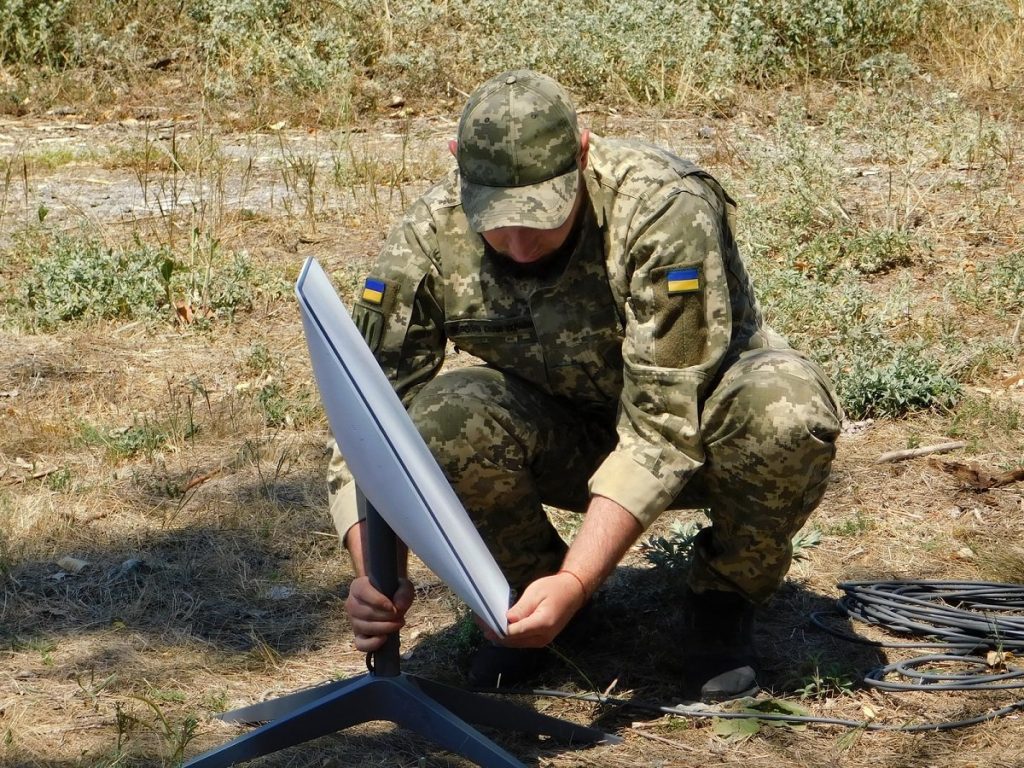
- The same night. Ukrainian drones and other hardware on SpaceX satellite links lost their connection above about 100 mph, according to Serhii Beskrestnov, a technology adviser to Zelensky, as Fortune reported. Ukraine says the cap hit Starshield, the military version of SpaceX’s Starlink internet service. Reuters reported that the receivers guide Ukrainian drones in flight and that the cap slowed the interceptor drones Ukraine uses against Russia’s Shahed attack drones.
- Oct. 15 and 16. Reuters, citing two U.S. officials and a Western official, reported that the order to slow the service came from inside the White House. A senior U.S. official said the president never made such a request. The British newspaper The Telegraph, citing four sources, reported that Elon Musk proposed the cap and Trump agreed. Trump told reporters, “It wasn’t me, and I don’t think it was Elon.”
- Weekend of Oct. 18. Secretary of State Marco Rubio called reports that the White House ordered the slowdown “categorically false,” said the slowdown “sort of happened” and said service was back to where it had been, Fortune reported. Ukraine disputed that. Rubio also said Ukraine does not have Starshield access now and that its request is under discussion. On Oct. 18 Trump wrote that Zelensky “doesn’t want to end this war, and probably never did,” Al Jazeera reported.
- Oct. 19. After an overnight ballistic missile attack on Kyiv, Ukraine again said it got no warning, the Kyiv Independent reported. Zelensky told a bipartisan group of senators that Ukraine had almost no Patriot air-defense interceptors left from the U.S. batch and that Defense Secretary Pete Hegseth had not signed off on Patriots European allies had already paid for.
- Oct. 20. The Washington Post reported that Hegseth had neither approved nor formally rejected releasing those Patriots, as relayed by HNGN. Zelensky said early warnings were working again after talks with U.S. officials, including a call with Rubio, and said he was “thankful to American side.” Rubio, speaking in India, said “Nothing has changed” in U.S. policy, the Associated Press reported. The Wall Street Journal reported that Musk ordered the slowdown himself, as summarized by Straight Arrow News, and Rubio has since said Washington knew nothing of it in advance.
The administration’s case
The administration has answers to most of what’s above. Rubio said there has been no political directive to harm Ukraine and that Patriot missiles are scarce and needed for American bases and allies. Sources told CBS News that intelligence sharing as a whole never stopped, and Rubio pointed to a software problem that U.S. European Command had looked into. Trump has said he wants the fighting over and that Ukraine’s drone strikes on refineries have been hurting world diesel markets, which have real causes in the Iran war as well, as we reported on Oct. 14.
On the satellite cap, I don’t know who gave the order. Reuters, The Telegraph and The Wall Street Journal each tell it differently. The White House says the president never asked for it, and Musk has said limits on Starshield are set by the military and the president, because the system is “owned and controlled by the US government.” The government’s role is real: in 2023 the Pentagon began paying SpaceX for Starlink service in Ukraine.
I checked the weather
The bad-weather explanation made me wonder whether the weather was really that bad, and whether warnings came through on nights just as cloudy. I pulled hour-by-hour cloud and rain figures from Open-Meteo, a public weather-data service that rebuilds past conditions from weather models, for Kyiv, Kharkiv and four Russian regions along the border: Bryansk, Kursk, Belgorod and Voronezh. If the missiles came from near the border, the sky over those regions is what a satellite would have looked through. Nobody has said exactly where these launches were, so this is a rough check, and model figures are estimates of the sky.
On Oct. 12, the night of the bad-weather explanation, Kyiv sat under full overcast with light rain. Across the four Russian border regions, though, the model averages about 71 percent cloud from 9 p.m. to 11 p.m., the hours around the attack, and over Belgorod it thinned to about 21 percent by 11 p.m. For the night as a whole those regions averaged about 81 percent, and five of the 16 nights from Oct. 5 to Oct. 20 were cloudier, at 90 percent or more.
The next night gives a cleaner test, because the warnings failed and worked within a few hours of each other. The first wave came late on Oct. 13 with no warning, and the later waves, around 3 a.m. and after, came with one. The model has the four border regions at about 98 percent cloud from 9 p.m. to 11 p.m. and about 99 percent from 3 a.m. to 6 a.m., with rain over Kharkiv and Bryansk during both stretches. The sky barely changed between those hours, while the warnings went from missing to working.
Oct. 18 into Oct. 19 tells a similar story. Ukraine’s Air Force said the first wave, around 11 p.m., came with no warning and that information did arrive for the second wave around 3 a.m., the Kyiv Independent reported. Kyiv was overcast with light rain at both hours, and Kharkiv was overcast at both. The border regions stayed mostly cloudy, though over Kursk the rain had stopped and the cloud had thinned to about 78 percent by 3 a.m., which fits the weather explanation. Under much the same sky elsewhere, one wave got a warning and the other didn’t.
U.S. warning satellites watch from orbit with infrared sensors that look for the heat of a rocket motor, according to the Center for Strategic and International Studies. A 2004 study in Science & Global Security found that thick cloud is what can delay such a sensor, and that a large missile’s exhaust is reliably seen by about 7 kilometers, or 23,000 feet, of altitude. Clouds can delay the first sighting by part of the missile’s climb.
Later, Rubio gave a different reason, the software problem. A senior Ukrainian official told the Kyiv Independent, “Now we’re seeing ‘bad weather’ three times in a row.” I don’t know which explanation is true. Cloudy nights were common over that border this month, and if cloud alone could stop a warning, Ukraine would go without one on a good share of them. That would be a problem worth fixing, whatever caused these missed warnings.
What the diesel buys
The first Russian shipment, about 2.25 million barrels, works out to roughly 0.6 days of U.S. diesel and heating-oil use by Ariel Cohen’s count in Forbes. Patrick De Haan of GasBuddy put it at about 1.5 days, according to Newsweek. Take the larger number and it is still less than two days of fuel. Republican Sens. Lisa Murkowski, Susan Collins, Thom Tillis and John Curtis joined Democrats in an Oct. 11 statement saying the deal runs counter to a 2022 law banning Russian energy imports, Time reported.
Set that next to the same 12 days in Ukraine: pressure to halt refinery strikes, nights Ukraine says came without missile warnings, drone links capped, and Patriot missiles Europe had already paid for still waiting. The warnings came back after a few days of talks. Rubio says the satellite speed is back to normal, and Ukraine says it isn’t.
The people killed
The barrage overnight Oct. 13 to 14 killed six people, CBS News reported, five of them in Kyiv. In a nine-story apartment building in the Desnianskyi district, at least three women were killed and 25 people were hurt, one of them a 7-year-old girl, the Kyiv Independent reported. On the night of Oct. 18 a 21-year-old woman was killed in Kyiv and eight people were injured, the Kyiv Post reported. None of the reports I found lists a child among the dead.
Whether a warning would have saved any of them, nobody can say. A warning buys minutes to reach a shelter or a hallway, it can’t stop a missile from hitting a building, and the reports don’t say which wave killed whom. It might have helped, and that doesn’t mean it would have. Nobody has shown that the missed warnings had anything to do with the diesel deal. But the pressure on Ukraine that week was about diesel, a demand to stop hitting Russia’s refineries, and a European official and a Ukrainian official told CBS News the threat behind it was a cutoff of intelligence sharing and of Europe’s weapons purchases for Ukraine. The same CBS News report said intelligence sharing as a whole never stopped. So I’ll ask it plainly: was less than two days of diesel worth any added risk to the seven people killed in attacks that opened with a wave nobody warned Ukraine about?
Where I land
Today, Oct. 21, envoy Steve Witkoff meets Putin in St. Petersburg with an updated peace proposal, Axios reported. I want this war over, with Ukraine still able to defend itself when it ends. Rubio says the Patriots are short and needed elsewhere. Europe has already paid for these, and whether Washington releases them is the next thing I’m watching.
- U.S. may have withheld warnings to Ukraine of Russian strikes, sources say (Oct. 14, 2026) · CBS News
- Order to limit Starshield for Ukraine came from inside White House, sources say (Reuters, Oct. 16, 2026) · Defense News
- Ukraine’s drones lose their Starlink link above 100 mph (Oct. 19, 2026) · Fortune
- Musk suggested Trump restrict Ukraine’s Starlink service, Telegraph reports (Oct. 16, 2026) · Kyiv Independent
- Musk ordered Ukraine’s Starlink slowdown, Trump administration denies prior knowledge (Oct. 21, 2026) · Straight Arrow News
- US reacts to Kyiv’s claim it received no advance notice of Russian ballistic missile launches (Oct. 19, 2026) · Kyiv Independent
- Zelenskyy says early warning system for Russian missile attacks resumes (Associated Press, Oct. 20, 2026) · KPBS
- Zelensky discusses ballistic missile early warning and Starlink restoration with Rubio (Oct. 20, 2026) · Ukrinform
- Pentagon holds Europe-paid Patriots for Ukraine; Rubio: ’Nothing has changed’ (Oct. 20, 2026) · HNGN
- Trump defends Russian sanctions relief, lashes out at Zelenskyy (Oct. 19, 2026) · Al Jazeera
- Trump says US to get diesel from Russia (Associated Press, Oct. 9, 2026) · WBTV
- Trump-Putin Diesel Deal Unlikely To Reduce Prices (Oct. 12, 2026) · Forbes
- Trump’s Russia Diesel Deal: Experts Weigh in on Price Impacts at the Pump (Oct. 2026) · Newsweek
- Republicans Denounce Trump’s Diesel Deal With Russia’s Putin (Oct. 12, 2026) · Time
- Pentagon awards SpaceX with Ukraine contract for Starlink satellite internet (June 1, 2023) · CNBC
- Russia strikes Kyiv with ballistic missiles after drone attack kills 2 (Oct. 12, 2026) · Kyiv Post
- Large-scale Russian missile attack on Kyiv strikes power plants, residential buildings (Oct. 14, 2026) · Kyiv Independent
- Kyiv strike kills 21-year-old woman as Ukraine again gets no early warning of ballistic attack (Oct. 19, 2026) · Kyiv Post
- Bad weather to blame for surprise Kyiv missile strike, U.S. says (citing Politico, Oct. 13, 2026) · The New Voice of Ukraine
- Historical hourly weather model data for Kyiv, Kharkiv, Bryansk, Kursk, Belgorod and Voronezh, Oct. 5-21, 2026 (retrieved Oct. 21, 2026) · Open-Meteo
- Space-based Infrared System (SBIRS) · Missile Threat, Center for Strategic and International Studies
- Dean A. Wilkening, Airborne Boost-Phase Ballistic Missile Defense, Science & Global Security 12 (2004)
- Putin to meet Trump envoy Witkoff on Ukraine peace plan (Oct. 20, 2026) · Axios
- Further reading from HeadLines Decoded: Diesel Fell 2 Cents in the First Weekly Reading After Trump’s Russian Diesel Announcement
E.G. v4.18 · I.R.G. v1.14 · L.R.G. v1.9 · P.L.G. v1.10
Produced under the HeadLines Decoded Editorial, Image & Rights, Legal & Risk, and Production & Layout guidelines at the versions shown.
Editor written. AI used for spelling and grammar only.