Diesel Fell 2 Cents in the First Weekly Reading After Trump’s Russian Diesel Announcement
The EIA's first diesel reading since Trump's Oct. 9 Russian shipment announcement is $6.179 a gallon, down 2 cents. Diesel had fallen 33 cents from the Sept. 21 record of $6.529 before the announcement.

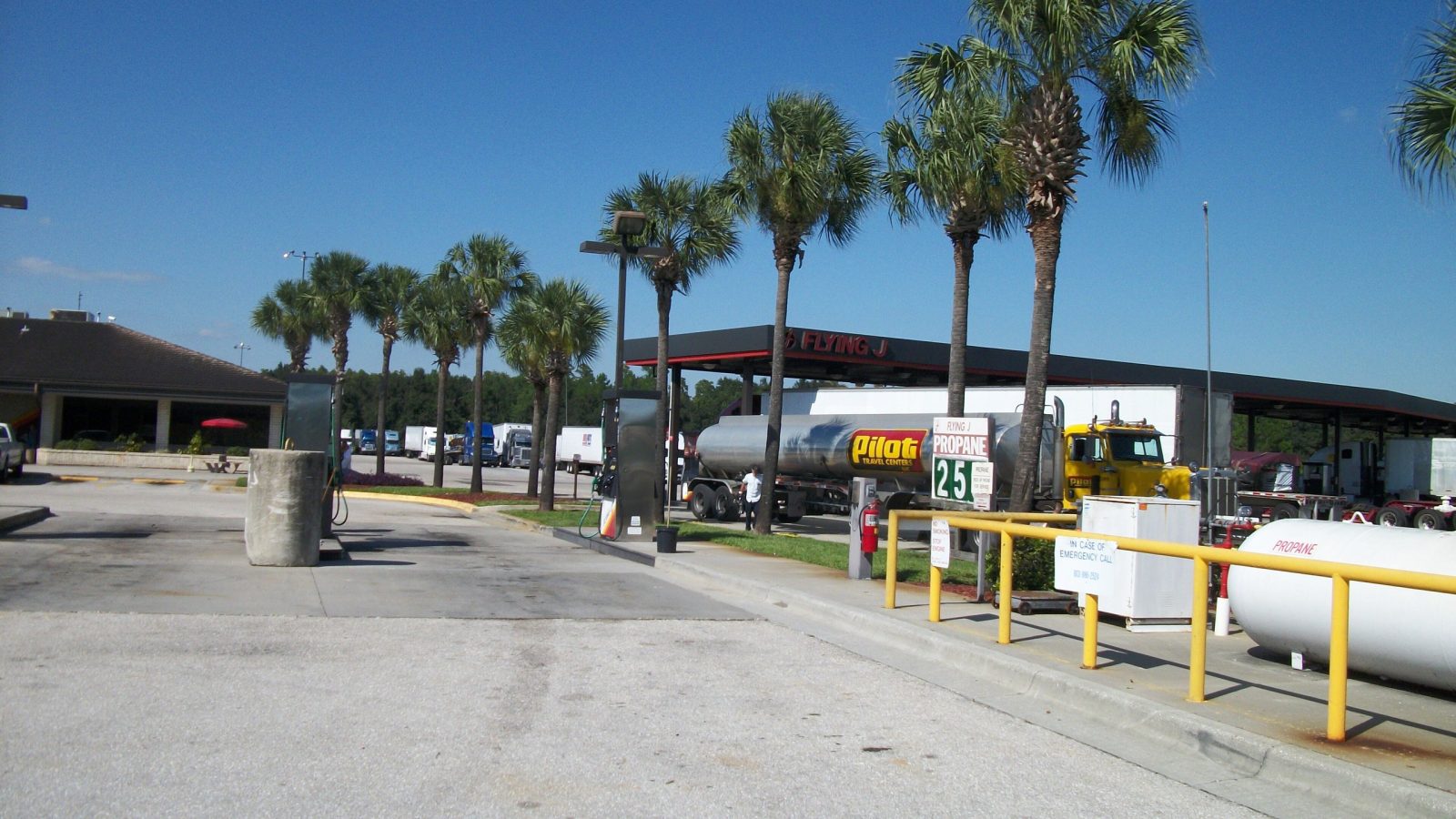
Credit: DanTD / Wikimedia Commons, CC BY-SA 3.0
Details as of Oct. 14, 2026. Prices are the weekly U.S. average for on-highway diesel from the Energy Information Administration (EIA), which posted its latest reading on Wednesday, Oct. 14.
I have heard the blame move from one name to another: Trump, Zelensky, Putin. The question underneath is whether any of those people can set the price of diesel. On Oct. 9 President Trump said Russia would ship diesel to the United States, and on Oct. 11 he announced an “energy ceasefire,” a pause in Russian and Ukrainian strikes on each other’s energy sites that Moscow had not confirmed as of Oct. 12. The first EIA reading since then, for the week of Oct. 12, is $6.179 a gallon. That is two cents below the week before.
Most of the decline came earlier. Diesel peaked at $6.529 in the Sept. 21 reading, then fell 14.7 cents and 18.3 cents in the next two weekly readings. That is 33 cents, about 94 percent of the 35 cents it has fallen since the record, and it happened before the Oct. 9 and Oct. 11 announcements.
Six weeks of EIA readings
| Week of | $/gal | Change | What was happening |
|---|---|---|---|
| Sept. 7 | 5.967 | +0.368 | Tops the June 2022 weekly high of about $5.81 |
| Sept. 14 | 6.285 | +0.318 | |
| Sept. 21 | 6.529 | +0.244 | Record |
| Sept. 28 | 6.382 | -0.147 | |
| Oct. 5 | 6.199 | -0.183 | |
| Oct. 12 | 6.179 | -0.020 | First reading after the Oct. 9 shipment announcement and the Oct. 11 ceasefire announcement |
The weekly figure comes from a Monday price survey, taken three days after the Friday announcement. FreightWaves reported that wholesale diesel futures, the contract price for diesel bought for delivery later, closed at $4.5694 a gallon on Oct. 6 and $4.7232 on Oct. 12, up about 15 cents, and that it was unclear whether the Russian shipment deal had any effect. Futures are a wholesale price, and the EIA figure is what stations charge. FreightWaves added on Oct. 13 that the daily national average from AAA, the motorists’ association, fell 17 days in a row from $6.5276 on Sept. 22, then moved only slightly over the next four days.
The American Action Forum (the Forum) estimated that each $1.00 a gallon adds about $120 million a day to the nation’s diesel bill. By that estimate, a 35-cent drop is roughly $42 million a day in lower diesel costs.
Little relief expected before Election Day
Several experts told Newsweek on Oct. 12 that the Russian deal is unlikely to lower pump prices before the Nov. 3 midterms. Ed Hirs of the University of Houston said the fuel consumed in the next three weeks is already in the supply pipeline. Bob McNally of Rapidan Energy said Russia’s added exports of about 0.1 to 0.2 million barrels a day fall well short of the roughly 1 million a day of global diesel supply lost to the Iran and Russia-Ukraine conflicts. Patrick De Haan of GasBuddy said slight decreases are possible, and only if the deal actually happens, and that he does not expect it to meaningfully affect U.S. diesel prices.
Ariel Cohen, writing in Forbes, converted the first Russian shipment, more than 300,000 metric tons, to about 2.25 million barrels, roughly 0.6 days of U.S. distillate use (diesel and home heating oil). De Haan put the same shipment at about 1.5 days of typical U.S. supply, and the reporting does not say why the two estimates differ. Cohen wrote that it is unclear how much of the diesel will reach American buyers directly. He also cited an International Energy Agency (IEA) finding that Russian and Gulf diesel exports together were 1.6 million barrels daily lower in August than in February, a different measure from McNally’s 1 million. The estimates cover different periods and different exports, so they do not add up to one number.
In 2022 the United States put 180 million barrels from the Strategic Petroleum Reserve, the government’s emergency oil stockpile, into the market over six months, and partner countries in the IEA added 60 million more. The Treasury Department estimated that the combined release lowered gasoline prices by 17 to 42 cents a gallon. Treasury said its analysis is more reliable for the near term than over longer periods, and it did not estimate an effect on diesel. Cohen’s 2.25 million barrels is under 1 percent of the 240 million barrels released in 2022.
Lost supply and strained U.S. refineries
Two supply losses overlap: the Iran war, which began when the United States and Israel attacked Iran on Feb. 28, and Ukraine’s drone strikes on Russian refineries. Forbes contributor Ken Silverstein wrote that the war disrupted the Strait of Hormuz, which normally carries about a fifth of the world’s oil, and that Gulf crude oil has partly found other routes but refined fuel such as diesel has not. Cohen cited an IEA estimate that Gulf refined-product exports are down nearly 60 percent. On the Russian side, FreightWaves reported in July that Kpler, a market-data firm, put Russian refinery output at about 3.8 million barrels daily, a 21-year low. Russia banned diesel exports on July 8, Cohen wrote. The Forum said Russia accounted for about 10 percent of global seaborne diesel trade.
Cohen estimated that roughly two-thirds of the combined shortfall comes from the Gulf and one-third from Ukrainian strikes. Fortune links the global squeeze largely to the strikes, citing Gregory Brew of Eurasia Group on weakened Russian air defenses. Arne Lohmann Rasmussen of Global Risk Management said, as Silverstein quoted him, that a halt to the refinery attacks would help but that the shortage of Middle East refined products matters far more. Rachel Ziemba of the Center for a New American Security, quoted by Silverstein, said that the Iran and Ukraine wars are reinforcing each other in fuel markets and that Middle East flows remain far from normal.
The Forum reported that on the U.S. Gulf Coast the gap between a barrel of crude and the diesel made from it topped $100 a barrel on Sept. 1, up from about $20 before the conflict. Forbes contributor Robert Rapier cited Reuters for U.S. refineries running at 98 percent of capacity in late August, the highest since 2018. Diesel demand barely responds to price in the short run, the Forum added, because few substitutes exist for farming and freight. On-highway use makes up about 75 percent of U.S. distillate consumption. Hydrocarbon Engineering reported that U.S. refinery capacity reached a record of nearly 19 million barrels daily in 2020. Closures and conversions to renewable diesel cut it afterward, and the EIA put it at 18.2 million on Jan. 1, 2026, down more than 250,000 from a year earlier.
Diesel prices since 2016
Selected years, annual averages of the EIA weekly series, rounded, as compiled by the site Weekly Diesel from EIA data:
| Year | Average $/gal | What was happening |
|---|---|---|
| 2016 | 2.30 | Shale glut |
| 2020 | 2.55 | Demand collapse |
| 2021 | 3.29 | Recovery |
| 2022 | 4.99 | Russia’s invasion of Ukraine |
| 2024 | 3.76 | Partial easing |
| 2025 | 3.66 | Little changed |
| 2026 so far | 5.04 | Iran war, Russian export ban |
The 2026 figure averages the 40 weekly readings through Oct. 5. The EIA series shows $3.897 a gallon on March 2, two days after the Feb. 28 attack, and $4.859 a week later, up 96 cents. After the 2022 invasion, fuel costs jumped worldwide and settled within a few months, Fortune noted.
The Russian shipment deal and the reaction
On Oct. 9, after a call with Russian President Vladimir Putin, Trump announced that Russian diesel shipments would begin, with more to follow in November, Silverstein reported. The Associated Press reported that Trump called lower fuel costs for farmers, ranchers and truckers his top priority and said Russia would immediately supply more than 300,000 tons, with 500,000 tons in November. The Treasury Department issued a temporary license that holds off U.S. sanctions until April 2027 on Russian diesel already loaded on tankers as of that Friday. A statement from Putin said Russia is ready to supply oil and oil products, and Russian Deputy Prime Minister Alexander Novak said Russia was lifting restrictions on diesel exports ahead of schedule and could begin supplying the United States this month, the AP reported.
Zelensky wrote of the deal, “Gifts to Putin will not bring peace.” The AP reported that Senate Democrats including Chuck Schumer and Elizabeth Warren called the announcement a betrayal of Ukraine, European allies and U.S. national security, and that Zelensky said the deal prolongs the war. On Oct. 10, Trump blamed Ukrainian President Volodymyr Zelensky’s drone attacks on the refineries for record U.S. diesel prices, Silverstein reported. On the ceasefire, Zelensky said Ukraine would stop attacking Russian refineries if Russia stopped striking Ukraine’s energy sites. Cohen recommended that any payments to Russia for the shipments go into an escrow account, a fund held until conditions are met, limited to verified humanitarian purposes.
Republicans did not all line up behind the deal. Senators Lisa Murkowski, Susan Collins, Thom Tillis and John Curtis joined Democrats Jeanne Shaheen, Ron Wyden and Richard Blumenthal in an Oct. 11 statement saying the deal runs directly counter to a 2022 law and urging the administration to reverse course, Time reported. Newsweek reported that House Majority Whip Tom Emmer said Trump is trying to lower fuel costs while seeking an end to the war, and that Senator John Barrasso called the diesel arrangement potential leverage against Putin. On Oct. 12 Trump said, “I made the right choice for the American People,” Time reported.
The legal question
The law is the Ending Importation of Russian Oil Act, passed in 2022, which bans U.S. imports of Russian energy products including diesel, Time reported. Representative Lloyd Doggett, its chief sponsor, said Trump is violating it, and Tillis said on NBC that there is a legitimate case the president is not following the law. Kristen Eichensehr of Harvard Law School told Time the law limits waivers unusually tightly and requires certifications to Congress that she said cannot be met now. Edward Swaine of George Washington University Law School said the administration could argue the Treasury license is only a temporary suspension of the ban. Treasury Secretary Scott Bessent said on Fox that the administration is acting under “all the legal authorities we have,” and Treasury said the license complies with all applicable laws. Representatives Brian Fitzpatrick and Don Bacon plan to introduce a bipartisan bill to block purchases of Russian oil, Newsweek reported.
A possible diesel export ban
President Trump floated a U.S. diesel export ban on Sept. 22, saying “let’s not send out the diesel,” Yahoo Finance reported. De Haan wrote on X that the move would backfire, because U.S. diesel prices are set by a global supply and demand balance, not a U.S. one. Newsweek reported on Sept. 23 that Energy Secretary Chris Wright called a ban a blunt tool that does not work and that Interior Secretary Doug Burgum was not at all confident it would lower the price. Bessent said the administration was examining whether a full or partial ban was feasible. S&P Global has warned that a ban would cut refinery output and raise gasoline prices.
- Time, Oct. 13, 2026, “Lawmakers Argue Trump’s Russia Diesel Deal ‘Violates’ the Law.”
- Time, Oct. 12, 2026, “Republicans Denounce Trump’s Diesel Deal With Russia’s Putin Amid Mounting Backlash”
- Newsweek, Oct. 2026, “Republicans Move to Block Trump’s Putin Diesel Deal Amid Legality Questions”
- Yahoo Finance, Sept. 2026, “’Let’s not send out the diesel’: Trump floats ban on US diesel exports”
- Yahoo Finance (FreightWaves), Oct. 13, 2026, “Russian diesel deal having limited impact, if any, on prices”
- Newsweek, Oct. 12-13, 2026, “Trump’s Russia Diesel Deal: Experts Weigh in on Price Impacts at the Pump”
- Newsweek, Sept. 23, 2026, “Trump’s diesel export plan dismissed by his own officials”
- Associated Press, Oct. 9, 2026 (WBTV), “Trump says US to get diesel from Russia, relaxing pressure on Moscow to ease prices before midterms”
- U.S. Energy Information Administration, “Gasoline and Diesel Fuel Update (weekly on-highway diesel)”
- Weekly Diesel, “Average Diesel Price by Year, 1994-2026 and Diesel Prices in 2026 (EIA weekly series)”
- U.S. Department of the Treasury, July 2022, “The Price Impact of the Strategic Petroleum Reserve Release”
- U.S. Energy Information Administration, “U.S. refining capacity decreased during 2025”
- Hydrocarbon Engineering, “US refining capacity falls”
- Forbes, Ken Silverstein, Oct. 11, 2026, “Trump Blames Kyiv For Diesel, But The Barrels Went Missing In Hormuz”
- Forbes, Ariel Cohen, Oct. 12, 2026, “Trump-Putin Diesel Deal Unlikely To Reduce Prices”
- Forbes, Robert Rapier, Sept. 9, 2026, “Why Diesel Is On Track To Set A 2026 Price Record”
- American Action Forum, “U.S. Diesel Prices Hit Record High: Factors and Implications”
- FreightWaves, July 14, 2026, “Russia, Strait of Hormuz combining to drive diesel higher after declines”
- Fortune, Sept. 5, 2026, “The overlooked Russia-Ukraine war grows its outsized impact on energy as U.S. diesel prices hit all-time high”
Editor written. AI used for spelling and grammar only.