Eliquis Lists at $346 a Month and Medicare’s Price Is $231. How Drug Prices Reach Your Pharmacy Counter
Eliquis has several true prices. Here is who sets each one and what a Medicare drug plan member pays in 2026 and 2027.

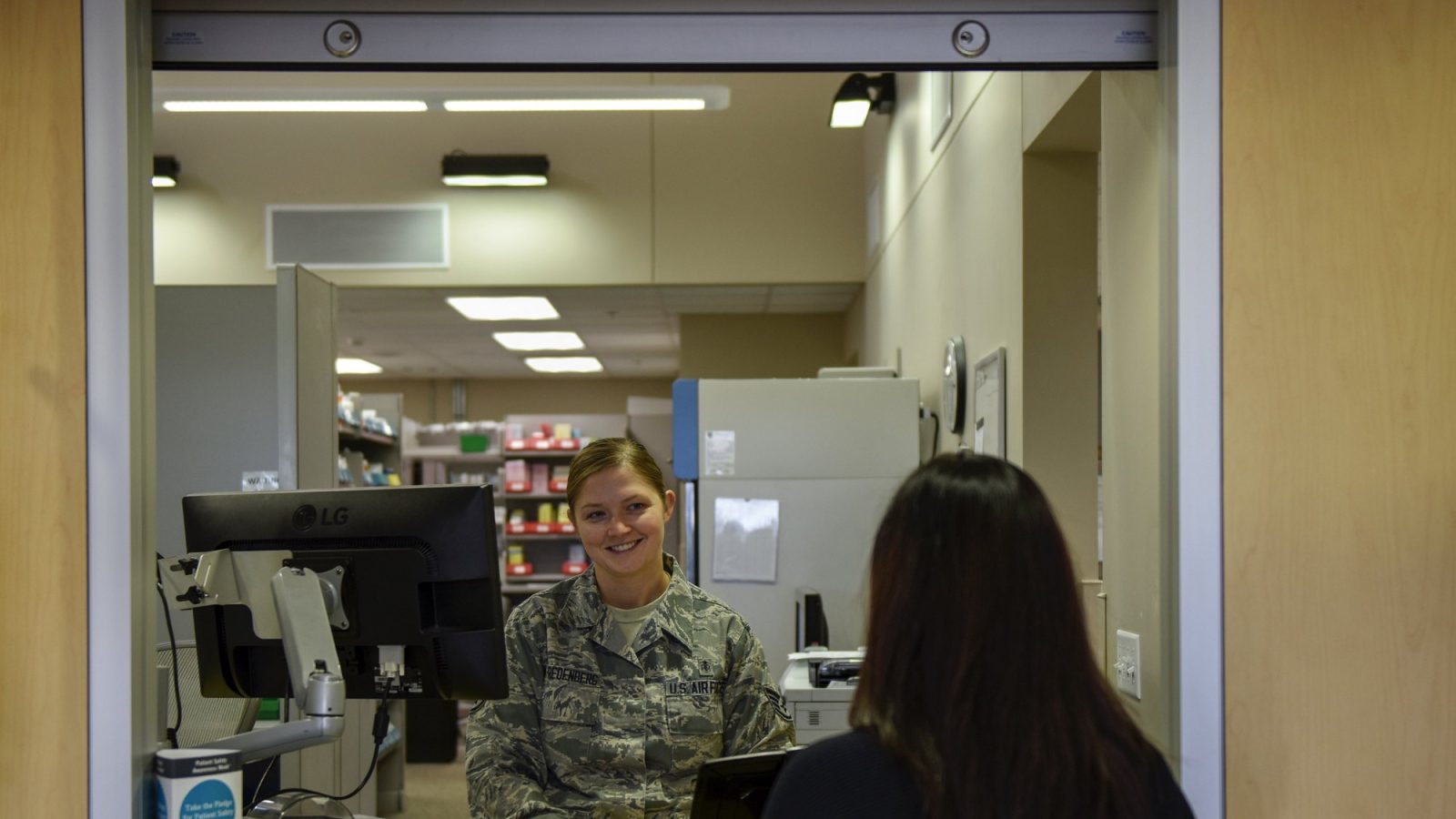
Credit: U.S. Air Force photo by Airman 1st Class Holden Faul
When someone tells you what a drug costs, the first thing to ask is which price they mean. A month of the blood thinner Eliquis, 60 tablets at two a day, has five different prices in 2026, and four of them are public. Its makers list it at $346, and pharmacies pay about $331 to stock it. Medicare’s negotiated price, in effect since January 1, 2026, is $231 by the 30-day measure of the Centers for Medicare & Medicaid Services (CMS), the federal agency that runs Medicare, or $248.70 for the 60 tablets. The price after manufacturer rebates is never published. And someone in a Medicare drug plan (Part D) with the standard benefit pays about $62 for those 60 tablets once the deductible is met. A common generic, 30 tablets of the cholesterol drug atorvastatin 20 mg, costs a pharmacy about 86 cents.
Each of those numbers is accurate, and each one tells you something different about who set it and whether you can change it at the counter. A 2022 law, the Inflation Reduction Act, lets Medicare negotiate prices for a few high-cost drugs, and the first ten negotiated prices, Eliquis among them, took effect on January 1, 2026. This part of Healthcare Costs, Decoded follows Eliquis and the generic atorvastatin to the pharmacy counter. The part before it covered 2027 Marketplace premium tax credits.
How research costs figure into a drug’s price
I once worked at a biotechnology company in San Carlos, California, and that work left me with a question that never went away: how does a dose that may cost very little to manufacture become a product sold for hundreds of times that amount? My memory is of roughly 25 cents in direct manufacturing cost for a dose that sold for $150 or more. That is my recollection from one company, and it is not a verified ratio for the drug industry.
A drug that succeeds has to pay for years of research, including the projects that failed. The Congressional Budget Office (CBO) reported in April 2021, in Research and Development in the Pharmaceutical Industry, that only about 12 percent of drugs entering clinical trials are ultimately approved by the Food and Drug Administration. Published estimates of the average cost of one new drug, counting failures and the cost of money tied up for years, run from less than $1 billion to more than $2 billion, CBO found.
The same report explains why that history does not work as a price formula. Once a drug is on the market, CBO wrote, “the price is set to maximize the net revenues from the drug without regard to how much it cost to develop.” What a company expects to earn decides how much it spends on research before approval.
Four kinds of cost behind one price
That gap breaks into four parts, and each is reported in a different place.
| Cost | What it covers | Where the public can see it |
|---|---|---|
| Making one more dose | Ingredients, filling and finishing, and other direct costs of one more unit | Almost never for one drug. CMS says companies reported unit costs of production during Medicare negotiation; its price files do not show them. |
| Fully loaded manufacturing | Quality testing, validation, failed batches, packaging, cold storage, plants and overhead | Cost of goods in a company’s annual report to the Securities and Exchange Commission, usually all products combined |
| Development and risk | Discovery, lab and animal studies, clinical trials, regulatory work, financing and projects that never reached market | Research spending in SEC filings, company-wide; CBO’s range of under $1 billion to over $2 billion per approved drug |
| Selling and financial | Distribution, rebates, marketing, royalties, acquisitions, taxes, profit and returns to investors | Selling and administrative expense and operating income in SEC filings, for the whole company |
The 25 cents I remember belongs in the first row. A company’s yearly research total belongs in the third, and it covers every project paid for that year, including drugs that will not reach patients for a decade. Dividing that total among one drug’s doses mixes in other drugs and needs a guess at future sales. Calling the other $149.75 pure profit leaves out the other three rows.
The Eliquis prices, from list to the counter
Eliquis, made by Bristol Myers Squibb and sold with Pfizer, cost Part D, Medicare’s prescription drug coverage, more than any other drug on the first negotiation list: $18.3 billion in total drug costs before rebates in 2023, for about 3.9 million enrollees, the CMS fact sheet on the first round shows.
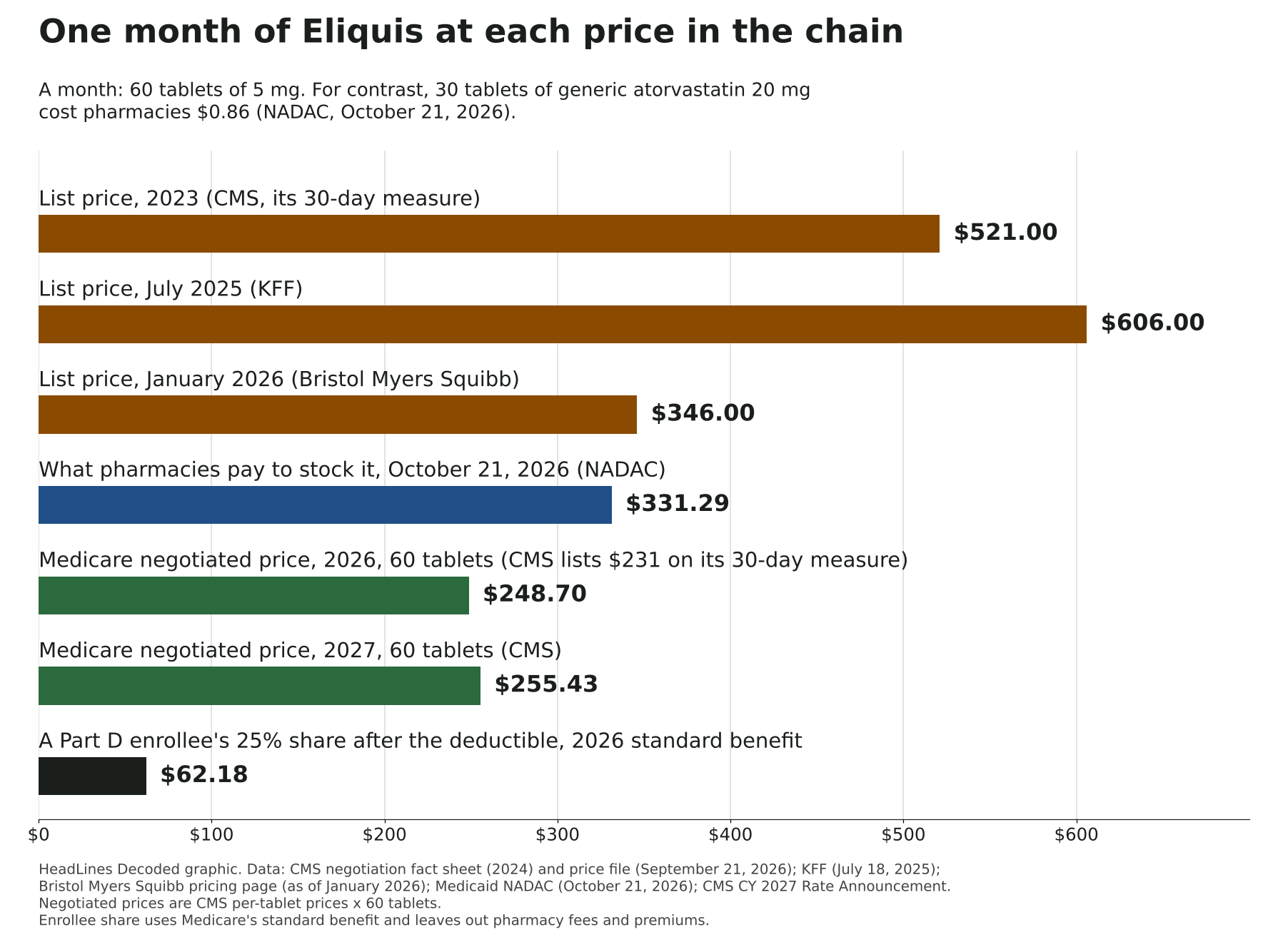
The list price is the wholesale acquisition cost, which Bristol Myers Squibb’s pricing page defines as “the price at which pharmaceutical manufacturers sell their products to wholesalers.” KFF, a health policy research group, reported in July 2025 that the makers were selling Eliquis directly to cash-paying patients at $346, which KFF’s Juliette Cubanski described as 43 percent off a $606 list price. By January 2026 the company’s page listed $346 as its list price. The page does not say why. Pharmacy costs fell with it. Medicaid’s National Average Drug Acquisition Cost file, called NADAC, is built by “averaging survey invoice prices from retail community pharmacies.” It priced a 5 mg Eliquis tablet at $9.69551 as of December 17, 2025, and $5.52654 from January 1, 2026, so the cost of 60 tablets fell from $581.73 to $331.59. By October 21 the tablet price was $5.52144, or $331.29 for 60.
CMS sets Medicare’s 2027 price at $4.257193 a tablet, which is $255.43 for 60 tablets or $237.25 on its 30-day measure. The Medicare price sits below what pharmacies pay, and the law covers that gap. A plan’s payment for a negotiated drug cannot exceed the negotiated price plus a dispensing fee, and when a pharmacy’s cost to buy the drug exceeds that price, the manufacturer owes the pharmacy a refund, the Congressional Research Service (CRS) explained in Negotiation Process for Medicare Part D Drugs on December 11, 2025. CMS estimated that the first ten prices, had they applied in 2023, would have cut Medicare’s net spending on those ten drugs by about $6 billion, or 22 percent. That estimate does not tell you what you will save.
What a Part D member pays for Eliquis in 2026 and 2027
Each plan sets its own copays, but CMS publishes a standard benefit every year. Under it, in 2026 a member pays the full price until a $615 deductible is met, then a 25 percent share of the price (called coinsurance), until out-of-pocket spending reaches $2,100. The CMS rate announcement for 2027, issued April 6, 2026, raises those to a $700 deductible and a $2,400 cap, with the 25 percent unchanged. The CRS report adds the piece that matters here: for these drugs, the deductible and coinsurance “must be based on that negotiated payment.”
Suppose Eliquis, 5 mg twice a day, is the only drug you fill all year. CMS’s price file sets $4.145072 a tablet in 2026, so a 60-tablet fill is $248.70. January and February 2026 cost $248.70 each. March costs $150.37, the last $117.59 of the deductible plus 25 percent of the remaining $131.11. April through December cost $62.18 a fill, and the year totals $1,207.36. At the 2027 per-tablet price a fill is $255.43 and the year comes to $1,291.29, because the deductible rises by $85 and the fill price by $6.73. Had the counter price been the $346 list price, 2026 would have cost $1,499.25, or $291.89 more.
The formulas, with prices from the CMS negotiated price file and deductibles from the CMS 2027 rate announcement: $615 + 25% x (12 x $248.70 – $615) = $1,207.36 for 2026, and $700 + 25% x (12 x $255.43 – $700) = $1,291.29 for 2027, with fills carried at the unrounded per-tablet price. At list price, swap in $346. Calculated October 21, 2026, leaving out premiums and pharmacy fees.
Many real plans charge a flat copay instead. The company’s pricing page says patients with Medicare drug coverage pay an average of $51 a month for Eliquis, in its section for patients with atrial fibrillation, but not which months of claims it covers. It is an average across plans, so it does not match the $62 figured above. Your own plan’s figure for next year is in Medicare’s Plan Finder, where you enter your drugs and pharmacy. If your 2026 plan statement prices 60 tablets far above $248.70 plus the pharmacy’s fee, ask your plan why; the law limits its payment to that price plus the fee.
A month of generic atorvastatin costs the pharmacy 86 cents
Generics follow a different path, because several companies make the same molecule and compete on price. In the NADAC file for October 21, 2026, a 20 mg atorvastatin tablet costs pharmacies $0.02858, so 30 tablets come to $0.86. The same file puts a month of Eliquis at $331.29, more than 380 times as much. What you pay at the register can be higher, because your price also covers the pharmacy’s fee for filling the prescription.
Rebates and the confidential net price
Between the list price and the money a drugmaker keeps sits a layer of rebates. In its January 2022 report Prescription Drugs: Spending, Use, and Prices, CBO described how a pharmacy benefit manager, the company that runs a plan’s drug coverage, “bargains with a manufacturer for a larger rebate on a drug in exchange for preferred placement” on the plan’s list of covered drugs. The actual price to the insurer, CBO wrote, “is largely determined by the rebate.”
Rebates mostly show up in premiums. CBO found that cost sharing “is not directly affected” by larger rebates, which “tend to be shared among all enrollees in a given plan through reductions in premiums,” and that average Part D cost sharing “is required to be based on retail prices.” That was written before negotiated prices existed, and for a drug that has one, the basis is now the negotiated payment. For other drugs, a member paying coinsurance on a heavily rebated drug pays a share of the higher number. Where rebate money goes next depends on contracts that are not public. The Federal Trade Commission’s July 2024 interim staff report on pharmacy benefit managers notes that benefit managers “may retain and/or pass through to their health plan clients some or all of the rebates.”
One more price stays out of view. Under the federal 340B Drug Pricing Program, drugmakers that take part in Medicaid sell outpatient drugs at reduced prices to qualifying clinics and hospitals, which the Health Resources and Services Administration says helps them “stretch scarce federal resources.”
Questions to ask at the pharmacy counter
A pharmacist can usually answer these in a minute, and the answers can change from one fill to the next:
- What is my price for this fill through my insurance?
- What is the cash price today, without insurance?
- If I pay cash, will this purchase count toward my deductible or my Medicare Part D out-of-pocket total?
- Is there a lower-cost alternative my prescriber could consider, such as a generic or a drug my plan prefers?
Whether a cash purchase counts toward your yearly total can matter more than the price of one fill. CMS’s Part D manual, in chapter 14, section 50.4.2, says a covered drug bought for cash at a network pharmacy (one your plan has a contract with), for less than the plan’s price and during the deductible phase, counts toward your total “provided the Part D plan finds out about it,” and it leaves sending the paperwork to you. The Commonwealth Fund’s Faith Leonard and Gretchen Jacobson wrote in October 2024 that prescriptions bought through online discount sites outside Part D would not count toward the out-of-pocket limit. Ask your plan which rule covers your purchase before you pay without your insurance card, and keep the receipt. The next part of the series, on November 3, is a guide to auditing a medical bill (Story coming Tue, Nov 3 at 9:00 AM) that shows how to check plan statements line by line.
More negotiated prices start January 1, 2027
Fifteen more drugs get Medicare negotiated prices on January 1, 2027, CMS’s second-round fact sheet says. Ozempic and the two other semaglutide drugs, Wegovy and Rybelsus, which HeadLines Decoded examined in its look at insurers and Ozempic coverage, get $274 a month, compared with a 2024 list price of $959. Trelegy Ellipta, an inhaler for lung disease, gets $175 a month, and Xtandi, a prostate cancer drug, $7,004. The CMS price file updated in September 2026 already lists 15 drugs for 2028, among them Trulicity and Botox, and as of October 21, 2026 their negotiated prices are not posted.
About this information. This article explains how health care costs and coverage rules work. It is general information. Nothing here is medical, insurance, legal, tax or financial advice. We do not recommend any plan or product. Prices and rules change, so check any figure with the source named here, your plan or a licensed professional before you make a decision. No insurer, hospital, drug company or health plan named in this article paid for it or reviewed it before publication.
- Medicare Drug Price Negotiation Program: Negotiated Prices for Initial Price Applicability Year 2026 (fact sheet) · CMS
- Negotiated prices for initial price applicability year 2026, table of list and negotiated prices (PDF) · CMS
- Negotiated Prices for Initial Price Applicability Year 2027 (November 2025) · CMS
- Selected drugs and negotiated prices, with the price file dated September 21, 2026 · CMS
- Announcement of Calendar Year 2027 Medicare Advantage Capitation Rates and Part C and Part D Payment Policies (April 6, 2026) · CMS
- Negotiation Process for Medicare Part D Drugs, IG10090 (December 11, 2025) · Congressional Research Service, via EveryCRSReport
- ELIQUIS pricing information (list price as of January 2026) · Bristol Myers Squibb
- Eliquis’s New Lower Direct-to-Consumer Price is Still Higher Than Medicare’s Negotiated Price (July 18, 2025) · KFF, Juliette Cubanski
- NADAC (National Average Drug Acquisition Cost) 2026, file as of October 21, 2026 · Medicaid.gov
- Survey of Retail Prices · Medicaid.gov
- Research and Development in the Pharmaceutical Industry (April 8, 2021) · Congressional Budget Office
- Prescription Drugs: Spending, Use, and Prices (January 2022) · Congressional Budget Office
- Pharmacy Benefit Managers: The Powerful Middlemen Inflating Drug Costs and Squeezing Main Street Pharmacies, interim staff report (July 2024) · Federal Trade Commission
- 340B Drug Pricing Program · Health Resources and Services Administration
- Medicare Prescription Drug Benefit Manual, Chapter 14: Coordination of Benefits · CMS
- Are Online Discount Websites Helping Medicare Beneficiaries? (October 1, 2024) · The Commonwealth Fund
- Medicare Plan Finder · Medicare.gov
- Further reading from HeadLines Decoded: Insurers Say They ‘Can’t Afford’ Ozempic and Zepbound
E.G. v4.18 · I.R.G. v1.14 · L.R.G. v1.9 · P.L.G. v1.10
Produced under the HeadLines Decoded Editorial, Image & Rights, Legal & Risk, and Production & Layout guidelines at the versions shown.
Editor written. AI used for spelling and grammar only.