How Health Insurance Premiums Are Set for 2027, and Why Your Share Can Jump 24%
Wellpoint Florida's 2027 rate request shows what goes into a premium and what pushed it up. If an employer holds its own contribution flat, a 6 percent premium rise means the worker pays all of it, and the deduction rises 24 percent.

Credit: The Bushranger, CC BY-SA 4.0, via Wikimedia Commons
An insurer builds a health insurance premium from a forecast. Its actuary estimates what next year’s medical and drug claims will cost for the people the company expects to cover. Then the actuary adds operating costs and a profit margin, and adjusts for money the insurer expects to pay or collect under a federal program called risk adjustment, which moves money from insurers with healthier customers to insurers with sicker ones. State and federal regulators check that math. Your payroll deduction is a separate number, and your employer sets it. If the premium rises 6 percent and the employer keeps its own dollar contribution the same, the worker’s share of an average family plan rises about 24 percent.
The pieces are easiest to see in a real filing. Companies selling individual coverage in Florida, the kind people buy for themselves rather than through a job, sent their 2027 rates to the state’s Office of Insurance Regulation this spring and summer. The Centers for Medicare and Medicaid Services (CMS) posts the filings on its rate review site, with a written justification for most of them. The filing from Wellpoint Florida lays out its arithmetic in more detail than most.
Wellpoint Florida asked for 17.3 percent
Simply Healthcare Plans, Inc., which sells individual plans as Wellpoint Florida and is part of Elevance Health, requested an average increase of 17.3 percent in its 2027 rates. Its written justification, dated June 30, 2026, puts the requested increases between 14.4 and 22.4 percent. For a 21-year-old, averaged across its plans, the requested monthly rate would go from $475.22 to $557.60. The company counted 22,534 people enrolled as of March 31, 2026, and its actuarial memo says the company entered Florida’s individual market in 2025 and requested a 29.7 percent change for 2026.
The filing splits the 17.3 percent into five pieces.
| Piece of the increase | What it means in plain words | Change |
|---|---|---|
| Claims experience, trend and pricing model | Its own 2025 claims, blended with a standard pricing model and pushed forward for rising costs | -8.7% |
| Morbidity and mix | How sick the average customer is expected to be | +10.7% |
| Geography | Wellpoint’s costs in Florida compared with its multistate model | +1.2% |
| Risk-adjustment transfer | A larger expected payment into the federal risk-adjustment program than its 2026 filing assumed | +14.7% |
| Retention | Its allowance for running the company and for margin | 0.0% |
| Overall | The requested average | +17.3% |
Actuaries combine these pieces by multiplying them. An 8.7 percent drop is written 0.913 and a 10.7 percent rise 1.107, so 0.913 times 1.107 times 1.012 times 1.147 comes to 1.173, which is the 17.3 percent the company requested. That same arithmetic shows where the increase comes from. Take out the risk-adjustment line and the other four multiply to about 2.3 percent, roughly $11 a month on the 21-year-old average rate, against the $82.38 the full request would add.
The 8.7 percent drop still includes rising prices for care. Medical trend is the yearly rise in claims cost from higher prices and heavier use of care, and Wellpoint’s parent company uses a combined medical and drug trend of 7.8 percent for this filing. The filing puts trend, updated 2025 claims and pricing-model updates in one line and does not say how much each contributed. So the newer claims or the pricing model must have pulled the line down by more than rising prices pushed it up, and it does not say which.
Morbidity is the actuary’s word for how sick a group of people is. Wellpoint says it raised that factor mainly because it expects the market’s customers to be sicker, “coinciding with the expiration of enhanced premium tax credits,” the larger federal subsidies that its memo says ended starting in 2026. Blue Cross and Blue Shield of Florida, Inc., known as Florida Blue, makes a similar forecast in its own filing, describing “an anticipated worsening of claims experience in 2027 from 2025.” What those credits look like for 2027 is the subject of the next part of this series (Story coming Fri, Oct 30 at 9:00 AM).
The state answered in October. The Florida Office of Insurance Regulation’s table of 2027 individual rates, dated October 16, 2026, lists approved changes of 17.4 percent for Wellpoint Florida and 18.8 percent for Florida Blue, taking Florida Blue’s average monthly premium per person from $1,099 to $1,306 before any tax credit. Wellpoint’s 17.4 percent is essentially its 17.3 percent request, averaged over the people actually enrolled in 2026. Florida Blue’s federal submission requested an average of about 26 percent, as the rate review site showed on October 21, 2026, and its public justification lists a smaller expected 2027 individual market among the reasons. The two Florida Blue figures are measured differently, the company’s on its own projection and the state’s on actual 2026 enrollment, so the gap between them is not an exact measure of what the state changed. The table gives a weighted average approved change of 10.4 percent for the companies it lists. It warns that it has not been reviewed or finalized by the U.S. Department of Health and Human Services, and on October 21 the federal site still showed both filings as pending review.
Some of the detail behind these numbers is not public. Florida Blue’s actuarial memorandum is marked as a confidential trade secret under section 624.4213 of the Florida Statutes, which covers trade secrets in insurance filings, and every exhibit is left out of the public copy. Wellpoint’s memo redacts its trend and risk-adjustment tables.
The premium dollar, split by the filing
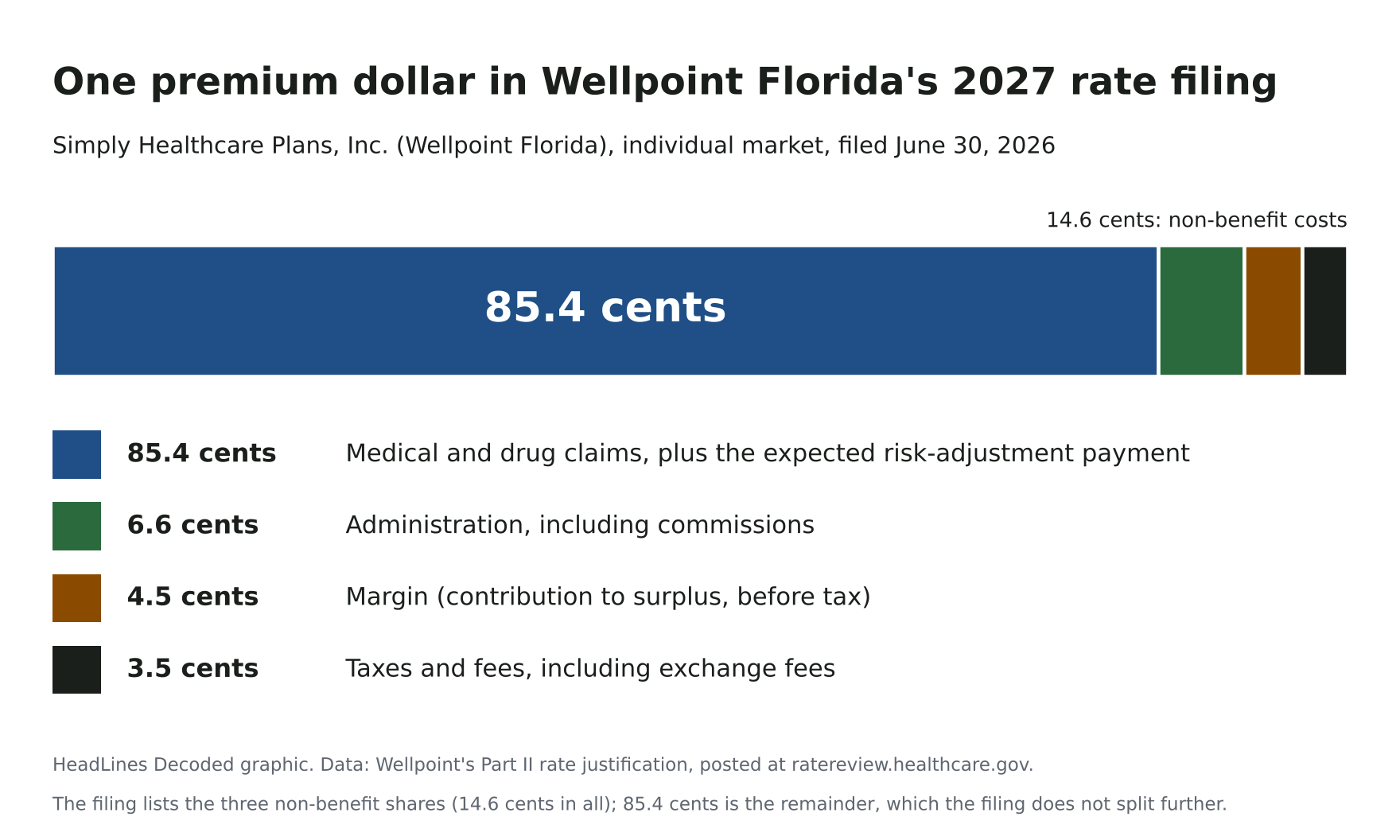
Under the filing, 14.6 cents of the premium goes to costs other than claims, and the margin is stated before income tax. The filing does not separate claims from the risk-adjustment payment, which the next section covers.
Risk adjustment moves money between insurers
Risk adjustment moved Wellpoint’s rate more than anything else, and it is easy to misread as a fee or a bonus. CMS runs it, and in the agency’s own description it covers individual and small-business plans that follow Affordable Care Act rules, on the marketplace or off it. It is budget-neutral, so whatever one insurer pays in, others receive, and each company’s transfer is figured against the average for the state.
Wellpoint’s filing says it now expects to pay a larger share of its premium into the program than it did in its 2026 filing. Capital Health Plan, Inc., another company on the state’s list, put the same idea in plainer terms in its filing: its members are projected to be less risky than the state average, so after expecting to receive money for 2026 it expects to owe a transfer in 2027, an adjustment its filing puts at $40.17 a month per member in allowed claims cost.
The 80 percent rule and its limits
Federal law sets a floor on how much premium has to go to care. Under 42 U.S.C. 300gg-18, insurers selling individual and small-group coverage must spend at least 80 percent of premium on medical care and quality improvement, and large-group insurers 85 percent. An insurer that falls short owes its customers a rebate, which CMS tracks each year. Florida Blue writes that its new rates are “expected to support a Medical Loss Ratio (MLR) that meets or exceeds the 80% requirement.”
The rule limits the share kept for overhead and profit. It does not limit the price a hospital or doctor negotiates with the insurer, and a higher negotiated price means bigger claims, which still count toward the 80 percent. The previous part of Healthcare Costs, Decoded, on hospital cash prices and insurance prices, shows how far those negotiated prices can spread for one MRI.
Two-thirds of workers with job coverage have self-funded plans
Most workers with coverage from a job are not in a plan like the ones Florida just approved, according to KFF’s 2025 Employer Health Benefits Survey, published October 22, 2025: 67 percent of covered workers are in self-funded plans, 80 percent at firms with 200 or more workers and 27 percent among those with 10 to 199. In a self-funded plan the employer takes direct financial responsibility for claims, and the insurance company whose name is on your card is often hired only to run the network and process claims. Wellpoint’s plans are fully insured: the insurer carries that risk in exchange for the premium.
Self-funding also changes who regulates the price. KFF notes that ERISA, the federal law covering job-based benefits, exempts self-funded plans run by private employers from most state insurance laws. So a large private Florida employer that pays its own claims files no rates with the state insurance office.
Many of those employers buy stop-loss insurance against very large claims, and KFF describes two kinds. Specific stop-loss pays what the plan owes above a set amount for any one person. Aggregate stop-loss caps what the plan pays for everyone over a year. At those 200-plus firms, three in four workers in self-funded plans are covered by it.
Group size changes how much one claim matters. A single $1 million claim comes to $5,000 a worker in a 200-worker plan, a bit more than half of KFF’s $9,325 average single-coverage premium, and about $44 a person across Wellpoint Florida’s 22,534 individual enrollees.
Why your payroll deduction can climb 24 percent
The premium is the full cost of the plan. KFF’s 2025 survey puts the average family premium at $26,993 a year, with workers paying $6,850 and employers paying the other $20,143, and family premiums rose 6 percent on average that year. Suppose the average plan goes up 6 percent again next year. The table shows two ways an employer could handle it.
| Family coverage, per year | This year | Next year, employer holds its dollars flat | Next year, employer keeps the same split |
|---|---|---|---|
| Total premium | $26,993 | $28,612.58 | $28,612.58 |
| Employer pays | $20,143 | $20,143 | $21,351.58 |
| Worker pays | $6,850 | $8,469.58 | $7,261.00 |
| Change in what the worker pays | None | Up 23.6% | Up 6.0% |
| Per paycheck, 26 a year | $263.46 | $325.75 | $279.27 |
When the employer’s dollars stay fixed, every new dollar of premium lands on the worker, and $1,619.58 a year on top of $6,850 is a 23.6 percent jump, about $62 more per paycheck. Single coverage climbs faster because the worker’s share starts small. Average single premiums rose 5 percent in 2025, and another 5 percent on the $9,325 average, with the employer holding at $7,885, would take the worker’s $1,440 to $1,906.25, up 32.4 percent. These are the averages from KFF’s 2025 survey. KFF scheduled its 2026 survey for release on October 22, 2026.
Five things to ask for at renewal
Your human resources office or plan administrator can supply each one.
- The Summary of Benefits and Coverage. HealthCare.gov says you get this standard, easy-to-compare summary at renewal or on request.
- The rate sheet. No federal form exists for this, so ask for the total monthly premium at each coverage level and the amount the employer pays at each. With last year’s sheet beside it, you can run the table above on your own plan.
- The Summary Plan Description. The Labor Department says the plan administrator must give it to you free of charge.
- The link to the plan’s machine-readable files. Under federal price transparency rules, plans post the prices they negotiated with in-network doctors and hospitals, along with past out-of-network allowed amounts.
- Whether the plan is fully insured or self-funded. For a private employer’s plan run or backed by an insurance company, a Labor Department rule, 29 CFR 2520.102-3, requires the plan description to say whether and to what extent benefits are guaranteed under an insurance policy. If they are not, the plan itself is paying the claims.
Florida’s 2027 filings, including Wellpoint’s and Florida Blue’s, can be searched by state and company on the CMS rate review site, and most of the written justifications run one to three pages.
About this information. This article explains how health care costs and coverage rules work. It is general information. Nothing here is medical, insurance, legal, tax or financial advice. We do not recommend any plan or product. Prices and rules change, so check any figure with the source named here, your plan or a licensed professional before you make a decision. No insurer, hospital, drug company or health plan named in this article paid for it or reviewed it before publication.
- Wellpoint Florida, Part II: Written Description Justifying the Rate Increase, 2027 Florida individual (June 30, 2026) · Wellpoint Florida, via ratereview.healthcare.gov
- Wellpoint Florida, Part III Actuarial Memorandum, redacted (June 30, 2026) · Wellpoint Florida, via ratereview.healthcare.gov
- Justification for Rate Increase, 2027 individual under 65 (June 2026) · Blue Cross and Blue Shield of Florida, Inc., via ratereview.healthcare.gov
- Actuarial Memorandum, redacted (June 10, 2026) · Blue Cross and Blue Shield of Florida, Inc., via ratereview.healthcare.gov
- Part II Rate Filing Justification, 2027 individual (July 14, 2026) · Capital Health Plan, Inc., via ratereview.healthcare.gov
- Unified Rate Review, Florida 2027 individual submissions (read October 21, 2026) · Centers for Medicare and Medicaid Services
- Individual PPACA Market Monthly Premiums for Plan Year 2027 (October 16, 2026) · Florida Office of Insurance Regulation
- Risk Adjustment Overview (May 7, 2012) · Center for Consumer Information and Insurance Oversight, CMS
- Medical Loss Ratio (modified March 13, 2026) · Centers for Medicare and Medicaid Services
- 42 U.S.C. 300gg-18, Bringing down the cost of health care coverage · Legal Information Institute, Cornell Law School
- 2025 Employer Health Benefits Survey (October 22, 2025) · KFF
- Summary of Benefits and Coverage (glossary) · HealthCare.gov
- Plan Information · U.S. Department of Labor
- 29 CFR 2520.102-3, Contents of summary plan description · Legal Information Institute, Cornell Law School
- Transparency in Coverage · Employee Benefits Security Administration, U.S. Department of Labor
- Further reading from HeadLines Decoded: Insurers Say They ‘Can’t Afford’ Ozempic and Zepbound. What the Data on Healthier Patients and Cost Savings Actually Shows.
E.G. v4.18 · I.R.G. v1.14 · L.R.G. v1.9 · P.L.G. v1.10
Produced under the HeadLines Decoded Editorial, Image & Rights, Legal & Risk, and Production & Layout guidelines at the versions shown.
Editor written. AI used for spelling and grammar only.