Hospital Cash Price vs Insurance Price: One Tampa MRI Runs From $249 to $4,349
We set Tampa General Hospital's posted cash prices beside the insurer rates its file names for three common services.


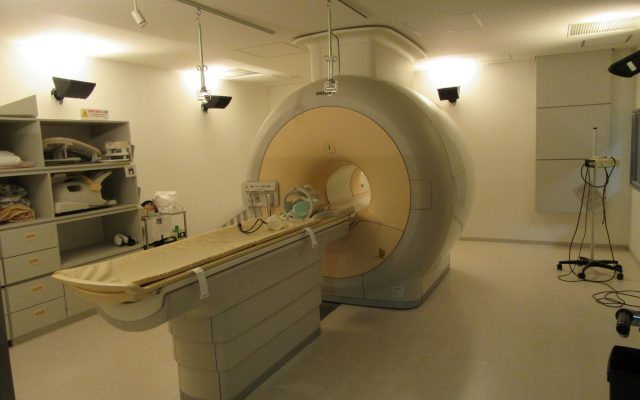
Credit: DanTD, CC BY-SA 4.0, via Wikimedia Commons (cropped by HeadLines Decoded)
Tampa General Hospital’s own price file lists a brain MRI without contrast, billing code 70551, at a cash price of $1,522.15. Every insurer rate the file lists as a flat dollar amount for that scan is lower, from $249.17 to $498.33. Thirteen more contracts, written as formulas instead of dollar amounts, list MRI figures from $1,201 to $3,886. For a diagnostic colonoscopy, code 45378, the order reverses: the $1,143.10 cash price is below 15 of the 27 flat dollar rates posted for insurers. Whether cash beats insurance at a hospital depends on the service and on your plan.
Those figures come from the standard-charges file Tampa General posted under federal rules, dated April 1, 2026, which HeadLines Decoded downloaded on October 21, 2026. We did not call the hospital. Every number below is as posted in that file on that date, and none of them promises what a particular patient will pay.
The previous part of this series sorted out the different prices that can attach to one service. The table sets three of them side by side for outpatient care at the hospital, counting only insurer rates the file states in dollars. Gross charge is the hospital’s list price before any discount, and cash price is what the file says applies when you pay without insurance.
| Service (code) | Gross charge | Cash price | Lowest insurer dollar rate | Highest insurer dollar rate | Cash price against the highest rate |
|---|---|---|---|---|---|
| Brain MRI, no contrast (70551) | $4,349 | $1,522.15 | $249.17, Capital Health Plan Tallahassee, Medicare Advantage | $498.33, Oscar, Marketplace plan | About 3.1 times as much |
| Diagnostic colonoscopy (45378) | $3,266 | $1,143.10 | $971.14, the same Capital Health plan | $2,923, UnitedHealthcare HMO/POS | About 61 percent less |
| Metabolic blood panel (80053) | $685 | $239.75 | $10.56, Oscar again | $21.12, also Oscar | About 11 times as much |
Tampa General’s posted price file
Federal rules at 45 CFR Part 180 require each hospital to post its standard charges in one large file a computer can read, free and without an account, and to update it at least once a year. The rules also require a small text file at the root of the hospital’s website that points to the price file. For Tampa General, that text file sits at tgh.org/cms-hpt.txt, and it led us to a 94-megabyte spreadsheet holding 358,312 rows of prices.
The Centers for Medicare & Medicaid Services, the federal agency that enforces the rules, began enforcing updated requirements for these files on April 1, 2026, according to its hospital price transparency page. The rules define five kinds of standard charge, and each has its own column in the file:
- Gross charge: the price on the hospital’s master price list, called the chargemaster, before any discount.
- Discounted cash price: the amount that applies to someone who pays cash for the service.
- Payer-specific negotiated charge: the rate the hospital agreed to with one insurer, or payer, for one of its plans.
- De-identified minimum negotiated charge: the lowest rate negotiated with any insurer, with the insurer’s name left off.
- De-identified maximum negotiated charge: the highest negotiated rate, also without a name.
Starting in 2026, when a rate is figured by formula or as a share of charges, the file must also carry figures drawn from claims the hospital was actually paid, including the median and the 10th and 90th percentile allowed amounts. An allowed amount is the total an insurer accepts for a service, counting both its own payment and the patient’s share.
What 19 insurer rates show for one MRI
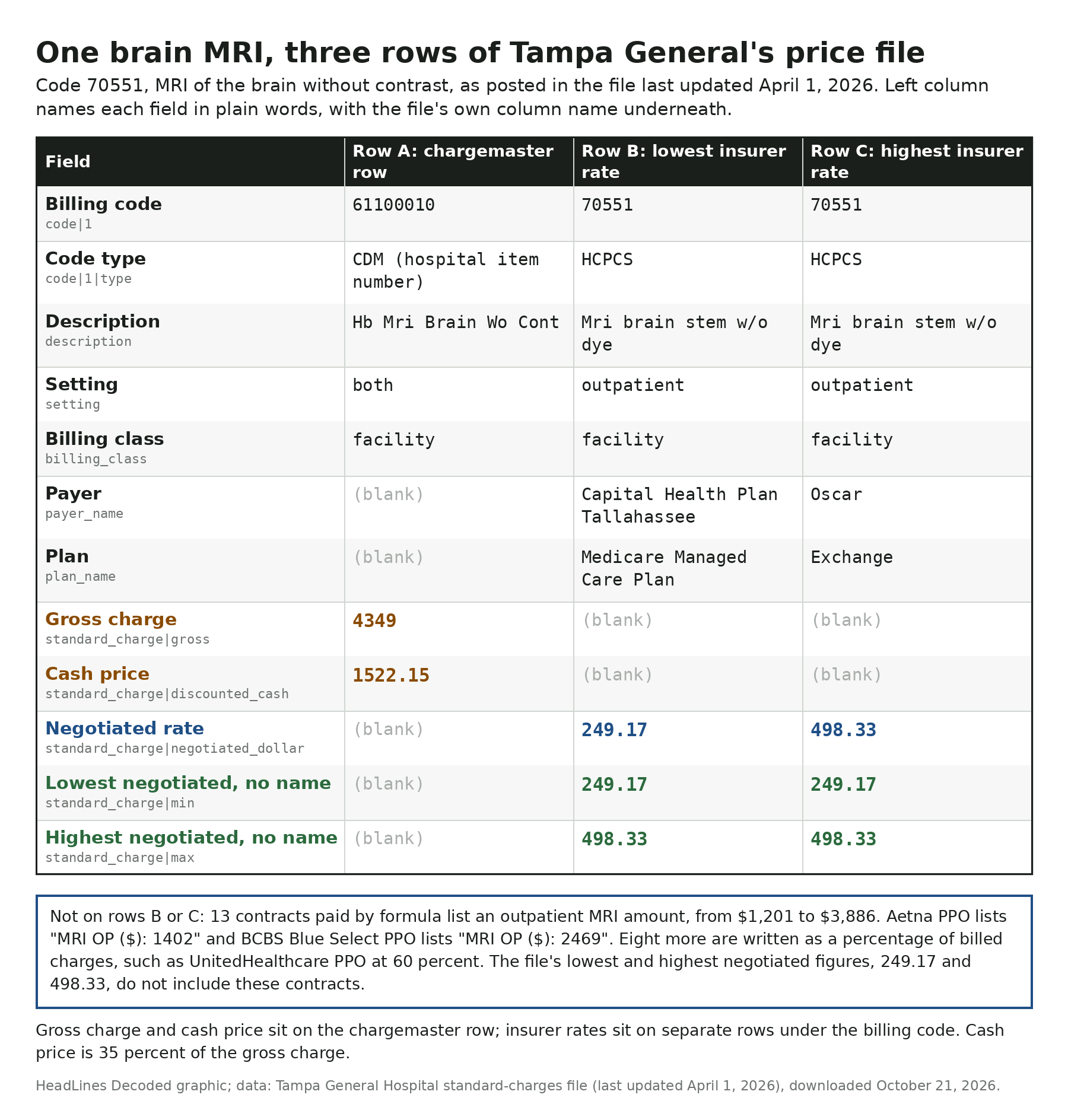
The prices for one scan do not sit on one line. The list price and cash price appear on a chargemaster row carrying Tampa General’s own item number, 61100010, along with code 70551. The insurer rates sit on 19 separate rows filed under the code alone and marked outpatient. You have to know to look for both before you can compare them.
The cash price is exactly 35 percent of the gross charge: $4,349 times 0.35 is $1,522.15. The file explains the discount in a header field labeled financial_aid_policy, which reads “65% off of facility standard gross charges.” The same 35 percent discount applies to the other two services in the table.
Thirteen of the 19 insurer rates belong to plans the file labels “Medicare Managed Care Plan,” a label for Medicare Advantage plans, and 12 of those sit between $249.17 and $279.07. Health First Health Plans is the exception at $448.50. The five Marketplace plans, which the file calls Exchange plans, run from $373.75 at Molina to $498.33 at Oscar. Truli for Health, listed for all its commercial plans, comes in at $473.42.
Many large commercial plans, including HMOs and some Exchange plans, have no dollar row for the MRI at all. Their contracts appear on other rows as formulas. Aetna’s PPO formula includes the line “MRI OP ($): 1402,” which we read as $1,402 for an outpatient MRI. For the plan the file calls BCBS Blue Select PPO, the same line reads $2,469. Both formulas begin with “Lesser Than Charges paid at %: 100,” which we take to mean the plan pays the lower of that amount or the full charge.
UnitedHealthcare’s PPO is one of eight contracts listed as a percentage of total billed charges, which run from 35 to 80 percent. Applied to the $4,349 gross charge, UnitedHealthcare’s 60 percent gives $2,609.40. That figure is our arithmetic, because the file does not do the multiplication, and a real claim could come out differently. Across the 13 formula contracts that list an MRI amount, the figures start at $1,201 and top out at $3,886, and eight of them are above the $1,522.15 cash price. The file’s de-identified maximum for the MRI is $498.33, the highest of the dollar rates, so that column alone does not show the full range.
The colonoscopy cash price beats 15 of 27 rates
For the diagnostic colonoscopy, cash lands in the middle. It tops 12 of the 13 Medicare Advantage rates, falling under only Health First’s $1,748.04. It is also below all 14 commercial and Exchange dollar rates in the file, which run from $1,326.84 for AvMed’s Exchange plan to $2,923 for UnitedHealthcare’s HMO/POS plan. Together that is 15 rates above cash.
Those are facility charges only. Tampa General’s hospital services and charges page says its charges “typically do not include physician services or the necessary services of other providers.” For a colonoscopy, the doctor who performs it and the anesthesia provider can each send a separate bill, and so can the lab that examines any tissue removed.
Code 80053 appears on eight chargemaster items
The comprehensive metabolic panel, a common blood test, shows a different problem: the code alone does not settle the price. Tampa General’s file attaches code 80053 to eight chargemaster items. Four list $685 gross and $239.75 cash. One, marked for a general health panel only, is $64 gross, and two others, one of them marked point-of-care, are $32. The eighth is labeled Magnesium, at $21.
Insurer rates for the panel run from $10.56 to $21.12, and both ends belong to Oscar’s Exchange plan. The file lists Oscar twice under that code, once with the note Laboratory and again with APC, short for Ambulatory Payment Classification, the grouping Medicare uses to pay for hospital outpatient care. Against the $685 version of the test, the $239.75 cash price is about 11 times Oscar’s higher rate.
Who can get the lowest rate in the file
The $249.17 at the bottom of the MRI column is the rate Tampa General’s April 1 file lists for Capital Health Plan’s Medicare Advantage members. A negotiated rate belongs to the contract between one hospital and one plan, so nobody outside that plan can claim it.
Inside your own plan, the posted rate works as the allowed amount. You pay part of it: first your deductible, the amount you pay each year before the plan starts paying, then your coinsurance, a set percentage of the allowed amount. Tampa General’s page makes the same point, saying patients “will likely pay only a portion of these rates via deductibles, co-payments, or co-insurance.” These rates also help set a plan’s premiums, which a later installment (Story coming Thu, Oct 29 at 9:00 AM) of the series explains.
The cash price also leaves out the radiologist who reads an MRI. If you have insurance and are thinking of paying cash instead, ask your plan first whether that payment would count toward your deductible.
10 fields to match before you compare two rates
Check that these ten fields match before you set one rate beside another. The third column shows what we found in Tampa General’s file.
| Field | What it tells you | What we found at Tampa General |
|---|---|---|
| 1. Code | The billing code for the service, such as CPT 70551 | Gross and cash prices sit on a row with the hospital’s item number and the code, while insurer rates are on rows with the code alone |
| 2. Description | The service in words | “Hb Mri Brain Wo Cont” on one row and “Mri brain stem w/o dye” on another, both tied to 70551 |
| 3. Setting | Inpatient, meaning admitted to the hospital, or outpatient | Chargemaster rows say “both” and insurer rows say outpatient |
| 4. Billing class | Whether it is a facility charge or a doctor’s professional charge | Every row we used was a facility charge |
| 5. Payer | The insurance company | Spellings vary, such as “Bcbs” and “BCBS” or “Avmed” and “AvMed” |
| 6. Plan | The specific product, such as a PPO or a Medicare Advantage plan | Aetna has separate rows for its HMO, PPO, Medicare and Medicaid plans |
| 7. Rate type | A dollar amount, a percentage or a formula | HMOs and PPOs from large commercial insurers used formulas or percentages for the MRI |
| 8. Rate | The number itself | Oscar had two different rates for one blood-test code |
| 9. Expiration date | When the contract price ends | Not in the hospital file; insurer files carry it |
| 10. Estimated allowed amount | Past payments on real claims, given as a median and a range | Not required on dollar rates, and blank there; filled in by service group on the formula rows |
Insurer price files and the October 2026 rule
Health plans post their own files under federal rules called Transparency in Coverage. Those files list in-network rates for covered services, plus allowed amounts and billed charges for out-of-network care, according to the CMS public data page. Each in-network rate carries the provider’s federal ID number and an expiration date, under the file format CMS publishes. We did not pull an insurer file for this story, so the comparison above rests on the hospital file alone.
In a fact sheet on final rule CMS-9882-F, finalized October 5, 2026 and published in the Federal Register on October 6, CMS said the Departments of Health and Human Services, Labor and the Treasury had identified barriers to using the insurer files that include “inaccessibility due to the large size of the machine-readable files,” “data ambiguity due to lack of contextual information alongside the raw data” and “areas of misalignment with the Hospital Price Transparency rule.”
The rule moves the rate files from monthly to quarterly posting and has plans post one rate file per provider network. It also lowers the number of claims needed before an out-of-network amount must be reported, from 20 to 11. Under the rule text, those changes apply beginning March 6, 2027, and three new supporting files begin September 6, 2027.
Getting a written estimate before you book
A price file shows what a hospital has posted, and it does not bind the hospital to charge you that amount. The hospital’s price page also says the documents “are not a guarantee of what you will be charged.”
If you will pay without insurance, the federal No Surprises Act gives you a firmer tool. Providers usually must give you a good faith estimate if you ask for one or schedule a service at least three business days ahead, and you may be able to dispute the bill if it comes in at least $400 above the estimate, according to CMS. Ask that the estimate list the billing code, so you can match it to the file.
If you are insured, call the number on your card with the code and the hospital’s name, and ask what the plan will allow and what your share will be, in writing or through the plan’s online estimator. Tampa General takes estimate requests through its Patient Financial Assistance office at 813-844-8084, weekdays from 8 a.m. to 4:30 p.m., according to its website. All eight parts, including the one that follows this same brain MRI through Medicare’s 2026 rates, are on the Healthcare Costs, Decoded page.
Before you use a number from Tampa General’s file, check the date at the top; ours was April 1, 2026.
About this information. This article explains how health care costs and coverage rules work. It is general information. Nothing here is medical, insurance, legal, tax or financial advice. We do not recommend any plan or product. Prices and rules change, so check any figure with the source named here, your plan or a licensed professional before you make a decision. No insurer, hospital, drug company or health plan named in this article paid for it or reviewed it before publication.
- Standard charges machine-readable file (last updated April 1, 2026; downloaded October 21, 2026) · Tampa General Hospital
- cms-hpt.txt price file index · Tampa General Hospital
- Hospital Services and Charges · Tampa General Hospital
- Hospital Price Transparency (page modified September 16, 2026) · Centers for Medicare & Medicaid Services
- 45 CFR Part 180, Hospital Price Transparency · Electronic Code of Federal Regulations
- Transparency in Coverage Final Rules (CMS-9882-F) fact sheet (October 2026) · Centers for Medicare & Medicaid Services
- Transparency in Coverage, document 2026-20447 (published October 6, 2026) · Federal Register
- Transparency in Coverage final rule text, public inspection copy · Federal Register
- Health Plan Price Transparency: Public Data (page modified October 8, 2026) · Centers for Medicare & Medicaid Services
- In-network rates schema, price transparency guide · CMSgov on GitHub
- Medical bill rights (page modified October 5, 2026) · Centers for Medicare & Medicaid Services
- Further reading from HeadLines Decoded: Whoop Opened a $799 Cancer Blood Test to Everyone. Here Is What the Numbers Actually Show.
E.G. v4.18 · I.R.G. v1.14 · L.R.G. v1.9 · P.L.G. v1.10
Produced under the HeadLines Decoded Editorial, Image & Rights, Legal & Risk, and Production & Layout guidelines at the versions shown.
Editor written. AI used for spelling and grammar only.