Medicare Advantage vs Medigap in 2027: The Choice That Can Be Hard to Undo
Before December 7, compare the 2027 cost of Medicare Advantage and Medigap, and find out whether a Medigap insurer could refuse you if you want to switch back.


Credit: APK, CC BY 4.0, via Wikimedia Commons
If you are on Medicare, you have until December 7 to join, switch or drop a Medicare Advantage plan or a drug plan for 2027. An Advantage plan, sold by a private insurer, often costs less each month and caps your yearly costs for in-network care, which means doctors and hospitals the plan has a contract with. Original Medicare, the government plan most people get at 65, with a Medigap supplement and separate drug coverage costs more each month, works with any doctor who takes Medicare and leaves less to pay when you are very sick. The part to look at closely is getting a Medigap policy again later. If you give up a Medigap policy for an Advantage plan and later want one again, an insurer can ask about your health and say no, outside a few protected situations. We found nothing in Florida law that adds an extra way back for people 65 and older.
Part B is Original Medicare’s doctor and outpatient coverage, and its monthly premium, the amount you pay each month, usually comes out of your Social Security check. Part D is Medicare’s drug coverage, sold separately. Plan G, Plan N and Plan F are letters for standard Medigap policies. If you check one number, make it the maximum out-of-pocket amount in your Annual Notice of Change, the yearly letter from your plan listing what changes in 2027. It is the most the plan can make you pay in a year for covered care inside its network.
Five differences between Medigap and Medicare Advantage
| Question | Original Medicare with Medigap and a drug plan | Medicare Advantage plan |
|---|---|---|
| Monthly cost | Part B premium, plus the Medigap premium, plus a drug plan premium | Part B premium and the plan’s premium, which is often $0 |
| Worst case in a year | No yearly limit in Original Medicare itself. Medigap Plan G leaves you the $283 Part B deductible (2026 amount). Drugs are capped at $2,400 in 2027. | Up to $9,850 for in-network care in 2027 (PPO plans, which also cover out-of-network doctors at higher cost: up to $14,800 in and out of network combined), plus up to $2,400 for drugs |
| Doctors and hospitals | Any provider in the country that accepts Medicare | The plan’s network and service area, the counties where it enrolls members; emergency and urgent care are always covered |
| Prior approval | In most cases none is needed, the Medicare & You 2027 handbook says | Plans can require approval first; 99% of enrollees are in plans that do for some services |
| Changing later | You can switch to an Advantage plan each fall, even with a pre-existing condition | You can return to Original Medicare each fall, or once from January 1 to March 31, but buying Medigap again may mean health questions and a possible no |
Prior approval, which insurers call prior authorization, means the plan has to agree before it pays for certain care, usually costly care such as a hospital stay or a scan. KFF, a health policy research group, counted nearly 53 million of these decisions by Advantage insurers in 2024. They fully or partly denied 4.1 million, or 7.7%. Only 11.5% of denials were appealed, and 80.7% of those appeals were decided at least partly in the patient’s favor.
The yearly limit in an Advantage plan counts what you pay for covered hospital and doctor care. Premiums and drug costs sit outside it. The Centers for Medicare & Medicaid Services (CMS), the federal agency that runs Medicare, capped what an Advantage plan may set as its limit in 2027 at $9,850 inside the network and, for PPO plans, $14,800 counting out-of-network care too, in its Final CY 2027 Part C bid review memo of April 22, 2026 (Table 3). Drugs have their own 2027 cap of $2,400, up from $2,100 this year, set in the CMS 2027 Rate Announcement of April 6, 2026. A drug plan can charge a deductible of up to $700 first, and it counts toward the cap.
Getting back into Medigap later
Medigap is private insurance that pays most of what Original Medicare leaves you, such as the 20% you owe on most doctor bills. Your Medigap Open Enrollment Period is the six months starting the first month you have Part B and are 65 or older. In it, a company must sell you any policy it offers in your state, at the price it charges people in good health. Medicare’s guide, Choosing a Medigap Policy (March 2026), says that window “can’t be changed or repeated.”
After it closes, the guide says, “There’s no guarantee that an insurance company will sell you a Medigap policy if you don’t meet their medical underwriting requirements.” Medical underwriting means the company asks about your health, then decides whether to sell and at what price.
Federal law carves out exceptions called guaranteed issue rights. The guide lists seven situations, on pages 17 and 18, when an insurer has to sell you a policy on the terms it gives healthy buyers, covering conditions you already have. They apply in narrow cases, such as your Advantage plan leaving Medicare or your area, or your moving out of its service area.
Two of these rights, which the guide calls trial rights, let you test an Advantage plan. One applies if you leave a Medigap policy to join an Advantage plan for the first time: you have 12 months to go back, and your old policy returns if the company still sells it. If not, you can buy a standard plan such as Plan G. The other applies if you joined an Advantage plan when first eligible for Medicare at 65: you can leave during its first 12 months and buy any Medigap policy sold in your state. You apply from 60 days before the Advantage coverage ends to 63 days after. After that first year, these rights generally end.
Florida law on Medigap
Some states give more than the federal minimum. Florida Statutes section 627.6741 and the Florida Office of Insurance Regulation’s 2024 Medigap questions and answers give people under 65 who have Medicare because of a disability or kidney failure a six-month Medigap open enrollment when they enroll in Part B, and another at 65. They give a two-month window without health questions after group health coverage ends, and a company can cancel a policy only for unpaid premiums or a material misstatement. That window is tied to group coverage ending, and we found nothing that applies it to someone leaving an individual Advantage plan. We found no Florida rule that lets someone 65 or older move from an Advantage plan back into Medigap without health questions outside the federal situations.
A 2027 example in dollars
We priced one example: a 65-year-old woman in Orlando who does not smoke and takes a few low-cost drugs. Her Medigap premium comes from our October 21 search of the state insurance office’s Medicare supplement rate lookup. For Plan G in ZIP code 32801 it listed 35 policies with rates effective January 1, 2027, at $2,427 to $3,953 a year. The middle one was $3,005, about $250 a month. For a 75-year-old in the same ZIP code the middle policy was $3,598. For a 65-year-old in Miami’s ZIP code 33130 it was $4,493. The lookup page says these are not final rates. A company can change your price after you answer its health questions, and some policies listed require a health screen or a membership. Use them as a starting point before you ask for real quotes.
| Example, 2027 | Original Medicare + Plan G + drug plan | Medicare Advantage, $0 premium |
|---|---|---|
| Part B premium, $202.90 a month (2026 amount) | $2,435 | $2,435 |
| Medigap Plan G, $250 a month (example) | $3,000 | none |
| Part B deductible left to you under Plan G (2026) | $283 | none |
| Drug plan premium, $36 a month (CMS projected 2027 average) | $432 | included |
| Drugs at the pharmacy (example) | $300 | $300 |
| Office copays: 4 regular at $0, 4 specialist at $40 (example) | none | $160 |
| Normal year total | $6,450 | $2,895 |
| Bad year: drug cap of $2,400 replaces the $300 | $8,550 | see next line |
| Bad year: $9,850 in-network limit plus $2,400 drug cap | $14,685 |
How we figured it: normal year = Part B + Medigap premium + Part B deductible + drug plan premium + pharmacy, against Part B + plan premium + pharmacy + copays. A bad year uses the $2,400 drug cap and, for the Advantage plan, its full in-network limit. CMS had not announced the 2027 Part B premium or deductible as of October 21, so the 2026 amounts stand in. The 3.6% Social Security cost-of-living increase that starts in January will arrive with the Part B premium for 2027 already taken out.
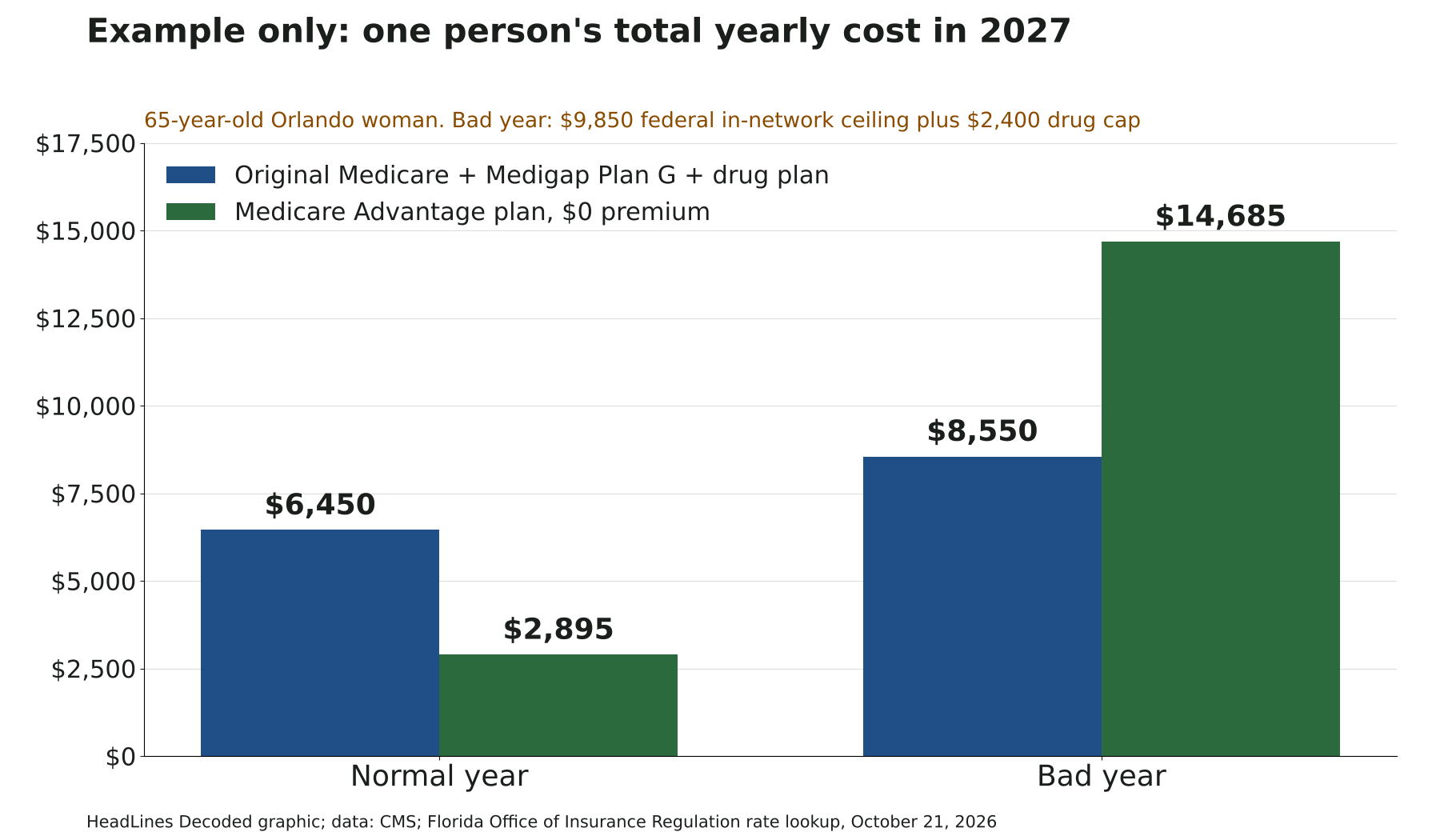
The Advantage plan in this example costs $3,555 less in a normal year, about $296 a month. With a hospital stay and the $9,850 federal ceiling as its limit, it costs $6,135 more. Averaged out, under these assumptions, the Medigap route costs less only if bad years come more than about 37 times in 100, a little over one year in three.
Many plans set a lower limit. KFF found the average in-network limit was $5,421 in 2026, and with that limit the bad year costs $1,706 more instead of $6,135. A plan with a limit under about $3,715 would cost less than Medigap even in a bad year. Some Medigap policies are priced by your age, so their premiums rise as you get older; others are not. A serious illness can also last more than one year, and outside the protected situations a Medigap insurer may turn down an applicant with health problems.
Where Advantage plans get money for extra benefits
Advantage ads often feature dental, vision and grocery allowances. Medicare pays each plan a set amount per member, and a plan that bids below Medicare’s local benchmark gets part of the difference as a rebate. The Medicare Payment Advisory Commission (MedPAC), which advises Congress, estimated in March 2026 that Medicare will pay 14%, or about $76 billion, more for Advantage members this year than it would spend if they were in Original Medicare. About $22 billion of that comes from what it calls coding intensity: plans record more diagnoses for their members than doctors record for similar patients in Original Medicare, and more diagnoses raise the payment. Rebates reached a record $222 per member per month, and MedPAC says plans expect to spend 38% of that money on benefits Medicare does not cover and 10% on administration and profit.
MedPAC also says the higher payments raise Part B premiums for everyone, about $14.61 a month per person in 2026, whether or not they are in a plan. The same report says members generally report satisfaction with their coverage and that its figures are not an estimate of plan profits. Its figures are national averages. They do not say any particular plan is poor value or any particular diagnosis false.
In a January 31, 2023 report, GAO-23-105527, the Government Accountability Office found that CMS had limited data on how often members used those extras. CMS then required plans to report use starting with 2024 benefits.
Lines to read in your Annual Notice of Change before December 7
Your Advantage or drug plan had to send this notice by September 30. It lists what changes on January 1, and if you do nothing, you stay in the plan with those changes. Most notices follow a model CMS gives plans, so look for these lines:
- Monthly plan premium, 2026 next to 2027.
- Maximum out-of-pocket amount from network providers, and for a PPO the combined amount with out-of-network care.
- Medical deductible, if the plan has one.
- Copays for primary care and specialist office visits.
- Cost for an inpatient hospital stay, often a daily copay for the first several days.
- Changes to the provider network. Look up each doctor and hospital you use in the 2027 provider directory.
- Changes to the pharmacy network, including whether your pharmacy has preferred pricing.
- Changes to the Drug List. Find each drug you take and its tier.
- Part D deductible and the cost for each drug tier.
- New or changed prior authorization and referral rules in the table of medical benefit changes.
- Any change to the plan’s name or service area, or a notice that the plan is ending.
- Extras such as dental or vision allowances, with their 2027 dollar limits.
If the notice says the plan is leaving your area or Medicare, it can give you a guaranteed issue right to Medigap. Keep it and its envelope.
Running Plan Finder and spreading drug costs
Medicare’s Plan Finder compares 2027 plans by ZIP code. Enter each drug and its dose, and pick the pharmacy you use. For each plan it shows the monthly premium and an estimate of your yearly drug and premium costs. Open a plan’s details to see its in-network limit and whether your doctors are listed, then call the doctors’ offices to confirm. For Medigap, Medicare’s Medigap search lists the companies selling each plan letter in your ZIP code. Every company sells the same benefits under a given letter, and prices for that letter differ from one company to the next.
If big bills at the pharmacy counter worry you, every Part D plan offers the Medicare Prescription Payment Plan, which spreads what you owe for covered drugs into monthly bills across the year. It does not lower your total, and the handbook says it may be a poor fit if you get Extra Help, Medicare’s program that helps people with limited income pay for drugs. If you are in it for 2026 and keep the same plan, it renews for 2027.
Estimate your own 2027 costs
This is the first part of our Healthcare Costs, Decoded series. Almost every number you need comes from Plan Finder or your plans’ own papers.
Medicare in 2027: a rough estimate of what each path could cost you
| Line | Original Medicare + Medigap + drug plan | Medicare Advantage plan |
|---|---|---|
| A. Part B premium for 12 monthsYour letter or bill shows a monthly amount: multiply it by 12.Where to find it: Social Security benefit letter, or your Medicare bill | The standard 2026 premium is $202.90 a month, about $2,435 a year. The 2027 amount is not out yet. | Copies the first column until you type here. |
| B. Medigap premium for the yearQuotes show a monthly premium: multiply it by 12.Where to find it: Your Medigap bill, or quotes from Medicare's Medigap search | not used | |
| C. What your Medigap letter leaves youWhere to find it: Your policy, or Medicare's Medigap guide | none | |
| D. Yearly drug plan premiumPlan Finder shows a monthly premium: multiply it by 12.Where to find it: Plan Finder, or your plan's notice | Your Advantage plan's own premium for 12 months, the monthly premium times 12 ($0 if it has none). It is already part of line E; the bad year uses it. | |
| E. Plan Finder's yearly estimate of drugs plus premiumWhere to find it: Plan Finder. If the drug part alone is over $2,400, use $2,400 plus the plan's yearly premium | ||
| F. Office visits and their copaysWhere to find it: Plan's Summary of Benefits | Only with Plan N: office visits in a year, at up to $20 each. | visitscopay |
| Normal yearWhere to find it: Your totals | A + B + C + E, plus $20 for each Plan N visit on line F | A + E + F |
| G. Plan's in-network limitWhere to find it: Summary of Benefits or the notice (no more than $9,850 in 2027) | none | |
| Bad yearWhere to find it: Your totals | A + B + C + D + $2,400, plus $20 for each Plan N visit on line F | A + 12 months of plan premium + G + $2,400 |
How they compare
- Most you pay for covered drugs in 2027 $2,400 CMS 2027 rate announcement, checked Oct. 21, 2026
- Highest in-network limit an Advantage plan can set in 2027 $9,850 CMS 2027 bid review memo, checked Oct. 21, 2026
- Part B deductible, 2026 (the 2027 amount is not out yet) $283 CMS 2026 Medicare Parts A and B premiums and deductibles fact sheet, checked Oct. 23, 2026
Free help, including SHINE in Florida
1-800-MEDICARE (1-800-633-4227, TTY 1-877-486-2048) answers around the clock. Every state has a State Health Insurance Assistance Program, or SHIP, that gives free, personalized help with choosing a plan and buying a Medigap policy; shiphelp.org lists them. Florida’s is SHINE, Serving Health Insurance Needs of Elders, run by the Florida Department of Elder Affairs at 1-800-963-5337. For questions about Medigap policies and premiums, Florida’s Department of Financial Services takes calls at 1-877-693-5236.
Dates from December 7 to March 31
Open Enrollment ends Monday, December 7, and changes take effect January 1. If you try an Advantage plan in 2027 and it doesn’t suit you, the Medicare Advantage Open Enrollment Period from January 1 to March 31 allows one change, to another Advantage plan or back to Original Medicare plus a separate drug plan.
- Medicare & You 2027 (September 2026) · Centers for Medicare & Medicaid Services
- Choosing a Medigap Policy: A Guide to Health Insurance for People with Medicare (CMS Product No. 02110, March 2026) · Centers for Medicare & Medicaid Services
- Announcement of Calendar Year 2027 Medicare Advantage Capitation Rates and Part C and Part D Payment Policies (April 6, 2026) · Centers for Medicare & Medicaid Services
- Final CY 2027 Part C Bid Review Memorandum (April 22, 2026), Table 3 (public copy hosted by LMI) · Centers for Medicare & Medicaid Services
- CY 2027 actuarial bid call weekly announcements, noting release of the Final Contract Year 2027 Standards for Part C Benefits, Bid Review and Evaluation on April 22, 2026 · Centers for Medicare & Medicaid Services
- 2026 Medicare Parts A and B Premiums and Deductibles (November 14, 2025) · Centers for Medicare & Medicaid Services
- Medicare Advantage and Medicare Prescription Drug Programs Expected to Remain Stable in 2027 (September 28, 2026) · Centers for Medicare & Medicaid Services
- Models, Standard Documents and Educational Materials, including the model Annual Notice of Change · Centers for Medicare & Medicaid Services
- Florida Statutes section 627.6741, Issuance, cancellation, nonrenewal and replacement (2026) · Florida Legislature
- Medigap Frequently Asked Questions (2024) · Florida Office of Insurance Regulation
- Medicare Supplement Rates lookup (searched October 21, 2026) · Florida Office of Insurance Regulation
- Report to the Congress: Medicare Payment Policy (March 2026) · Medicare Payment Advisory Commission
- Medicare Advantage: Plans Generally Offered Some Supplemental Benefits, but CMS Has Limited Data on Utilization, GAO-23-105527 (January 31, 2023) · U.S. Government Accountability Office
- Medicare Advantage in 2026: Premiums, Out-of-Pocket Limits, Supplemental Benefits, and Prior Authorization (June 5, 2026) · KFF
- Medicare Advantage Insurers Made Nearly 53 Million Prior Authorization Determinations in 2024 (January 28, 2026) · KFF
- Medicare Part B Premium Expected to Rise in 2027 (October 5, 2026) · AARP
- Medicare Plan Finder · Medicare.gov
- Find a Medigap policy · Medicare.gov
- Medicare Prescription Payment Plan · Medicare.gov
- SHINE, Serving Health Insurance Needs of Elders · Florida Department of Elder Affairs
- State Health Insurance Assistance Programs · SHIP National Technical Assistance Center
E.G. v4.18 · I.R.G. v1.14 · L.R.G. v1.9 · P.L.G. v1.10
Produced under the HeadLines Decoded Editorial, Image & Rights, Legal & Risk, and Production & Layout guidelines at the versions shown.
Editor written. AI used for spelling and grammar only.