Nervous System Care Is the New Daily Essential
The industry calls it neurowellness and it is the biggest wellness story of the year. Some of it holds up in a blinded trial. For some of it, the science has not caught up with the claim. Here is the sorting.

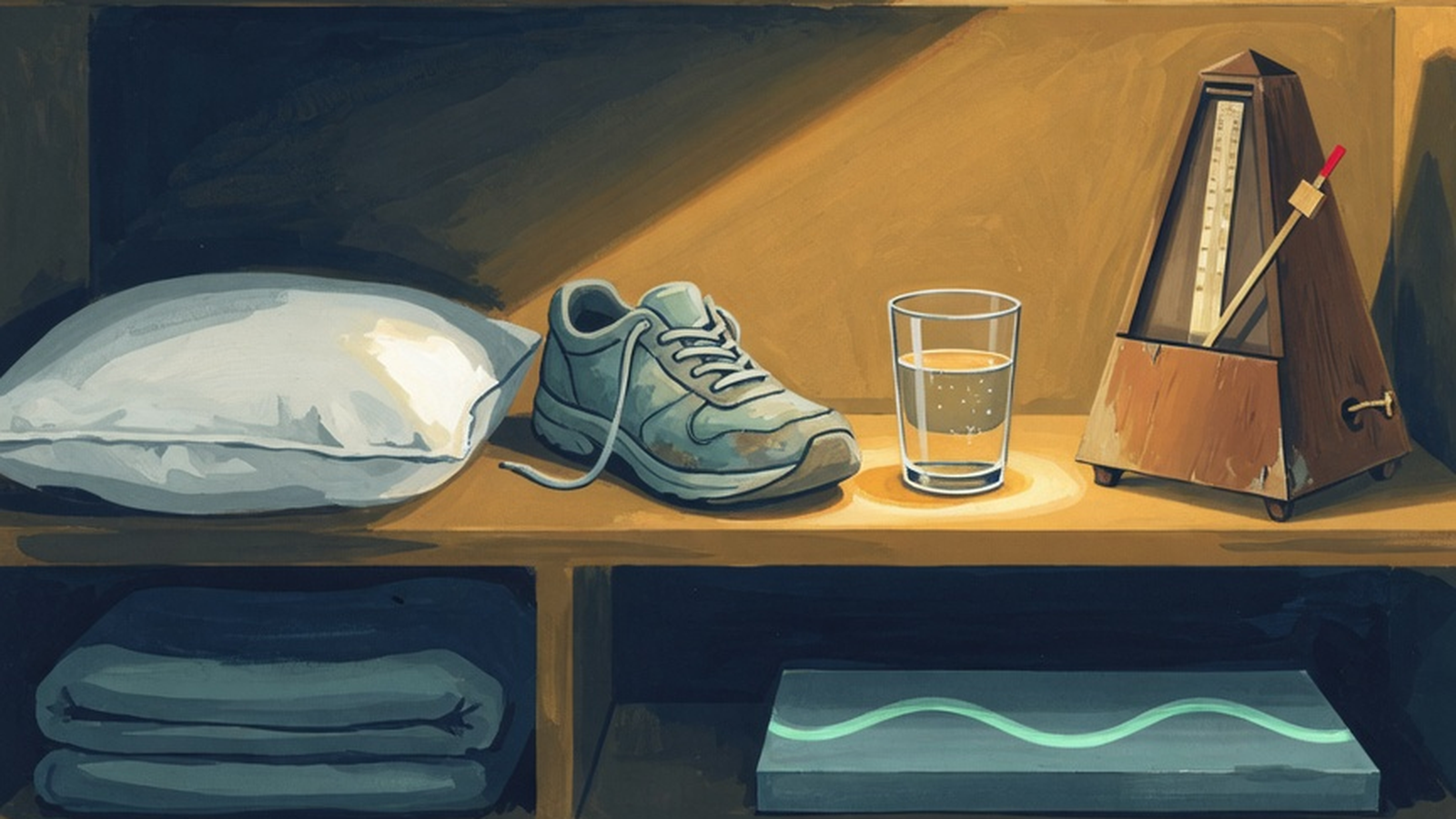
Credit: AI-generated illustration. · HeadLines Decoded LLC
Illustration generated with AI.
For twenty-eight days, 108 people at Stanford spent five minutes every morning doing something with their breath. One group did box breathing. One group hyperventilated on a cycle. One group meditated. The fourth group did a thing the researchers called cyclic sighing: two inhales through the nose, the second one short and sharp on top of an already full lung, then a long slow exhale through the mouth until empty.
At the end of the month, the sighing group had the biggest lift in mood and the biggest drop in resting breathing rate. They beat the meditators. The intervention cost five minutes a day and nothing else.
That trial, published in Cell Reports Medicine in early 2023, is one of the strongest single pieces of evidence behind a category that now has a name, a market and a hype cycle. The Global Wellness Summit calls it neurowellness and made it one of the ten predictions in its Future of Wellness 2026 report, published on 27 January. The pitch is that we have spent a decade optimising muscles, guts and sleep, and the last frontier is the wiring. Regulate the nervous system before it breaks, rather than after.
The pitch is fair. The shelf it is being sold from is a mess.
Because “nervous system care” now covers, in one breath, a five minute breathing pattern with a randomised trial behind it, a class of devices that run a small current through the skin of your ear, an app that draws you a squiggle, an ice tub, and a theory that the field’s own anatomists say is wrong. The reader is expected to sort all of that out at checkout.
So let us sort it.
What the phrase means, underneath the branding
Strip the marketing away and there is real anatomy holding this up.
Your autonomic nervous system runs the machinery you never think about: heart, lungs, gut, pupils, sweat glands. It has two broad settings. One speeds things up for effort or threat. The other slows things down for digestion and repair, and it runs largely down the vagus nerve, a long wandering cable from the brainstem into the chest and abdomen.
Then comes the part that makes any of this measurable. Your heart does not tick like a metronome. It speeds up a little when you breathe in and slows down a little when you breathe out. The size of that swing is called heart rate variability, and it is the single number the entire industry is built on. A bigger swing generally means the braking system is in good working order.
The physiology here is well established, and it explains why slow breathing does something that a mantra cannot. Your blood pressure runs its own correction loop, cycling roughly every ten seconds. Breathe at about six breaths a minute and your lungs fall into step with that loop. The two rhythms start pushing in the same direction, and the swing in your heart rate gets considerably larger.
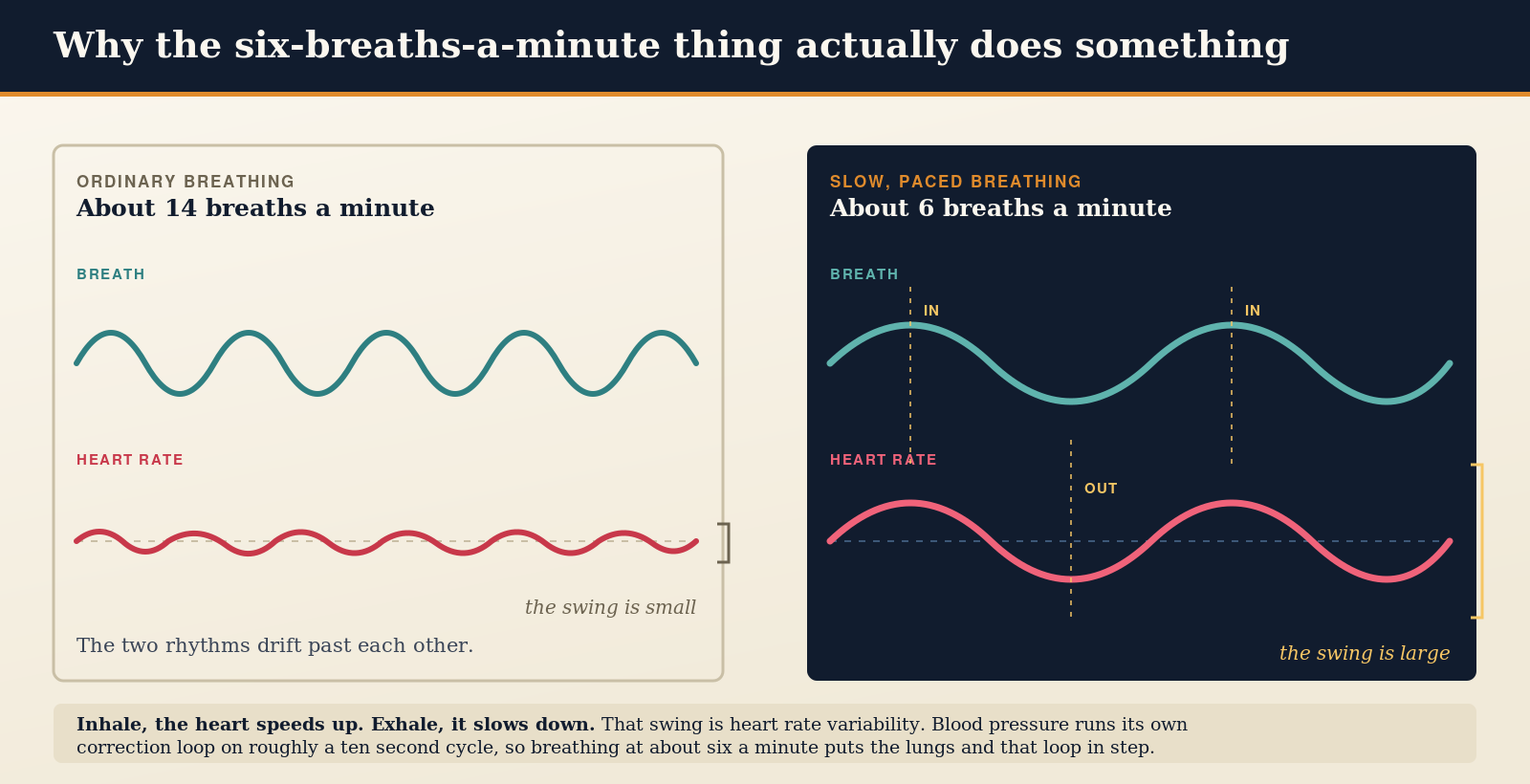
That is the mechanism. It is unglamorous, it is free, and it is the load-bearing wall under most of what follows.
The theory doing the selling has a problem
Almost every somatic course, trauma-informed workshop and vagus nerve gadget you will meet borrows its vocabulary from polyvagal theory, introduced by the psychologist Stephen Porges in 1994. It gave us “dysregulated.” It gave us “vagal tone.” It gave us fight, flight and freeze as a three-rung ladder, and the claim that a distinct, evolutionarily newer mammalian vagus governs social connection and the feeling of safety.
Take the strongest version of it first, because it has earned that. Polyvagal theory handed clinicians a language for something patients had been describing for years and could not name, in a field that had spent decades attending almost exclusively to thoughts. Therapists who use it report that their clients get better. Its defenders lean on that hard, and they are not wrong to.
The trouble is underneath, in the science. In 2025 an international group of researchers published an evaluation in Clinical Neuropsychiatry under a title that does not hedge: “Why the Polyvagal Theory Is Untenable.” Every co-author agreed that the theory’s major tenets are unsupported by past or current knowledge, and in several instances contradict the broader evidence base. The objections are anatomical and evolutionary rather than rhetorical. The brainstem wiring the theory requires does not appear to exist as described, and the lungfish, which is not a mammal, turns out to have exactly the sort of myelinated vagal fibres running to its heart that the theory presents as a mammalian innovation.
Read that carefully, because it is easy to over-read. The vagus nerve is not fake. Slow breathing has not stopped working. Heart rate variability is a genuine measurement and slow breathing genuinely raises it. What collapses is the story wrapped around those facts, and the story is what is being sold to you.
A practice can work while the explanation attached to it is wrong. Most of medical history looks like that. What you cannot do is use the broken explanation to predict what else will work, which is precisely what a product page invites you to do.
Sorting the shelf
One question separates the tiers below, and you can carry it into any shop.
What happens to the effect when the person does not know whether they got the real thing?
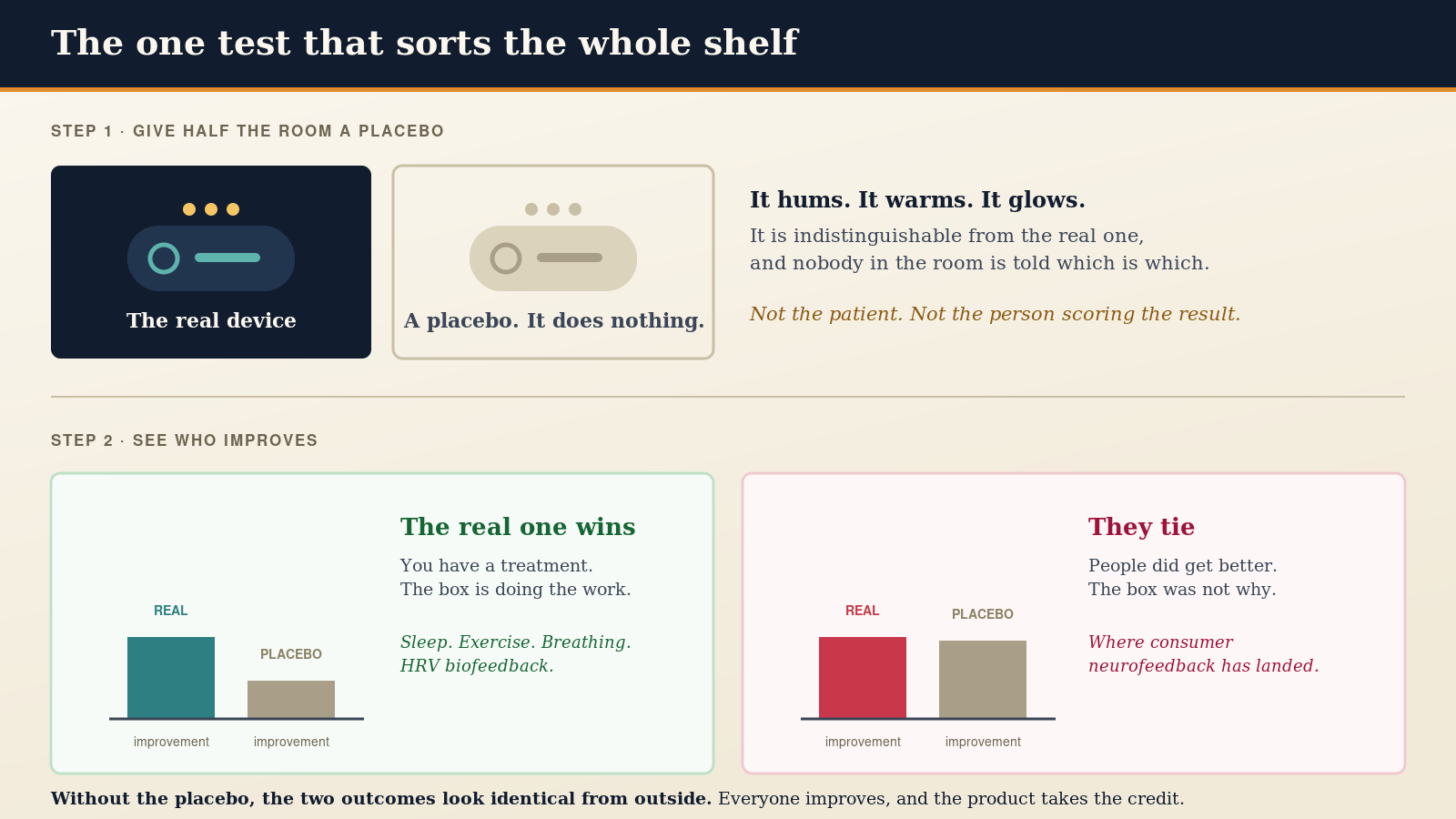
That is the job of a placebo-controlled trial. Half the group gets a device that hums, warms and glows, and does nothing at all. Neither they nor the person scoring the result is told which is which. If the real device still wins, you have a treatment. If both groups improve at the same rate, the improvement is real and the device was not the thing that caused it.
| Practice | What the strongest study actually found | Verdict |
|---|---|---|
| Sleep | Amygdala reactivity to disturbing images about 60% higher after one sleepless night, with a loss of prefrontal damping (Walker lab, 2007). | Probably works |
| Exercise | Umbrella review of 97 reviews, 1,039 trials, 128,119 people. Median effect: anxiety −0.42, depression −0.43 versus usual care (BJSM, 2023). | Probably works |
| Slow paced breathing | Five minutes a day for 28 days beat mindfulness meditation on mood and respiratory rate. 108 participants (Cell Reports Medicine, 2023). | Probably works |
| HRV biofeedback | 24 studies, 484 participants. Hedges’ g of 0.83 against controls, on self-reported stress and anxiety (Psychological Medicine, 2017). | Probably works |
| Mindfulness, at full dose | 276 adults. Eight weeks of MBSR was non-inferior to escitalopram for anxiety disorders (JAMA Psychiatry, 2022). The dose was 45 minutes daily plus weekly classes. | Probably works |
| Touch | 137 studies, 12,966 people. Consistent medium benefits, largest in those already unwell (Nature Human Behaviour, 2024). | Probably works |
| Cold water immersion | 11 studies, 3,177 adults. Stress fell at 12 hours after immersion, not immediately. Authors flag weak, heterogeneous evidence (PLOS One, 2025). | Might work |
| Vagal stim devices (as a category) | Clinical taVNS has placebo-controlled support in some settings. Consumer devices do not match the trial protocols they borrow their credibility from, and results on anxiety are mixed. | Might work |
| Weighted blankets | Swedish RCT in psychiatric insomnia: blanket group nearly 26 times more likely to halve insomnia severity. Blinding is impossible. | Might work |
| Consumer EEG neurofeedback | With probably-blinded raters, the effect on ADHD symptoms falls to −0.29, confidence interval crossing zero, p = 0.07. The placebo group does about as well. The calm-and-focus claims sold to consumers have not been tested at all. | Evidence not there yet |
| Humming, gargling, ice on the face | The diving reflex is real and drops heart rate within seconds. No body of controlled trials has yet tested whether daily practice changes anxiety, mood or sleep over weeks. | Evidence not there yet |
| Chasing your daily HRV score | HRV is a real signal. The morning number also moves with alcohol, illness, hydration and strap position, and no trial has shown that watching it daily improves anything. Sleep clinics have a name for the failure mode: orthosomnia. | Evidence not there yet |
Probably works
Sleep, and it is not close. In a 2007 imaging study from Matthew Walker’s group at Berkeley, people kept awake for a single night showed amygdala responses to disturbing images roughly 60 percent larger than rested controls, alongside a loss of connectivity to the prefrontal regions that normally hold that response down. Nothing else on this list, no clip and no tub and no app, has an effect of that magnitude. Sleep is the nervous system intervention, and it is the first thing sacrificed to make time for the others.
Movement. The largest synthesis we have, an umbrella review in the British Journal of Sports Medicine in 2023, gathered 97 reviews, 1,039 trials and 128,119 participants. Physical activity produced median effect sizes of −0.42 for anxiety and −0.43 for depression against usual care. The authors observe that these are comparable to, or slightly greater than, what psychotherapy and medication deliver. Shorter, higher-intensity programmes did better than long gentle ones.
Slow, paced breathing. The Stanford trial above, resting on the mechanism in the diagram. Five minutes. No equipment.
Heart rate variability biofeedback. A meta-analysis in Psychological Medicine pooled 24 studies and 484 participants and reported a large effect on stress and anxiety, a Hedges’ g of 0.83 against control conditions. Two caveats, both of them the authors’ own: the outcomes are self-reported, and they say plainly that more well-controlled studies are needed. This is the one place a gadget earns its keep, because it does something you cannot do unaided. It shows you, in real time, whether you have found your own resonant breathing rate.
Mindfulness, at a serious dose. In a 2022 randomised trial in JAMA Psychiatry, 276 adults with anxiety disorders received either eight weeks of mindfulness-based stress reduction or escitalopram, a standard first-line drug. Mindfulness was non-inferior. Now look at the dose, because the marketing never will: eight weekly classes of two and a half hours, a weekend retreat, and 45 minutes of home practice every single day. That is close to a part-time job. No trial has shown that three minutes on an app matches a drug, and none claims to.
Touch. A 2024 meta-analysis in Nature Human Behaviour, covering 137 studies and 12,966 people, found consistent medium-sized benefits for mental and physical health, with the largest effects in people who were already unwell. A hug sits on firmer evidential ground than most of the hardware in this article, and nobody is selling it to you.
Might work, and nobody can honestly tell you yet
Cold water. The most cited recent synthesis, a 2025 systematic review in PLOS One covering 11 studies and 3,177 adults, contains a finding the marketing has never once mentioned. The reduction in stress did not appear immediately after the plunge. It appeared around 12 hours later. Immediately after immersion, unsurprisingly, you have just done a stressful thing to yourself. The authors flag substantial variation between studies and a wide gap between the public enthusiasm and the underlying data. Something is going on in the cold. The claim that it “resets your nervous system” on the spot is not what their numbers show.
Vagus nerve stimulation clips. Stimulating the vagus through the skin of the ear is a real technique with a real clinical literature, and some placebo-controlled trials do find effects on anxiety. Others find effects that are small and never reach statistical significance. The difficulty for a shopper is the leap from that literature to a product. The trials use specific electrode placements, currents and durations, and a wellness device advertised on your feed is under no obligation to match any of them. A related device has held European certification for anxiety disorders since 2019. Certification and a settled evidence base are different achievements.
Weighted blankets. A Swedish randomised trial of insomnia in psychiatric patients produced a startling number: the blanket group was almost 26 times more likely to see insomnia severity fall by half or more. A 2024 pilot trial in adults with insomnia also found better sleep quality. The catch is structural and probably unfixable. Nobody can be blinded to the fact that they are lying under nine kilos of blanket, so nobody can separate the weight from the expectation of the weight.
Where the claims have run ahead of the science
Consumer EEG neurofeedback. This one has been tested carefully, which is what makes it useful to look at. Neurofeedback for ADHD looked promising for years on ratings made by people who knew who had received the real thing. Restrict the analysis to raters who were probably blinded and the effect shrinks to a standardised mean difference of −0.29, with a confidence interval crossing zero and a p value of 0.07. The real group and the placebo group improve at about the same rate. The American Journal of Psychiatry has published a piece asking whether it is time to call it quits. That is the condition neurofeedback has been studied in most heavily. The calmer, sharper, better-regulated version now sold to healthy consumers has barely been studied at all, so the honest position is that the evidence is not there yet, and what evidence exists is not encouraging.
Vagal toning hacks. Humming, gargling, ear massage, ice water on the face. The physiology behind the last of those is genuine: cold on the face combined with a held breath triggers the mammalian diving reflex, and heart rate falls within seconds. What does not yet exist, as far as I can find, is a body of controlled trials testing whether doing any of it daily changes anxiety, mood or sleep across weeks. That is an absence of evidence rather than a verdict, and it may well turn out to work. It is worth noticing what has rushed in to fill the absence in the meantime, which is the polyvagal vocabulary that the section above already emptied out.
Chasing your HRV score. Heart rate variability is a real signal. Your wearable’s morning number is also pushed around by alcohol, illness, hydration, room temperature, what time you woke and where the strap was sitting. What no trial has shown is that watching that number every morning makes anyone calmer. Sleep clinicians have already published on the failure mode: in 2017, researchers at Rush University coined “orthosomnia” for patients whose sleep got worse because they were pursuing a better sleep score. The same trap is now available for your nervous system, on a monthly subscription.
And here is the tell that should settle the argument. The same Global Wellness Summit report that named neurowellness one of its ten trends for 2026 lists, as another of its ten trends for 2026, “The Over-Optimization Backlash.” The industry has already priced in the exhaustion its own products create.
One thing on this shelf is a medical device
In December 2025 the FDA authorised the first at-home brain stimulation device for major depressive disorder. It passes a weak direct current through the skull to the left dorsolateral prefrontal cortex, an area that tends to be underactive in depression. In the pivotal trial, 58 percent of patients were in remission after ten weeks, against 29 percent on placebo. It is indicated for adults with moderate to severe depression who are not treatment-refractory, and it is expected to reach American homes from the second quarter of this year.
That is not a wellness product. It is a regulated medical device with an indication, a trial, a risk profile and a regulator, and it happens to look like a headband. What separates the two shelves has nothing to do with how technical the object appears, or how confident the copy sounds. It is whether anybody made it prove itself against a placebo.
What it means for you
The pattern running through the whole table is an awkward one for a 6.8 trillion dollar industry. The evidence runs almost exactly inverse to the price.
Everything in the first tier is free or close to it. Sleep. Walking fast. Six breaths a minute. Being touched by another person. The single paid item that earns its place, HRV biofeedback, works by teaching you to do a free thing correctly, and once you can find your resonant breathing rate without it, you can stop paying.
Everything in the bottom tier has a price, a subscription, or both, and a claim that is still waiting on its evidence.
If you want a daily practice tonight, here is the whole of it.
- Protect the sleep first. Everything else on this list is downstream of it, and it is the one you are most likely to trade away.
- Move most days, hard enough that talking gets awkward.
- Five minutes of slow breathing, around six breaths a minute, with the exhale longer than the inhale. Do it daily, when you are calm. It is a practice, not an emergency brake.
- Get touched. A hug, a hand, a massage. It is the best-evidenced item here and the only one with no business model.
- If you are going to spend money, spend it on something that has beaten a placebo.
That last one is the test to carry into any shop, clinic or feed that uses the word regulation at you. Ask what the placebo version of this looked like, and ask who won. If nobody has run that experiment, the honest answer is that nobody knows yet, and you are paying to find out.
The most interesting thing about neurowellness in 2026 has surprisingly little to do with the neurotech. A decade of wellness culture has finally worked its way inward to the body’s own regulating machinery, and found waiting for it a handful of practices that cost nothing and a vocabulary that cannot survive peer review.
Your nervous system is not a device to be optimised. It is the part of you that keeps score of how you are living. Sleep, movement, breath and contact were never hacks aimed at it. They are the inputs it evolved to read, and it has been reading them all along, whether or not anyone was charging you for the reading.
If you want the habits with actual evidence behind them rather than a trend, start with Decode Your Wellbeing: The Six Habits With Real Evidence for a Longer Healthspan.
- Balban MY, Neri E, Kogon MM, et al. Brief structured respiration practices enhance mood and reduce physiological arousal. Cell Reports Medicine, 2023.
- Global Wellness Summit. The Future of Wellness 2026 Trends, and the ten trends announcement, 27 January 2026.
- Global Wellness Summit. The Rise of Neurowellness.
- Why the Polyvagal Theory Is Untenable: an international expert evaluation. Clinical Neuropsychiatry, 2025. See also Fundamental challenges and likely refutations of the five basic premises of the polyvagal theory, 2023, and the Polyvagal Institute’s own response.
- Singh B, Olds T, Curtis R, et al. Effectiveness of physical activity interventions for improving depression, anxiety and distress: an overview of systematic reviews. British Journal of Sports Medicine, 2023.
- Goessl VC, Curtiss JE, Hofmann SG. The effect of heart rate variability biofeedback training on stress and anxiety: a meta-analysis. Psychological Medicine, 2017.
- Hoge EA, Bui E, Mete M, et al. Mindfulness-Based Stress Reduction vs Escitalopram for the Treatment of Adults With Anxiety Disorders: A Randomized Clinical Trial. JAMA Psychiatry, 2022.
- Packheiser J, Hartmann H, Fredriksen K, et al. A systematic review and multivariate meta-analysis of the physical and mental health benefits of touch interventions. Nature Human Behaviour, 2024.
- Cain T, Brinsley J, Bennett H, et al. Effects of cold-water immersion on health and wellbeing: A systematic review and meta-analysis. PLOS One, 2025.
- Transcutaneous Auricular Vagus Nerve Stimulation for Myoarthropathic Symptoms: a pilot randomised controlled trial, 2025, and a systematic review and meta-analysis of taVNS for functional dyspepsia, 2025.
- Ekholm B, Spulber S, Adler M. A randomized controlled study of weighted chain blankets for insomnia in psychiatric disorders. Journal of Clinical Sleep Medicine, 2020. See also the 2024 pilot RCT in adults with insomnia.
- Neurofeedback for ADHD: Time to Call It Quits? American Journal of Psychiatry. See also the double-blind, placebo-controlled fMRI neurofeedback trial in children with ADHD.
- Baron KG, Abbott S, Jao N, Manalo N, Mullen R. Orthosomnia: Are Some Patients Taking the Quantified Self Too Far? Journal of Clinical Sleep Medicine, 2017.
- Coverage of the FDA clearance of the first at-home brain stimulation device for major depressive disorder, December 2025: Medical Device Network and Neurology Advisor.
- Goldstein AN, Walker MP. The Role of Sleep in Emotional Brain Function. Annual Review of Clinical Psychology, 2014, which reviews the 2007 amygdala findings.
at the versions shown. What this means
Editor written. AI used for spelling and grammar only.