The Paint That Tries to Cool Without Power
Two very different technologies are being sold under nearly the same words. One cools a surface below the air around it. The other is the bag on the hardware store shelf.

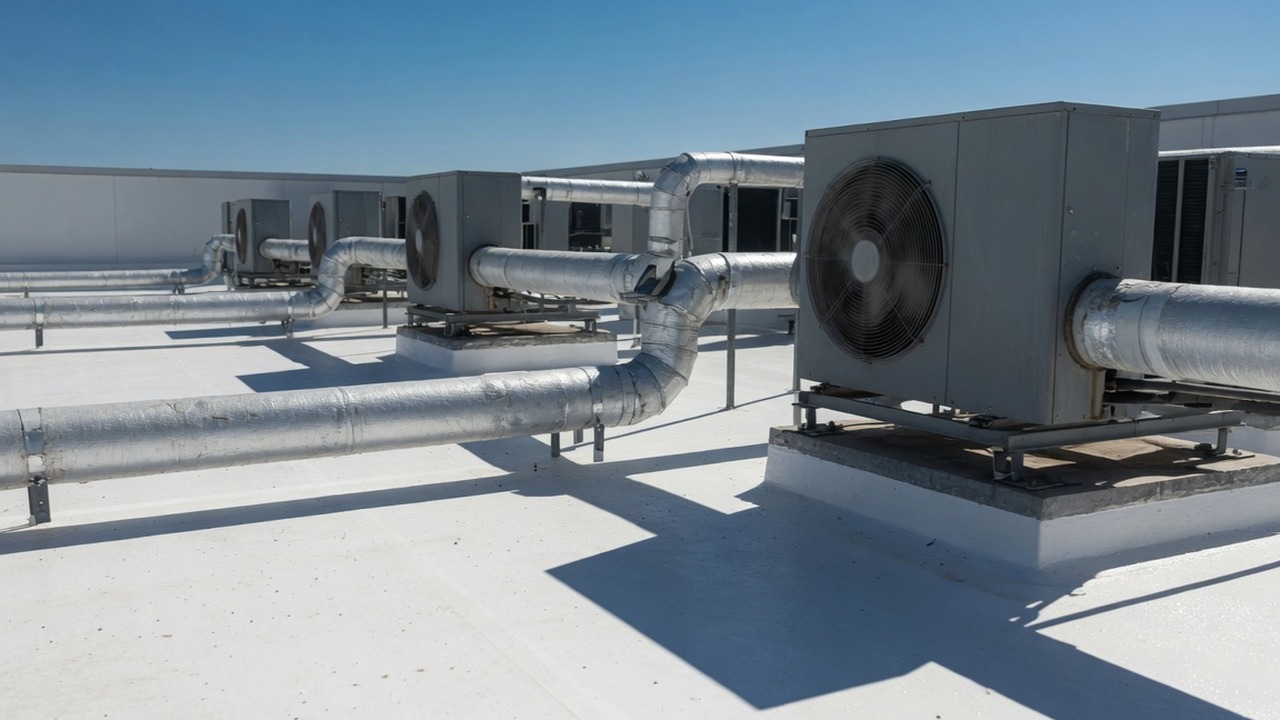
Credit: AI-generated illustration. HeadLines Decoded. · HeadLines Decoded LLC
Illustration generated with AI.
- Passive daytime radiative cooling, a surface that stays below air temperature with no power, is real, and it made the World Economic Forum Top 10 Emerging Technologies of 2026.
- It works by reflecting over 90 percent of sunlight and emitting heat in the 8-to-13-micrometer atmospheric window that escapes straight to space; engineered versions log around 20 percent energy savings in commercial buildings.
- The ceramic microsphere additives homeowners can actually buy (such as Insuladd) are a more modest reflective upgrade; independent testing has generally found their edge over good light-colored paint to be small.
- A first-hand test on a dark olive-green Florida house that kept its exact color: adding the microspheres returned the air conditioning to normal cycling and let it finally reach lower setpoints, at the cost of a thick, sandy, dusty application.
In the middle of a Florida July, the pitch sells itself: a paint so good at shedding heat that the surface it coats stays cooler than the air around it, no power, no compressor, no moving parts. That is a real thing. It is called passive radiative cooling (the daytime kind), and this summer it earned a place on the World Economic Forum Top 10 Emerging Technologies of 2026. The catch is that the version most homeowners can actually buy at a hardware store is not quite that thing. It is a quieter cousin wearing the same marketing. Knowing which one you are holding is the whole game.
How Passive Radiative Cooling Works
True radiative cooling pulls off two optical tricks at once. First it reflects the overwhelming majority of sunlight, across the band from roughly 0.3 to 2.5 micrometers, so the energy never lands as heat. Second, and this is the clever part, it glows in a specific slice of the infrared, the 8-to-13-micrometer window where the atmosphere happens to be transparent. Heat radiated in that band does not bounce back; it travels straight out to the cold of space. Do both at once and a surface can sit several degrees below the surrounding air in full sun, quietly dumping something like 70 to 100 watts per square meter into the sky.
Ordinary white paint gets the first job partly right and the second job mostly wrong. Engineered radiative materials are tuned for both, with solar reflectance north of 90 percent and high emission right inside that atmospheric window, and the field has moved out of the lab. SkyCool Systems has put panels and roof films on real commercial buildings and refrigeration systems; grocery and retail deployments have logged energy savings in the neighborhood of 20 percent; coatings that keep power cables cooler let the same wire carry more current. California and Chinese standards have begun to name high-performance radiative materials outright. This is not speculative. It is arriving, from the top of the market down.
The thing in the bag
What shows up in a hardware-store search is a different animal. Ceramic microsphere additives, sold under names like Insuladd, are hollow ceramic beads you stir into ordinary paint. As the paint dries the beads pack together and are meant to form a reflective radiant barrier. The claims on the bag are bold: heat gain cut by up to 40 percent, a measurable bump in R-value.
Independent testing has been a good deal cooler about it. The Florida Solar Energy Center found no meaningful advantage for insulating paints over ordinary ones. Cold-climate housing researchers came to the same place on energy cost. A Washington State University analysis of one popular additive judged that any real-world benefit on an exterior wall “very likely may be small.” Some direct-sun exposures do show heat-gain reductions around 20 percent, but that is the honest work of a decent reflective coating, not the sub-ambient magic of engineered radiative cooling. The beads make paint more reflective. They are not tuned for the atmospheric-window emission that defines the real thing, and they rarely drive a surface below air temperature.
| True radiative cooling | Ceramic additive (what you buy) | |
|---|---|---|
| Reflects sunlight | Over 90 percent, broadband | More reflective than plain paint, less selective |
| Emits in the 8-13 µm window | Yes, engineered for it | Not optimized for it |
| Cooler than the air | Yes, several degrees in full sun | Rarely; mostly cuts heat gain |
| Where it is used | Commercial roofs, panels, refrigeration | Consumer paint, hardware stores |
| Independent verdict | Measured savings, ~20% at some sites | Modest; small edge over good light paint |
One dark house in Florida
Here is where the theory met a specific afternoon. The house was dark olive green, and in summer that color acted like a sponge: the air conditioning would run flat out and still lose the fight well into the evening. When it came time to repaint, the color had to stay exactly the same dark olive green. The only variable that changed was the addition of Insuladd microspheres to the paint. That constraint is what makes the result worth anything, because whatever happened could not be blamed on going to a lighter color.
I mixed the additive into a good acrylic exterior paint and put three coats on the surfaces that take the full Florida sun. Be warned: the additive turns the paint into something almost paste-like, thick enough that it fights the brush, and during mixing it throws up clouds of fine dust that you do not want in your lungs. A respirator is not optional. The dried film comes out with a distinctly sandy, rough texture, nothing like the smooth finish of plain acrylic. Acrylic was the deliberate choice so that Florida rain would help rinse the surface clean, though the rough texture works against that a little.
The change in daily operation was hard to miss. The air conditioning now cycles on and off the way it is supposed to, instead of running without pause. We can drop the thermostat and the house actually gets there, which it never used to do. Walls that once soaked up the whole afternoon feel cooler to the hand. Because the color never changed, the improvement points back to the microspheres themselves, adding reflectance and a thin radiant barrier even on a dark base. The costs are real too: the thickness, the sandy finish, the dust you have to respirator against. But so was the difference in how the house met a Florida afternoon.
None of that requires the additive to be a miracle. The independent numbers put the reflective gain in the modest range, and that fits what happened here rather than contradicting it. A cooling system already living at the edge of keeping up is exactly the place a small bump shows. Ours was on the verge of not cooling well enough, and a few points of reflectance were enough to tip it back into normal cycling instead of the losing race it ran every afternoon.
The bottom line
Two technologies are being sold under nearly the same words, and the gap between them is where the disappointment usually lives. The engineered kind, high reflectance married to atmospheric-window emission, genuinely runs surfaces below air temperature and is already banking measured savings in commercial buildings. The ceramic additive you can buy today is a more modest reflective upgrade, and independent tests keep finding its average edge over good light-colored paint to be small. Yet on one dark house that refused to change color, it moved the needle on real air-conditioning behavior, which is more than the lab-grade averages would predict. The science of cooling a surface into space without power is sound, and the polished version is coming. The bag at the store is the humble cousin. Buy it for what it is, not for what the better technology can do, and it can still earn its place on the right wall.
A cooling bill is one line in a household budget that has been moving for twenty-five years: Wages vs. the Real Cost of Living: A 25-Year Look at Prices and Spending Habits.
- World Economic Forum, Top 10 Emerging Technologies of 2026 (passive radiative cooling)
- SRI, self-cooling paint named in the WEF 2026 emerging-technologies report
- SkyCool Systems, commercial passive radiative cooling panels and deployments
- Bob Vila, Insulating Paint 101: making sense of the claims (independent review)
- Insuladd, manufacturer product information and claims
Editor written. AI used for spelling and grammar only.