PPO vs HSA in 2027: Four Scenarios That Show Which Plan Costs Less
Our household picks between these two plans at work. Example numbers show what each costs across four kinds of years, and what happens when a $4,000 bill arrives in January.


Credit: Harrison Keely, CC BY 4.0, via Wikimedia Commons
“PPO versus HSA” is how many benefit menus and search boxes put this choice, but the two terms name different things. A PPO, short for preferred provider organization, is a network of doctors and hospitals. An HSA, or health savings account, is a tax-favored account you own. The plan sold beside it is an HSA-eligible high-deductible health plan, which may use a PPO network itself.
In the example worked out below, the HSA-eligible plan has the lower estimated cost in all four kinds of years, by $3,000 to $4,200, mostly because its premiums are $2,400 lower and the employer adds $1,000. Your own numbers can reverse that. A plan that costs less over 12 months can also be hard to pay for in January.
Our household chooses between two plans through work, both from the same national insurer. The PPO costs us about $200 a month in premiums, the amount taken from each paycheck to have the plan. The HSA-eligible plan costs $0 a month, and its deductible, the care we pay for in full each year before the plan pays, is about a third higher than the PPO’s. We put the maximum into a health flexible spending account, or FSA, every year and pay for care with its debit card.
This is the second part of Healthcare Costs, Decoded. The $200 premium gap is ours. The other figures are example numbers I set so you can check every line, and they are not our plan’s. Readers already on Medicare will want the first part, on Medicare Advantage and Medigap.
Four example years under both plans
The example uses family coverage. The PPO has a $3,000 deductible, and after that you pay 20 percent of each bill, called coinsurance. The HSA-eligible plan’s deductible is $4,000, a third higher, then 10 percent. Both plans stop charging you for covered in-network care once you have paid $7,000 in a year, the out-of-pocket limit. The employer puts $1,000 into the HSA on January 1. Preventive care is free under both plans, and each deductible covers doctor visits and prescriptions together. The PPO’s copays, flat charges such as $30 a visit, are left out.
The yearly cost of each plan is its premiums plus what you pay for care, minus any employer money in the HSA. Your own HSA deposits are not counted as a cost, since that money stays yours.
| Kind of year | Care, at the price the insurer agreed with the doctor | PPO: premiums + what you pay | HSA-eligible plan: premiums + your share – employer money | HSA-eligible plan costs less by |
|---|---|---|---|---|
| Quiet year: checkups and a few routine prescriptions | $800 | $2,400 + $800 = $3,200 | $0 + $800 – $1,000 = -$200 (the account keeps $200) | $3,400 |
| Expected year: regular visits and monthly prescriptions | $3,500 | $2,400 + $3,100 = $5,500 | $0 + $3,500 – $1,000 = $2,500 | $3,000 |
| Known-care year: a planned surgery | $20,000 | $2,400 + $6,400 = $8,800 | $0 + $5,600 – $1,000 = $4,600 | $4,200 |
| Worst covered year: both out-of-pocket limits reached | $34,000 or more | $2,400 + $7,000 = $9,400 | $0 + $7,000 – $1,000 = $6,000 | $3,400 |
The HSA-eligible plan starts $3,400 ahead, the $2,400 in premiums plus the employer’s $1,000. The most its higher deductible can cost you, compared with the PPO for the same care, is $800. That happens at exactly $4,000 of care, where you pay all $4,000 on the HSA-eligible plan and $3,200 on the PPO. Above that the gap closes, because 10 percent is half of 20 percent, and past $12,000 of care the HSA-eligible plan’s share is the smaller one.
To check your own plans, add the yearly premium difference to any employer HSA money; in the example that is $3,400. If the HSA-eligible plan’s out-of-pocket limit exceeds the PPO’s by more than that, the PPO costs less in the worst year. Flat PPO copays for office visits and generic drugs would shrink the HSA-eligible plan’s lead in the quiet and expected years. One insurer can also use different networks and negotiated prices for its two plans, so look up your doctors and prescriptions under each plan by name. Part 3 explains what sets the price of health care (Story coming Tue, Oct 27 at 9:00 AM).
For 2027, IRS Revenue Procedure 2026-24 says an HSA-eligible plan’s deductible must be at least $1,750 for one person or $3,500 for family coverage, and its out-of-pocket limit can be no more than $8,700 or $17,400. The example plan fits.
The tax break on each plan
If your employer takes PPO premiums out of pay before tax, through what the tax code calls a cafeteria plan, the PPO gets a tax break too, and your pay stub will show it. FSA money comes out the same way. HSA deposits made through payroll skip income tax and also Social Security and Medicare tax, because IRS Publication 969 treats them as employer contributions.
Take a household in the 22 percent federal bracket that also pays 7.65 percent in Social Security and Medicare tax, 29.65 percent in all. On the PPO side, $2,400 of premiums and a $3,400 FSA go in before tax. That is $5,800, and it saves about $1,720. On the HSA side, the same $5,800 can go into the HSA by payroll, the old FSA amount plus the premium no longer charged. That saves the same $1,720. Only money beyond that changes the tax result. The 2027 family limit is $9,000, counting the employer’s $1,000, so the household could put in $8,000 of its own money and save about $2,372, which is $652 more. It gets that $652 only by putting in $2,200 more.
The $3,400 is the 2026 FSA limit, with a carryover cap of $680, from IRS Revenue Procedure 2025-32, announced in IR-2025-103 on October 9, 2025. The IRS had not published 2027 FSA figures by October 21, 2026.
Money you send the HSA yourself, outside payroll, is deducted on your tax return. That saves income tax only, so the same $5,800 saves about $1,276. Social Security tax stops at a wage cap, $192,300 for 2027 according to the Social Security Administration, so higher earners save less. And two states tax HSA money. California’s Franchise Tax Board says the state “does not conform” to the federal HSA deduction and adds employer HSA money back into income. It also taxes HSA earnings in the year they are earned. Brian Gilmore, a benefits lawyer at the brokerage Newfront, has written that New Jersey also treats contributions as after-tax, and the New Jersey Division of Taxation’s 2025 NJ-1040 instructions do not list HSAs among the income it excludes.
The FSA has a quiet-year cost of its own. A household that elects $3,400 and has only $800 of care can carry $680 forward, if its plan allows, and loses the other $1,920, more than the roughly $1,008 the election saved in tax.
A $4,000 bill in January
Suppose a $4,000 scan or procedure lands in January, the HSA-eligible plan’s whole deductible. On the PPO, your share would be $3,200, and the FSA card could pay all of it in the first week, because Publication 969 says the amount you elected must be available “at any time during the coverage period, regardless of the amount you have actually contributed.”
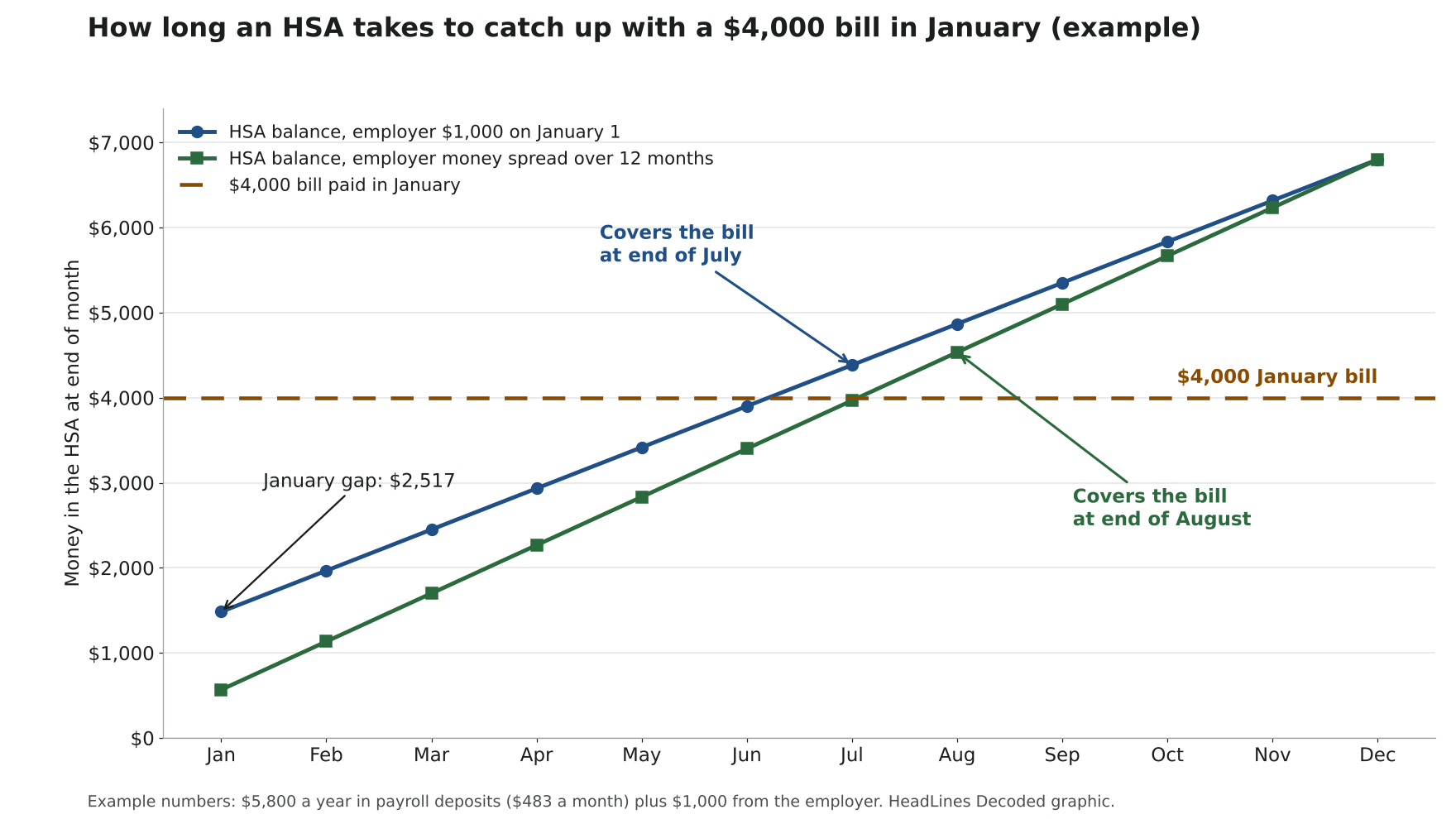
An HSA pays out only what has been deposited. In the example, payroll adds $5,800 a year, about $483 a month, and the employer’s $1,000 arrives January 1. After January’s deposits the account holds about $1,483, which leaves $2,517 to cover from savings or a payment plan with the provider.
Publication 969 allows tax-free reimbursement for qualified expenses incurred after the HSA was set up, so you can pay the January bill from savings and pay yourself back as deposits arrive. Here the account catches up in July. By the end of June the account holds $3,900, which leaves $100 owed. July brings it to $4,383, $383 over the bill, and December to $6,800. If the employer spreads its $1,000 across the year, the January balance is about $567 and the account does not pass $4,000 until August.
If the gap would sit on a credit card for six months, the interest eats into the yearly saving shown in the first table. Before you enroll, ask the HSA custodian, the bank or firm that holds the account:
- Does this HSA come with a debit card?
- Can the card pay a bill larger than the current balance?
- After a later deposit, how fast can I repay myself for a bill I covered?
- Can I deposit more from early paychecks, or add money directly?
Unspent HSA money carries over from year to year, so a withdrawal years from now can repay you for a qualified bill you paid yourself, as long as the bill came after the account was opened. Publication 969 says you must keep records showing that the money went only to qualified medical expenses, that those expenses were not paid or reimbursed from another source, and that they were not taken as an itemized deduction. A folder of itemized bills and insurer statements, kept by year, is that record.
Switching from an FSA can block HSA deposits for a year
If you use a health FSA now, check this rule first. Unused FSA money is lost unless the plan allows a grace period of up to two and a half months or a carryover, Publication 969 says.
A carryover into a general-purpose FSA, the ordinary kind that pays for any medical expense, makes you ineligible for HSA deposits for that FSA’s whole plan year. The IRS Office of Chief Counsel said so in a 2014 memo, CCA 201413005, and spending the carried-over money does not cure it: you still cannot contribute “even for months in the plan year after the health FSA no longer has any amounts available.” The memo is the IRS lawyers’ reading of the rule and cannot be cited as precedent.
The memo describes two ways around it, if your employer’s plan offers them. You can decline the carryover before the new plan year begins, or move the leftover money into a limited-purpose FSA, which covers dental and vision care and can sit beside an HSA. If your FSA has a grace period instead, Publication 969 says HSA deposits can start with the new year only if the old FSA balance is zero when its plan year ends; otherwise they wait until the grace period is over. Under IRS Revenue Ruling 2004-45, a general-purpose FSA through your spouse’s employer blocks your HSA deposits too.
Turning 55, or joining Medicare
At 55 or older, your HSA limit goes up $1,000, and a married couple who both qualify must each put the extra $1,000 in their own HSA. Once you enroll in Medicare, you can no longer put money into an HSA, starting that month. If you sign up after 65 for premium-free Part A, Medicare’s hospital coverage, Medicare.gov says coverage starts six months back from when you sign up, though never before the month you turned 65. HSA deposits made in those back months count as over the limit and bring a 6 percent tax each year until you take them out. Money already in the account stays yours for medical bills.
Run your own numbers on paper
Our PPO vs HSA calculator does this arithmetic for you, and the worksheet below follows the same order for anyone who would rather use a pencil. The plan figures are in each Summary of Benefits and Coverage; last year’s figures are in your insurer’s claims summary.
| Line | What to write down | PPO | HSA-eligible plan |
|---|---|---|---|
| 1 | Monthly paycheck deduction, times 12 | ||
| 2 | Deductible (the family amount if you cover family) | ||
| 3 | Out-of-pocket limit | ||
| 4 | Last year: which plan you had, the insurer’s agreed price for all your care (the “allowed” amount on its statement), and what you paid | ||
| 5 | Coinsurance after the deductible, in percent | ||
| 6 | Employer HSA money for the year; does it all arrive January 1? | none | |
| 7 | A year like last year: line 1, plus your cost for line 4’s care, minus line 6 | ||
| 8 | A bad year: line 3 plus line 1, minus line 6 | ||
| 9 | January: your share of a bill the size of the HSA plan’s deductible, minus what pays it at once (PPO: the amount you set for your FSA; HSA plan: the balance after one paycheck) |
Terms of use
This worksheet and our calculator are provided by HeadLines Decoded for general information and education only. They are not insurance, financial, tax, legal or medical advice, and they do not recommend any plan or insurer. No adviser-client or other professional relationship is created by using them.
The results are estimates based only on the numbers you enter and on the simplified assumptions in the example above. They may be incomplete or wrong for your situation. Plan rules, prices, tax law and IRS limits change, and your plan may work differently.
The worksheet is provided “as is,” without any warranty, including any warranty of accuracy or of fitness for a particular purpose. You are responsible for your own decision. To the fullest extent the law allows, HeadLines Decoded, its owner and its writers are not liable for any loss or damage arising from the use of, or reliance on, this worksheet or its results. Before you enroll, read your plan’s Summary of Benefits and Coverage and talk with your benefits office or a licensed professional.
- Revenue Procedure 2026-24: 2027 HSA and high-deductible plan limits (2026) · Internal Revenue Service
- Publication 969 (2025), Health Savings Accounts and Other Tax-Favored Health Plans · Internal Revenue Service
- Chief Counsel Advice 201413005, Health FSA carryovers and HSA eligibility (March 28, 2014) · Internal Revenue Service
- Revenue Ruling 2004-45, HSAs and other health arrangements (2004) · Internal Revenue Service
- IRS releases tax inflation adjustments for tax year 2026, IR-2025-103 (October 9, 2025) · Internal Revenue Service
- News releases for October 2026 (checked October 21, 2026) · Internal Revenue Service
- Topic 751, Social Security and Medicare withholding rates · Internal Revenue Service
- 2027 Cost-of-Living Adjustment fact sheet, maximum taxable earnings $192,300 (October 2026) · Social Security Administration
- 2025 Instructions for Schedule CA (540) · California Franchise Tax Board
- 2025 NJ-1040 Resident Income Tax Return instructions · New Jersey Division of Taxation
- California and New Jersey HSA State Income Tax, by Brian Gilmore (June 21, 2019) · Newfront
- When does Medicare coverage start? · Medicare.gov
- Further reading from HeadLines Decoded: Insurers Say They ‘Can’t Afford’ Ozempic and Zepbound. What the Data on Healthier Patients and Cost Savings Actually Shows.
E.G. v4.18 · I.R.G. v1.14 · L.R.G. v1.9 · P.L.G. v1.10
Produced under the HeadLines Decoded Editorial, Image & Rights, Legal & Risk, and Production & Layout guidelines at the versions shown.
Editor written. AI used for spelling and grammar only.