What Sets the Price of Health Care? Follow One MRI Through Five Prices
Medicare's approved amount for a brain MRI is $195.40 in a doctor's office and $311.57 in a hospital outpatient department in 2026, and both include the share a patient pays. The hospital's charge, each insurer's rate, the cash price and your own share are four more prices, each set by a different party.

Credit: Walter Davies, CC BY-SA 4.0, via Wikimedia Commons
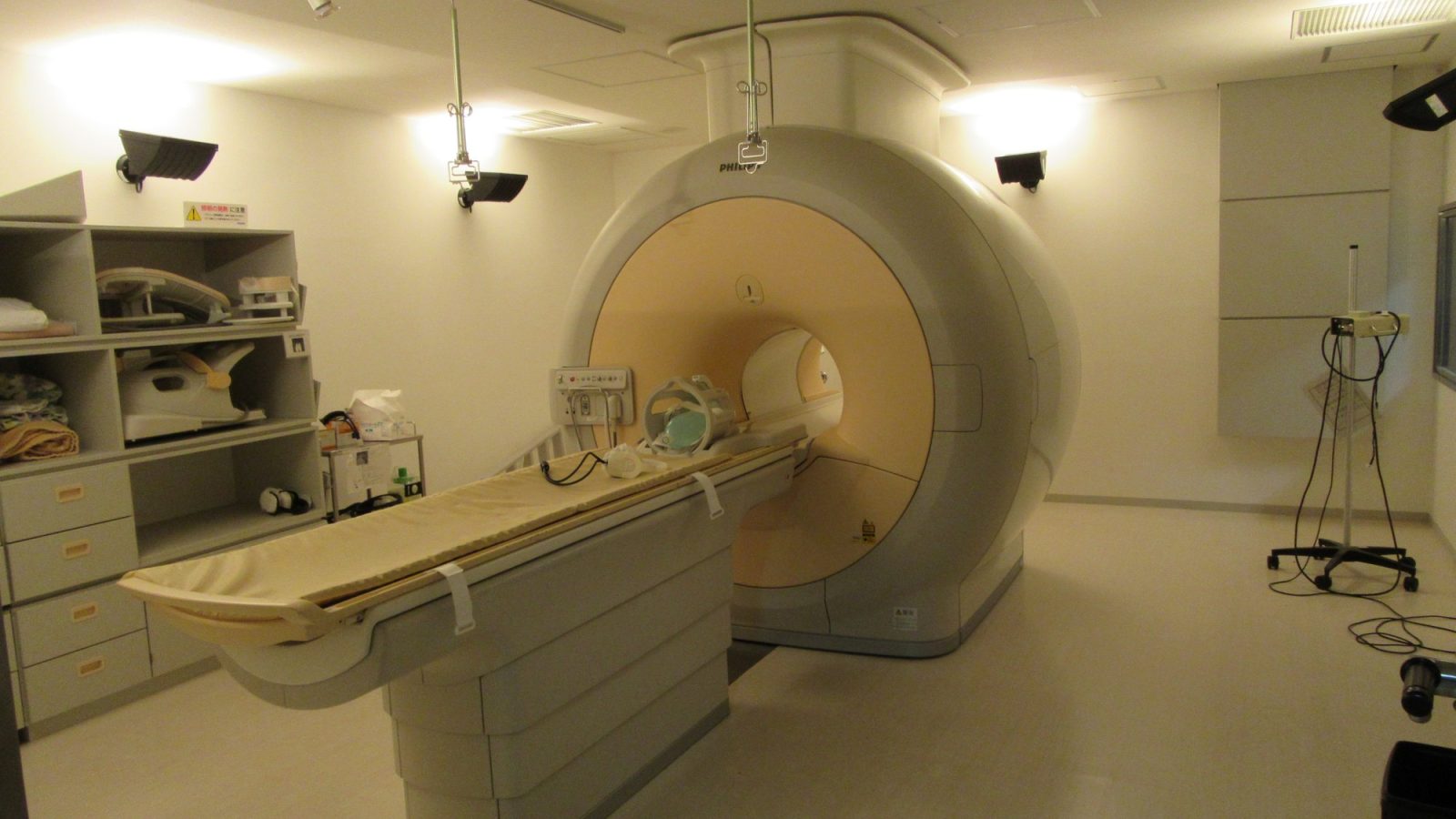
One brain MRI, billed under one code, carries a hospital charge, a rate each insurer negotiated, a cash price, a Medicare-approved amount and a share left for you, and a different party sets each of them. Even Medicare, with one national rule book, approves two different amounts for this scan in 2026: $195.40 in a doctor’s office or imaging center, and $311.57 for the same scan in a hospital outpatient department (a hospital-run clinic where you are not admitted). Both amounts include the share you pay. Who pays, where the scan happens and which code goes on the claim are what set the price.
That is a different kind of number from the one in most headlines. The Centers for Medicare and Medicaid Services counts what the whole country spends on health care, and its figure for 2024 is $5.3 trillion, or $15,474 per person and 18.0 percent of the economy. Hospitals took in $1.635 trillion of it, doctors and clinics $1.110 trillion, and retail prescription drugs $467 billion. Those totals show where the money went. They cannot tell you what one scan should cost.
This part of Healthcare Costs, Decoded follows one ordinary service, a brain MRI without contrast dye (billing code 70551, the number a claim carries to say what was done), through the prices it carries, using the 2026 payment files CMS publishes.
One brain MRI and the prices attached to it
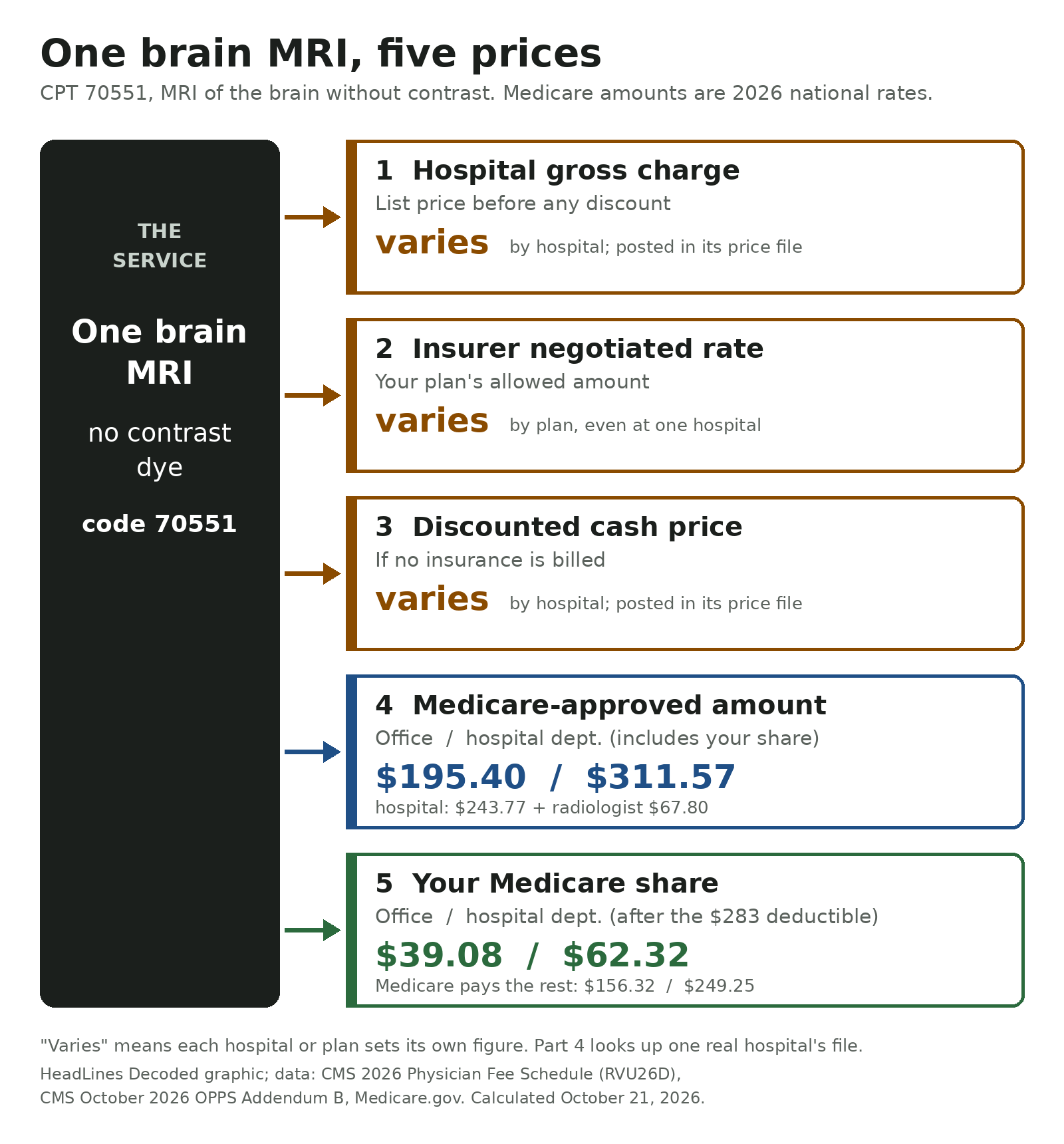
Medicare’s prices are public and set by formula. A doctor’s payment under the Medicare Physician Fee Schedule is a number of points, called relative value units, multiplied by a dollar figure CMS sets each year, called the conversion factor. In the 2026 fee schedule file CMS released on August 26, 2026, the conversion factor for most doctors is $33.4009. A brain MRI done in an office carries 5.85 points, which covers both taking the pictures and the radiologist’s reading of them, and 5.85 times $33.4009 comes to $195.40.
If the same scan is done in a hospital’s outpatient department, Medicare approves two amounts, one for the hospital and one for the radiologist. The hospital’s share comes from a separate CMS price list for outpatient departments, the Outpatient Prospective Payment System, which puts this scan in payment group 5523. CMS’s October 2026 rate file lists that group at $243.77. The radiologist then bills only for reading the images, which carries 2.03 points, or $67.80. Together Medicare approves $311.57.
Subtract the office amount from the hospital amount and the gap is $116.17. For the same code, under the same 2026 national rates, Medicare’s approved amount is 59.5 percent higher when the scan is done at a hospital. These are national base amounts. Medicare adjusts both for local wages and costs, so the dollars in your county will be different, but the gap between the two settings comes from the rules shown here.
Your share follows the same split. Under Original Medicare, the government-run plan, you first pay the Part B deductible, $283 in 2026, and after that Medicare.gov says you generally pay 20 percent of the Medicare-approved amount. If you have a Medicare Advantage plan, your plan sets your share instead. On the office scan your 20 percent is $39.08, and Medicare pays the other $156.32.
At the hospital you owe a copayment, a set dollar amount, which the rate file lists at $48.76 for this scan, plus a fifth of the radiologist’s $67.80, which is $13.56, for a total of $62.32. Medicare pays the remaining $249.25. Medicare.gov adds that a hospital copayment can run higher than that 20 percent, but in most cases it can’t be more than the Part A hospital stay deductible, which is $1,736 in 2026 and is what you pay before Medicare covers a hospital stay.
When a hospital buys a doctor’s practice or an imaging center, the same scan on the same machine can be billed as a hospital service. Congress limited that for Medicare in section 603 of the Bipartisan Budget Act of 2015. Under that law, an off-campus hospital department gets a reduced rate unless it was already billing Medicare as part of the hospital before November 2, 2015, the day the act was signed. CMS’s 2026 outpatient payment rule says that rate remains 40 percent of the hospital amount. For this MRI the hospital would get $97.51, and with the radiologist’s $67.80 the approved amount would be $165.31, which is below the $195.40 office amount. Departments on a hospital’s main campus still get the full hospital rate, and so do most off-campus departments that were billing before that date, and hospital emergency departments.
Private insurance has no federal rule like that one. Linda J. Blumberg and Christine H. Monahan, writing in Health Affairs Forefront on August 4, 2023, described patients being charged “a hospital facility fee on top of a physician’s fee,” and noted that Connecticut, Indiana and Maine had begun moving to limit those fees. If your plan pays a hospital department for your scan, the hospital’s part can show up on your bill as a line of its own.
The other prices for this scan do not follow Medicare’s formula. The first is the hospital’s gross charge. The federal Hospital Price Transparency rule defines it as the price on the hospital’s master price list, called a chargemaster, “absent any discounts,” and every hospital has to post it. It is the starting number on an itemized bill and often appears as the amount billed on your explanation of benefits, or EOB, the statement your insurer sends after a claim.
The second is the negotiated rate, the price a hospital has agreed to with one insurer for one plan. HealthCare.gov calls the same number your plan’s allowed amount, “the maximum amount a plan will pay for a covered health care service.” It varies from plan to plan even inside one hospital, because each insurer bargains separately. How far above Medicare those rates run is in dispute. A RAND Corporation study led by Christopher M. Whaley found that employers and private insurers paid hospitals, on average, about two and a half times what Medicare would have paid for the same care in 2022, or 254 percent of Medicare’s rates. The American Hospital Association rejected it. Molly Smith, the association’s group vice president for public policy, said measuring against Medicare was “an apples-to-oranges comparison” and said RAND’s data “still represents less than 2% of overall hospital spending,” a way of saying the study covers a small slice of what hospitals are paid.
The third is the discounted cash price, which the same rule defines as the charge for someone who pays cash for a hospital service. Hospitals must post it in the same file as their negotiated rates. Whether it is lower than a given insurer’s rate depends on the hospital and the plan, and Part 4 of this series (Story coming Wed, Oct 28 at 9:00 AM) checks one real hospital’s posted file to see.
The last is your share: the deductible, any copay or coinsurance, plus anything your plan does not cover. Coinsurance is a percentage of the allowed amount. With private insurance your share is figured from the allowed amount if you use a doctor or hospital that has a contract with your plan. HealthCare.gov says such a preferred provider “may not balance bill you for covered services,” meaning it cannot bill you for the difference between its full charge and the allowed amount. Part 2 walked through how a deductible and coinsurance add up over a year for a family comparing two plans.
Insurers’ rates are public but scattered. They are posted hospital by hospital and plan by plan, so no single file shows what your insurer pays for this scan near you. On October 5, 2026, a Transparency in Coverage fact sheet from CMS and the Labor and Treasury departments said insurers’ own price files have been hard to use because they are very large and do not line up well with the hospital files.
What drove U.S. health spending growth in 2024
CMS does split national growth into prices and everything else. In its National Health Expenditures 2024 Highlights, released in December 2025, the agency says spending growth in 2023 and 2024 “was primarily fueled by non-price factors,” which it describes as growing demand for care and shifts in the kinds of goods and services people used. Hospital spending grew 8.9 percent in 2024 while hospital prices rose 3.4 percent, the fastest price increase since 2007 and up from 2.7 percent in 2023. Spending at doctors’ offices and clinics grew 8.1 percent while their prices rose 1.8 percent. Retail drug spending grew 7.9 percent, with prices up 1.4 percent.
Which number am I looking at?
Seven yes-or-no questions will usually tell you what kind of number is on a bill or in the news. Start at the top and stop at the first yes.
| Ask this | If yes, you are looking at | Where it usually shows up |
|---|---|---|
| 1. Is it in billions or trillions, for the whole country or a whole program? | National spending figure | News stories and CMS reports |
| 2. Does it say Medicare approved? | Medicare-approved amount, the full Medicare rate with your share included | Your Medicare Summary Notice, the statement Medicare mails you listing your claims |
| 3. Does it say Medicare paid? | What Medicare itself paid, after your share is taken out | Your Medicare Summary Notice |
| 4. Is it a price offered because no insurance is being billed? | Cash price | A hospital’s price file or a written quote |
| 5. Is it the full price before any discount, often called amount billed or charges? | Charge | An itemized bill, or the amount billed line on your EOB |
| 6. Does it say allowed amount or negotiated rate? | Allowed amount, the price your plan agreed to | Your EOB |
| 7. Does it say you may owe or patient responsibility? | Your share: deductible, copay, coinsurance or uncovered costs | Your EOB and the provider’s bill |
The question that matters most on an MRI comes before the scan: will this place bill as a physician’s practice or as a hospital? The answer decides which Medicare amount applies, $195.40 in an office, $311.57 in a hospital department or $165.31 in a newer off-campus one, and with a private plan it decides whether a separate hospital charge can appear. The person who schedules the scan can tell you. Afterward, the line to check on your Medicare Summary Notice or EOB is the approved or allowed amount.
About this information. This article explains how health care costs and coverage rules work. It is general information. Nothing here is medical, insurance, legal, tax or financial advice. We do not recommend any plan or product. Prices and rules change, so check any figure with the source named here, your plan or a licensed professional before you make a decision. No insurer, hospital, drug company or health plan named in this article paid for it or reviewed it before publication.
- NHE Fact Sheet (page modified June 24, 2026) · Centers for Medicare & Medicaid Services
- National Health Expenditures 2024 Highlights (December 2025) · Centers for Medicare & Medicaid Services
- RVU26D, 2026 Physician Fee Schedule relative value file, October release (August 26, 2026) · Centers for Medicare & Medicaid Services
- October 2026 OPPS Addendum B (file dated October 14, 2026) · Centers for Medicare & Medicaid Services
- CY 2026 Hospital Outpatient Prospective Payment System final rule, CMS-1834-FC (Federal Register, November 25, 2025) · Centers for Medicare & Medicaid Services
- 42 U.S.C. 1395l(t)(21), off-campus outpatient departments (section 603, Bipartisan Budget Act of 2015) · Legal Information Institute, Cornell Law School
- 2026 Medicare Parts A and B Premiums and Deductibles (November 14, 2025) · Centers for Medicare & Medicaid Services
- Diagnostic non-laboratory tests: what you pay · Medicare.gov
- 45 CFR 180.20, hospital price transparency definitions · Legal Information Institute, Cornell Law School
- 45 CFR 180.50, requirements for the machine-readable standard charge file · Legal Information Institute, Cornell Law School
- Allowed amount (glossary) · HealthCare.gov
- Balance billing (glossary) · HealthCare.gov
- Prices Paid to Hospitals by Private Health Plans: Findings from Round 5 (revised December 10, 2024) · RAND Corporation
- AHA Statement on RAND 5.0 Hospital Pricing Study (May 13, 2024) · American Hospital Association
- Facility Fees 101: What Is All the Fuss About? (August 4, 2023) · Health Affairs Forefront
- Transparency in Coverage final rules, CMS-9882-F (October 5, 2026) · Centers for Medicare & Medicaid Services
- Further reading from HeadLines Decoded: Insurers Say They ‘Can’t Afford’ Ozempic and Zepbound
E.G. v4.18 · I.R.G. v1.14 · L.R.G. v1.9 · P.L.G. v1.10
Produced under the HeadLines Decoded Editorial, Image & Rights, Legal & Risk, and Production & Layout guidelines at the versions shown.
Editor written. AI used for spelling and grammar only.