The Education Department does not run your kid’s school
Federal money has usually covered less than a tenth of public school revenue. Since March 2025, other agencies have taken over much of the department's daily work, and Congress has kept funding it.
 Todd Ruffner-Schoenfeld
Editor in chief. A knack for the fine print, and likes it.
Todd Ruffner-Schoenfeld
Editor in chief. A knack for the fine print, and likes it.
If you have a child in public school, your school district and your state hired the principal and picked the reading books. The U.S. Department of Education did none of that. The 1979 law that created it bars the department from controlling what schools teach or whom they hire.
What the department does is narrower, and for a lot of families it is more personal. It sends federal money to schools that teach poor children and children with disabilities. Its biggest jobs are the Pell Grant, which is college aid for low-income students that does not have to be paid back, and the federal student loan program, which makes the department the lender for about 42 million people. Its Office for Civil Rights rules on discrimination complaints at schools and colleges, and the department also keeps the national statistics, including the test known as the Nation’s Report Card.
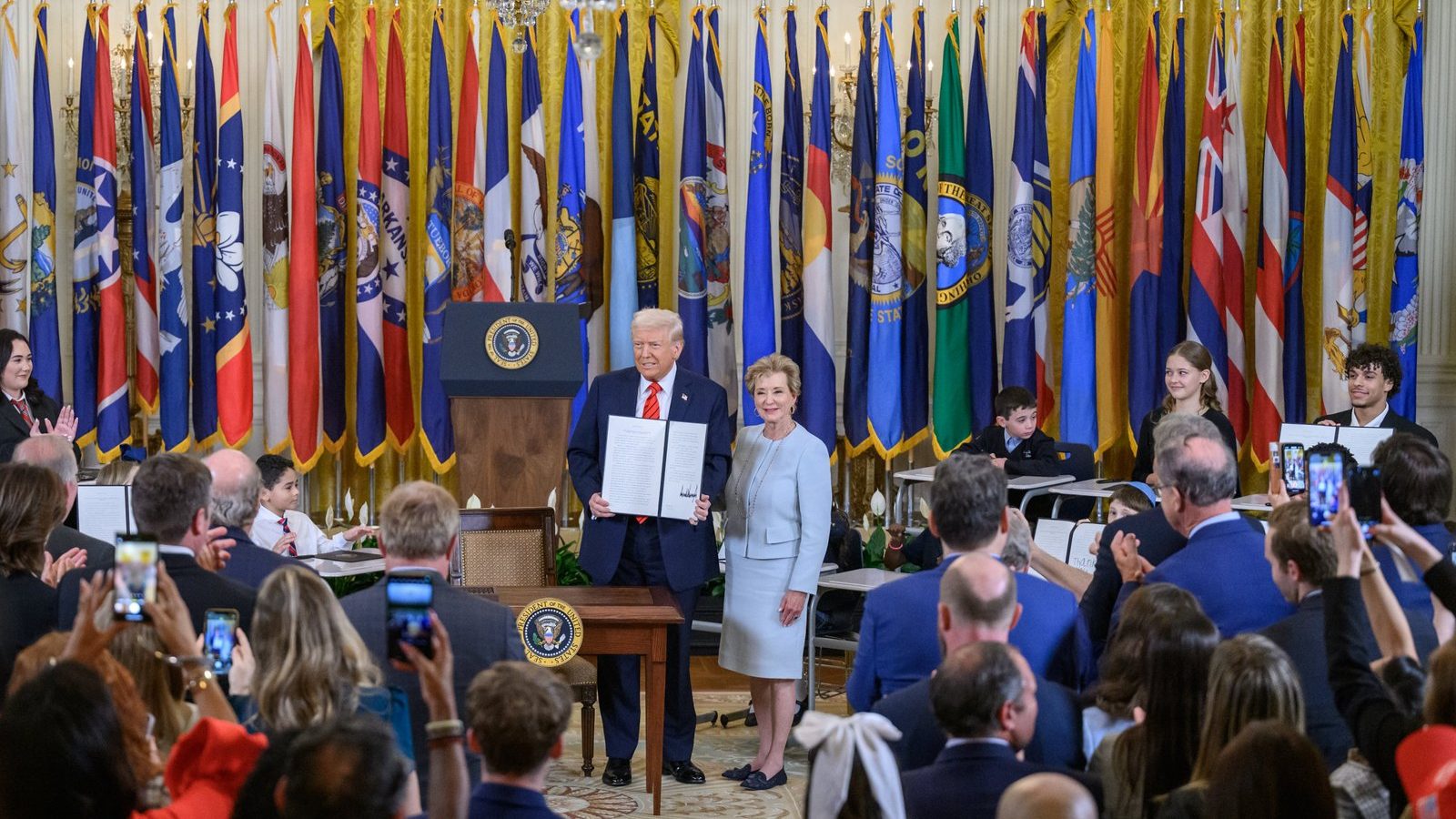
In March 2025, President Trump told Education Secretary Linda McMahon to start closing the department as far as the law allows. Only Congress can abolish a Cabinet department, and it has not. So the department’s work is being handed to other agencies one piece at a time, while Congress keeps paying for almost all of it.
The money
Federal money pays for only a small part of public schools. Before the pandemic it was 7.6 percent of public elementary and secondary school revenue, according to the National Center for Education Statistics. Pandemic relief pushed it to 11.7 percent in the 2023-24 school year, the latest count, and that relief money has since run out. Your state and your local property taxes pay for the rest. College is different. There, Washington is the country’s main student lender.
The biggest federal check for public schools is Title I, which goes to districts that teach children from low-income families. Congress set it at about $18.4 billion in the spending law Mr. Trump signed in February. The National Education Association, the big teachers union, says nearly nine in ten school districts get some of it, and they usually spend it on things like extra reading help and tutoring.
The second is special education. The Individuals with Disabilities Education Act, known as IDEA, guarantees a child with a disability a free public education and a written plan for it, called an IEP. Under it, Washington sends the states about $14.2 billion a year. When Congress passed the original law in 1975, it promised to pay, for every child in special education, 40 percent of the average cost of educating a student. It now pays about 10 percent of that average cost, a quarter of what it promised, according to the Congressional Research Service. States and districts cover the rest.
On the college side, the top Pell award is $7,395 a year. Mr. Trump’s budget request for fiscal 2026, the budget year that ends Sept. 30, proposed cutting it to about $5,700, and Congress kept it at $7,395. The department also holds the federal student loans themselves: about 42.3 million borrowers owing more than $1.7 trillion, by its own count through June 30.
The department’s civil-rights office decides the disability complaints parents file when a school will not follow a child’s plan, along with complaints about race and sex discrimination. The department can hold back federal money from a school or college that refuses to comply.
How the job grew
Congress created the department in 1979 by carving it out of the old Department of Health, Education, and Welfare, and it opened in May 1980. For its first decade it was mostly a grant office. Student loans then were made by private banks, and Washington guaranteed that they would be repaid. A Senate investigation led by Sen. Sam Nunn of Georgia reported in 1991 that the guaranteed loan program was full of fraud and abuse, much of it at for-profit trade schools, and that the department’s oversight had failed.
Two years later Congress let the government lend the money itself, which it called direct lending. In 2010 it cut the banks out of new federal student loans altogether, so the department now makes all of them.
For public schools, the big change came in January 2002. No Child Left Behind, a law both parties backed, passed the House 381 to 41 and the Senate 87 to 10, and President George W. Bush signed it. It required states to test students every year in grades 3 through 8 and once in high school. Schools that got Title I money had to meet higher test-score targets every year, which the law called “adequate yearly progress.” Schools that missed them faced penalties. The tests were state tests, but for many parents this was the first time Washington seemed to be inside the classroom.
In December 2015, President Barack Obama signed the Every Student Succeeds Act, which kept the yearly tests and gave states back the job of deciding what counts as a good school. It is still the law today.
In the 2020s the fights moved to college debt and civil rights. The Supreme Court struck down President Joe Biden’s main loan cancellation plan in June 2023. In December 2023, the department launched a simpler FAFSA, the free federal aid application, as Congress had ordered. It came out about three months late and then had months of processing errors, so many families waited a long time for their college aid offers.
In July 2025, Mr. Trump signed the budget law known as the One Big Beautiful Bill Act. It ended Grad PLUS loans, which had let graduate students borrow up to the full cost of their program, for new borrowers starting on July 1, 2026. It also capped what graduate students and parents can borrow and started a new repayment plan on that same date.
The civil-rights office changed direction with each president. Title IX is the 1972 law that bans sex discrimination in schools and colleges that take federal money. Under Mr. Biden, the department wrote a 2024 Title IX rule that extended the law to cover gender identity, and Chief U.S. District Judge Danny Reeves in Kentucky threw it out in January 2025. Under Mr. Trump, the department has opened investigations into school districts over transgender students’ use of bathrooms and locker rooms and their places on girls’ teams, and into colleges over antisemitism. In August 2025 it put the Alexandria, Arlington, Fairfax, Loudoun and Prince William County school districts in Northern Virginia on high-risk status over their bathroom and locker room policies, which meant they had to spend their own money first and ask Washington to pay them back.
The closure order
On March 20, 2025, Mr. Trump signed an executive order telling Ms. McMahon, “to the maximum extent appropriate and permitted by law,” to “facilitate the closure of the Department of Education” while keeping its services running. The staff went from about 4,100 people to about 2,200 after layoffs and buyouts that spring, and the Supreme Court let the layoffs go ahead in July 2025.
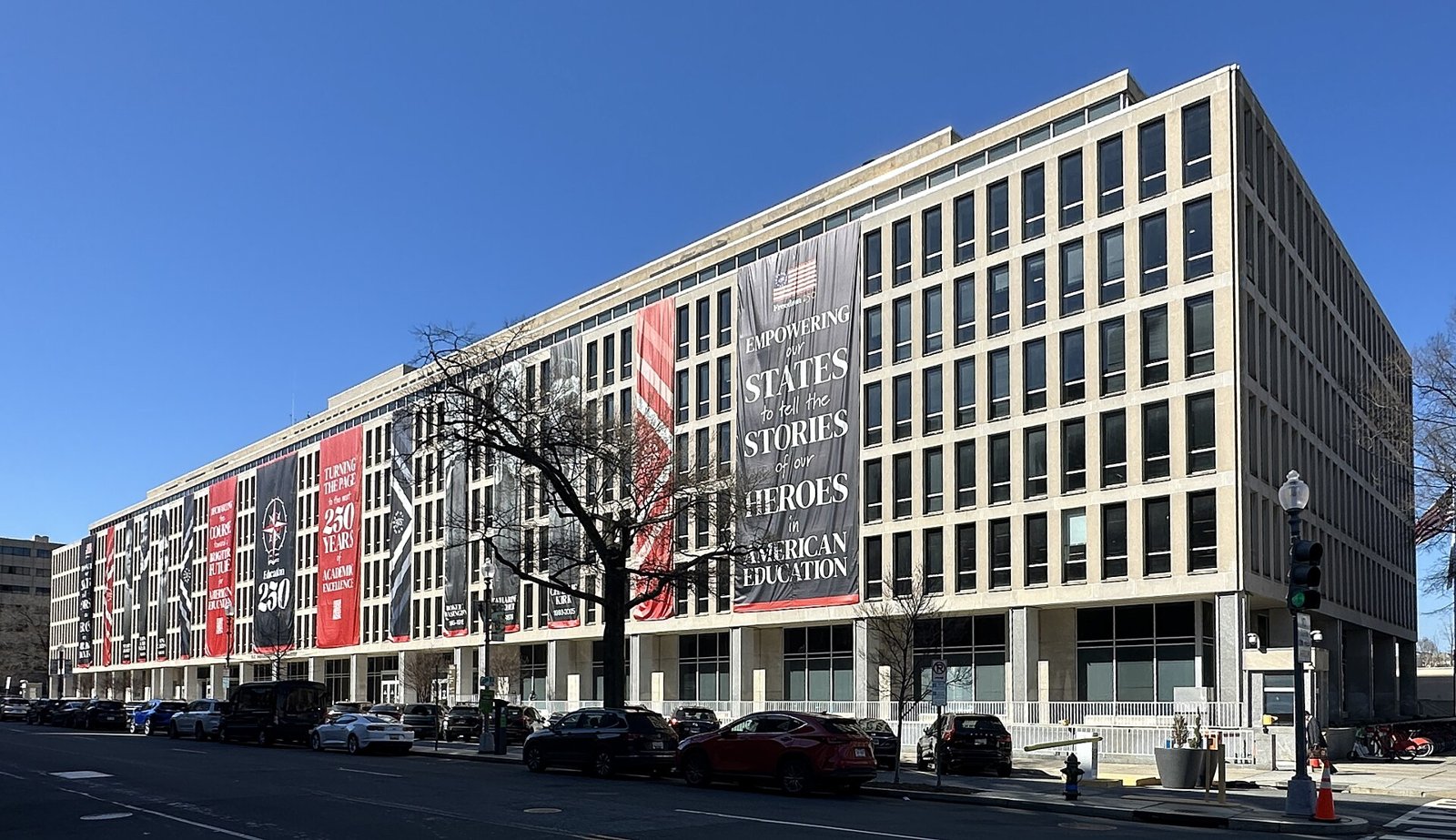
Since then the department has signed 14 agreements with six other agencies, covering at least 148 programs by Education Week’s count in June. Under them, another agency’s employees do the day-to-day work, while the Education Department keeps the legal responsibility and the final decision on awards and enforcement, the Congressional Research Service found. The biggest pieces are in the table below.
Some of the cuts have been walked back. The department called laid-off civil-rights lawyers back to work in December 2025 to deal with a pile of unanswered complaints. The Government Accountability Office put the cost of laying off those staff and then reversing it at $28.5 million to $38 million. Federal Student Aid, the office that runs Pell and the loans, shrank from 1,440 employees to 731 and said in May that it planned to hire about 380 people, NPR reported.
Congress so far
Bills to abolish the department, including a one-sentence bill from Rep. Thomas Massie of Kentucky and a Senate bill from Sen. Mike Rounds of South Dakota, have not passed either chamber.
For fiscal 2026, Mr. Trump asked Congress for $66.7 billion for the department’s regular spending, a 15 percent cut. Congress passed about $79 billion instead, about $217 million more than the year before, and he signed it on Feb. 3. Title I, special education, the maximum Pell Grant and work-study all stayed close to their old levels. Work-study pays part of the wages for students’ part-time campus jobs. A stopgap law signed on Sept. 2 keeps the money flowing at the same level into the new budget year, which starts Oct. 1, through Dec. 11.
Some members of Congress are pushing back on the transfers themselves. On July 30, the Senate Health, Education, Labor and Pensions Committee voted 13 to 9 for a bill from Sen. Tim Kaine, a Virginia Democrat, and Sen. Susan Collins, a Maine Republican, that would cancel four of the agreements, covering K-12 grants, college grants, special education and Indian education. The committee’s chairman, Sen. Bill Cassidy, a Louisiana Republican, voted no, saying the administration should be allowed to try the agreements out. Ms. McMahon wrote to Congress defending all 14. The bill still needs votes in the full Senate and the House.
Two lawsuits argue the transfers are illegal. One comes from 21 states led by New York, plus the District of Columbia. The other comes from the school district in Somerville, Mass., and others. Both are waiting for a ruling from U.S. District Judge Myong Joun in Boston.
The case for closing it
Conservatives start with who should run schools. They argue, as Lindsey Burke did in the education chapter of the Heritage Foundation’s Project 2025 plan, that states and parents should decide, and that a Cabinet department in Washington adds cost and paperwork without better results. They point to the FAFSA failure as proof that the department struggles to run its biggest system, and to civil-rights enforcement as a place where each new president pushes his own agenda onto the country’s schools.
Mr. Trump has said closing the department would return education to the states, and his order’s title speaks of empowering states. He cannot do that on his own. Title I, IDEA and Pell Grants are all set by laws Congress passed. Unless Congress repeals those laws, the money and its rules still come from Washington, and the agreements with other agencies only change which one sends it.
Some of the harshest criticism of how Mr. Trump is handling the closure comes from people who want the department abolished. Joe Lancaster wrote in Reason, the libertarian magazine, on Sept. 8 that Mr. Trump signed a budget $12 billion bigger than he asked for and never pushed Congress to pass an abolition law. Mr. Lancaster also argued that the department is using its civil-rights power more aggressively than before, pointing to a Title IX case against Jeffco Public Schools in Jefferson County, Colo., over transgender students. The department said the district had as many as 61 boys on the rosters of girls’ teams. The district says those names belonged to people who were not players, such as trainers and mascots, and it sued the department in July to keep about $50 million in federal money.
What defenders worry about
Defenders of the department, including the NEA and Mr. Kaine, mostly worry about what happens to the programs. For a child with an IEP or a school full of poor children, the money from those programs pays for services the district could not otherwise afford. They say the agencies taking over are new to school grants, and the Education Department has about half its old staff to watch them. That could mean slower grant payments and longer waits on complaints. Ms. McMahon has answered that the agreements “have demonstrated measurable results by driving stronger grant competitions.” The worry reaches past Democrats: Ms. Collins, a Republican, co-wrote the Senate bill to undo some of the transfers.
If your family uses these programs
Your school’s Title I money still reaches the district through your state, and the district still decides how to spend it. Your child’s rights under IDEA come from the law itself, which has not changed.
For college, the top Pell Grant stays at $7,395 for the 2026-27 school year. The new borrowing caps and the end of Grad PLUS apply to loans taken out on or after July 1, 2026. Students who had already borrowed for their current program before that date can keep borrowing under the old limits for up to three years. Loans you already have keep their balances and interest rates, but some borrowers have to switch repayment plans. The biggest group is the roughly 7.5 million people on SAVE, a Biden-era income-based plan that the 8th U.S. Circuit Court of Appeals blocked. On July 1, their loan servicers began sending notices telling them to pick a new plan within 90 days or be moved into one automatically.
If you file a civil-rights complaint against a school, including a disability complaint, Justice Department lawyers now do the investigating, though the final decision stays with the Education Department. The department’s yearly budget is set only through Dec. 11, so Congress has to pass another spending bill in the weeks after the Nov. 3 election. Under the department’s own shutdown plan, Pell Grants and federal student loans keep going out even if that deadline passes.
- 20 U.S. Code 3403(b), the limit in the Department of Education Organization Act on federal control of curriculum, instruction and staff. Cornell LII.
- Executive Order 14242, “Improving Education Outcomes by Empowering Parents, States, and Communities,” March 20, 2025. Federal Register.
- National Center for Education Statistics, public school revenues and expenditures, FY2024 First Look (May 2026), and Digest table 235.20 for 2019-20. NCES.
- Congressional Research Service, R44624, IDEA Part B funding and the 40 percent authorization, February 2026. CRS via EveryCRSReport.
- Federal Student Aid, FSA Data Center portfolio update through June 30, 2026, posted Sept. 22, 2026; 2026-27 Pell maximum, Jan. 30, 2026. FSA Partners.
- Education Department, plan for the 7.5 million borrowers in the SAVE plan, with servicer notices starting July 1, announced March 27, 2026. ed.gov.
- U.S. Department of Labor, Labor-Education partnerships for elementary, secondary and postsecondary programs, Nov. 18, 2025. dol.gov.
- K-12 Dive on the Senate committee vote, Sen. Bill Cassidy’s objection and Secretary McMahon’s letter defending the 14 agreements, July 30, 2026. K-12 Dive.
- Civil Rights Litigation Clearinghouse, New York v. McMahon, D. Mass., Judge Myong J. Joun. Clearinghouse.
- Harvard Student Financial Services summary of the One Big Beautiful Bill Act student-loan changes effective July 1, 2026 (P.L. 119-21, signed July 4, 2025). Harvard SFS.
- K-12 Dive on the interagency agreements and the Education Week count of 14 agreements covering at least 148 programs. K-12 Dive.
- H.R. 899 (Rep. Thomas Massie) and S. 1402 (Sen. Mike Rounds), bills to abolish the Education Department. Congress.gov.
- Civil Rights Litigation Clearinghouse, Somerville Public Schools v. Trump, D. Mass. Clearinghouse.
- NASFAA on the Education Department shutdown contingency plan: Pell Grants and Direct Loans continue to be disbursed during a lapse. NASFAA.
- History.com on the Jan. 8, 2002 signing of No Child Left Behind, and Education Week, “No Child Left Behind: An Overview,” with the House and Senate votes. Education Week.
- Federal Student Aid, GEN-10-05, on the 2010 law ending new bank-made federal loans, and CRS R41127 on direct lending since 1993. FSA Partners.
- Education Department, Every Student Succeeds Act, signed Dec. 10, 2015. ed.gov.
- Supreme Court, Biden v. Nebraska, June 30, 2023. supremecourt.gov.
- NPR on the GAO review of the delayed 2024-25 FAFSA launch, Sept. 24, 2024. NPR.
- K-12 Dive on the Supreme Court order and the Education Department staff cut from about 4,133 to about 2,183. K-12 Dive.
- McGuireWoods on the six interagency agreements of Nov. 18, 2025 (Labor, Interior, HHS, State). McGuireWoods.
- Education Department, partnerships announced Feb. 23, 2026, moving college foreign-gift reporting to State and school-safety programs to HHS. ed.gov.
- Lindsey M. Burke, “Department of Education,” chapter 11 of the Heritage Foundation’s Project 2025 “Mandate for Leadership.” Inside Higher Ed copy.
- Chalkbeat on Jeffco Public Schools suing the Trump administration over its Title IX finding, July 29, 2026. Chalkbeat.
- National Education Association on the share of districts receiving Title I. NEA.
- Congressional Research Service, LSB11392, on the interagency agreements and what the Education Department keeps. CRS via EveryCRSReport.
- Education Department and Treasury Department, student aid partnership announcement, March 19, 2026. ed.gov.
- Higher Ed Dive on moving civil-rights complaint investigations to the Justice Department, June 2026. Higher Ed Dive.
- Supreme Court order in McMahon v. New York, July 14, 2025. supremecourt.gov.
- NPR on Federal Student Aid staffing and hiring plans, May 21, 2026. NPR.
- Government Accountability Office, GAO-26-108320, on the cost of the civil-rights office layoffs and their reversal. GAO.
- H.R. 7148, Consolidated Appropriations Act, 2026, signed Feb. 3, 2026. GovTrack.
- White House, H.R. 6500, the stopgap funding law signed Sept. 2, 2026. White House.
- NPR on the fiscal 2026 budget request and the proposed Pell cut, June 2, 2025. NPR.
- Joe Lancaster, “Trump Is Weaponizing the Department of Education After Pledging To Kill It,” Reason, Sept. 8, 2026. Reason.
- Education Week on the five Northern Virginia districts placed on restricted funding status, August 2025. Education Week.
- Chalkbeat on Chief U.S. District Judge Danny Reeves vacating the 2024 Title IX rule, Jan. 10, 2025. Chalkbeat.
- The Century Foundation on the 1991 Senate Permanent Subcommittee on Investigations report on student-loan abuse. TCF.
- Brookings, “FAQs: Checking in on the Department of Education,” Feb. 20, 2026. Brookings.