Three governments announced a Greenland deal. Only one calls it control.
President Trump says the agreement hands the United States permanent control over security in Greenland, forever and at no cost. Denmark and Greenland say it protects Danish sovereignty and the Greenlandic right to self-determination. Nothing has been signed, no text has been published, and two parliaments still have to vote.
 Todd Ruffner-Schoenfeld
Editor in chief. A knack for the fine print, and likes it.
Todd Ruffner-Schoenfeld
Editor in chief. A knack for the fine print, and likes it.
What Greenland is
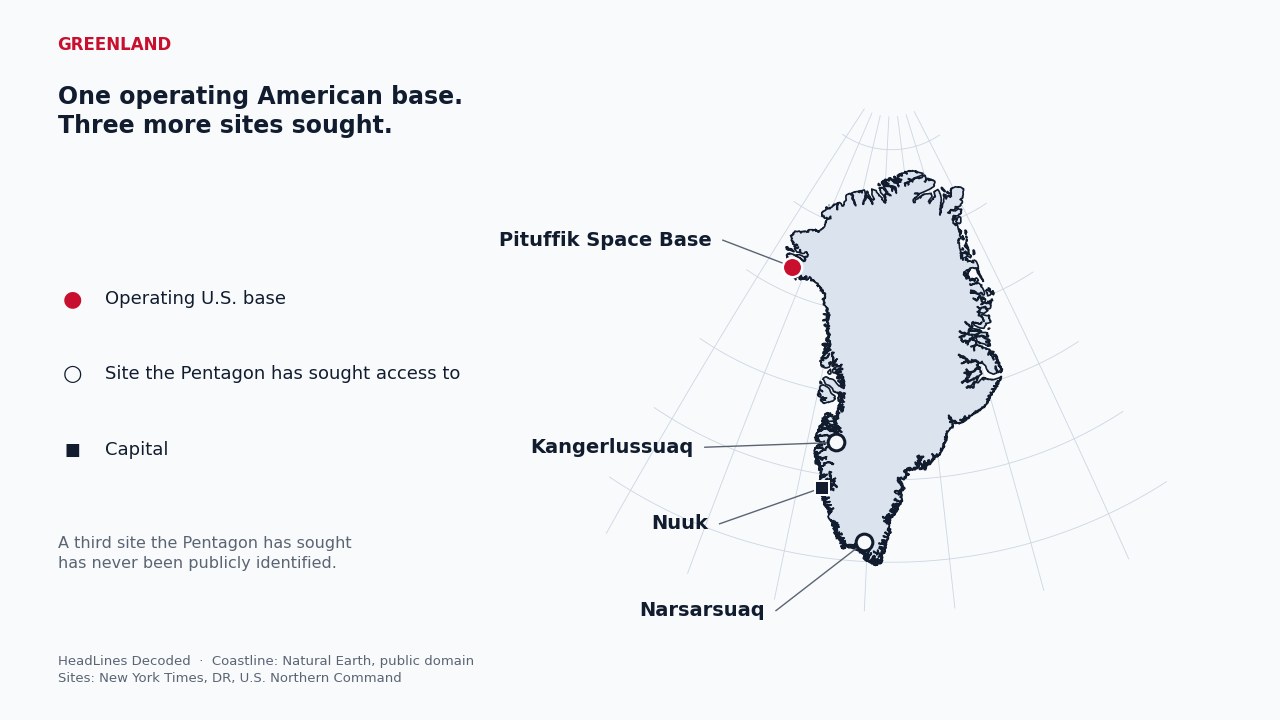
Greenland is the largest island in the world and one of the emptiest, with about 56,700 people, roughly a third of them in the capital, Nuuk, on the southwest coast.
Greenland is neither a Danish province nor an independent state. Since 2009 it has governed itself under the Act on Greenland Self-Government, which hands Nuuk its own domestic affairs, including its mineral resources, and leaves a short list with Copenhagen: the constitution, citizenship, the Supreme Court, the currency, and foreign, defence and security policy. Greenlanders hold Danish passports, which makes them European Union citizens, although Greenland itself voted in 1982 to leave the European Community, the EU’s predecessor, and left in 1985. A Danish block grant of about 4.3 billion kroner a year, roughly 670 million dollars, covers a little over half of what Greenland’s government spends. The 2009 act also sets out how Greenland could leave the kingdom altogether. Greenlanders take that decision first. Copenhagen and Nuuk then negotiate the terms of the separation, and the agreement they reach has to win a referendum in Greenland and a vote in the Danish parliament.
Greenland’s own government is Naalakkersuisut, its cabinet, and its 31-seat parliament is Inatsisartut. Nuuk has a minister for foreign affairs who speaks for Greenland on the matters Greenland controls. The power to sign a defence treaty is not one of them. It sits in Copenhagen.
All three governments say they will sign. What legal weight Greenland’s signature carries next to Denmark’s is one more thing the text would show.
How it became Danish, and how often America has asked
Norse settlers from Iceland reached southwest Greenland in the 980s and farmed there for four centuries before the colony died out; the last written record of them is a wedding at Hvalsey church in 1408. In 1261 those Norse Greenlanders had accepted the overlordship of the king of Norway, and when Norway entered its long union with Denmark from 1380, Greenland went along with the crown. Denmark then lost touch with the island for roughly three hundred years. In 1721 a Norwegian-born Lutheran missionary, Hans Egede, sailed from Bergen to find the lost Norse colonists and bring them back to the faith. He found Inuit instead, and stayed. The settlement his expedition led to, founded in 1728 as Godthab, is the town now called Nuuk.
Then Denmark lost Norway and kept the island. The Treaty of Kiel, signed in January 1814 as the Napoleonic wars wound down, handed Norway to the king of Sweden. Article IV ceded the Norwegian provinces “together with their dependencies (Greenland, the Faroe Isles, and Iceland, excepted).” Greenland is Danish today because of the three names inside those brackets.
Denmark’s claim to all of Greenland took another century to settle. Norway occupied part of the east coast in 1931 and declared it Norwegian territory. Denmark took the dispute to the Permanent Court of International Justice, and in April 1933 the court ruled against Norway by twelve votes to two. Denmark leaned partly on what other powers had already said. In 1916 the U.S. Secretary of State, Robert Lansing, wrote that Washington would not object if Denmark extended its interests to the whole island. He signed that declaration the same day Denmark agreed to sell the Danish West Indies, now the U.S. Virgin Islands, to the United States for 25 million dollars in gold.
Greenland stopped being a colony on June 5, 1953, when a new Danish constitution made it an ordinary Danish county with two seats in parliament. Greenlanders did not vote on that. They did vote on home rule, which arrived in 1979, and on self-government, which arrived in 2009, and both passed by wide margins.
Trump is not the first American to want the island. Secretary of State William Seward looked into buying Greenland and Iceland together in 1867, the year he bought Alaska, and never made an offer. An American ambassador floated a territorial swap in 1910 that went nowhere. In December 1946, Secretary of State James Byrnes put three options to Denmark’s foreign minister in New York, one of them outright purchase; State Department papers had already valued the island at 100 million dollars in gold. The Joint Chiefs of Staff suggested trying again in 1955, and the State Department replied that the time for that approach was long past. Denmark said no to the one that reached it. The United States got its base anyway, under the 1951 Defense of Greenland agreement that remains the legal basis for the American presence there.
Why the United States wants it
Look at a globe. A missile fired from Russia at the United States would not cross the Atlantic. It would go over the pole, and Greenland sits under that path.
Watching for that is the job of Pituffik Space Base, on Greenland’s northwest coast, which was called Thule Air Base until 2023 and is the U.S. Defense Department’s northernmost installation. A U.S. Space Force unit there, the 12th Space Warning Squadron, runs a ballistic missile early warning radar. It was upgraded in 2014, it watches for launches from Russia and from the North Atlantic, and it reaches about 3,000 miles. Greenland is also the G in the GIUK gap, the water between Greenland, Iceland and the United Kingdom that NATO has watched for Russian submarines since the Cold War. Somewhere between 100 and 200 American personnel are stationed at Pituffik today, and published figures vary within that range.
How this got to Friday
Trump has wanted the island since before he took office again. In December 2024 he posted that American “ownership and control of Greenland is an absolute necessity.” At Mar-a-Lago the following month, asked to rule out using military or economic force to get it, he answered, “I’m not going to commit to that.” In March 2025 he told a joint session of Congress the United States would get Greenland “one way or the other.”
Greenlanders gave their answer twice. Verian, a polling firm, surveyed 497 Greenlandic adults for the newspapers Berlingske and Sermitsiaq in late January 2025 and asked whether they wanted to leave Denmark and become part of the United States. Six percent said yes, and 85 percent said no. Six weeks later, in the March 2025 general election, Greenlanders elected Demokraatit, a party that wants Greenland independent from Denmark one day and has never wanted it to join the United States. Its leader, Jens-Frederik Nielsen, became Greenland’s head of government and said so out loud: “We don’t want to be Americans. We want to be Greenlanders.”
In January 2026 the White House tried economic pressure instead. It announced tariffs on eight European countries, Denmark among them, at 10 percent from February and 25 percent from June. Ten days later, at the World Economic Forum in Davos, Trump cancelled those tariffs and said he and NATO Secretary General Mark Rutte had “formed the framework of a future deal with respect to Greenland.” The tariffs were never collected. NATO disputed the rest of it inside a day, with a spokesperson saying Rutte “did not propose any compromise to sovereignty,” and Nielsen noted that nobody had asked Greenland: “I don’t know what is in the agreement or the deal about my country over some discussions I didn’t attend.”
Three-way talks ran quietly from February, according to reporting by the AP and Reuters. Friday was the first time any of the three governments said those talks had produced anything.
Two statements, describing one agreement
Trump’s post said the agreement “gives the United States permanent control over security, and all other needs, in Greenland.” There will be “NO COST to the United States!” he added, and the country would “immediately begin the process of developing a large Military presence in the appropriate part of Greenland.” No American adversary, he went on, can put a base in Greenland, keep troops there, or make sensitive investments there. Any of that would need “our express written approval.” He called it an “Infinite Life” agreement, a phrase of his own, with no end to it. Secretary of State Marco Rubio put out a statement calling the deal a “huge win” and saying it “permanently and completely addresses our national security concerns in Greenland.”
The joint Danish and Greenlandic statement describes that same agreement and makes no such claim. Mette Frederiksen, Denmark’s prime minister, said she was glad “that we are about to make a great agreement.” The agreement, she said, also “recognizes the sovereignty and territorial integrity of the Kingdom and the Greenlandic people’s right to self-determination.” The Kingdom is the formal name for Denmark, Greenland and the Faroe Islands together. Nielsen said the agreement “recognizes Greenland’s interests and our place in the international cooperation.” The statement ends there: “There are no further comments at this time.”
Permanent American control over security and all other needs is a much larger claim than anything Copenhagen and Nuuk have put their names to, and both have stuck to their own wording since.
What the 1951 treaty already allows
The United States and Denmark signed the Defense of Greenland agreement in April 1951, and it is still in force. It set aside particular parcels of the island as defense areas. Inside those, it let Washington build and run installations, control landings and takeoffs, and move ships, aircraft and vehicles, while saying Denmark remains sovereign. It lasts as long as the North Atlantic Treaty, the 1949 treaty that founded NATO.
The Pentagon has been trying to add to it. In April 2026, The New York Times reported that the Pentagon was negotiating with Denmark, under the 1951 agreement, for access to three more sites. It named two: Narsarsuaq in the south and Kangerlussuaq on the west coast, both former American bases handed back decades ago. On Thursday of this week, Denmark’s public broadcaster DR reported that four U.S. service members were out on the runway at Narsarsuaq with surveying equipment. U.S. Northern Command, the command responsible for North America, confirmed that specialists were measuring the airfield and said the work was being done jointly with the Greenlandic and Danish governments.
What officials say is in it
With nothing published, what the public has is a briefing. A State Department official described the terms to reporters on condition of anonymity, and Reuters, The Associated Press, CBS News and NBC News each wrote up a version. Fox News Digital got a second briefing from a senior U.S. official; Fox did not say whether that official was from the State Department. Each version carries a different list.
Two things in that table do not fit what the president said. The officials set out a flat ban on any non-NATO base or troops. Trump announced a ban on adversaries that American approval can lift. On investment, Reuters was told only the United States and its allies may invest at all, while Trump’s post allows an adversary to invest with written American approval. Only the document can say which rule was written.
One term went further than anything the State Department described. The official who briefed Fox said Denmark and Greenland would not have approval authority over new American installations, and that Washington would consult them and then build what it judged it needed. No other outlet has reported that language. Set against the 1951 treaty, it is one of only two terms described this week that Washington did not already hold. The other is the promise that the agreement outlives Greenlandic independence.
No territory changes hands. Every version of the briefing says so, which is the difference between this agreement and the purchase Trump had been describing since 2024. A NATO spokesperson said on Friday that the deal would “help advance security, stability and cooperation in this vital region.”
How much of it is new
Daniel Fried spent years as the State Department’s assistant secretary for Europe and is now at the Atlantic Council, a Washington research institute. Writing for the council, he called the promises to keep adversaries out “welcome assurances but hardly breakthroughs,” because the 1951 agreement already carried the basing rights. Mikkel Runge Olesen, of the Danish Institute for International Studies, made a separate point to Al Jazeera. Shutting out Chinese and Russian bases costs Denmark and Greenland nothing, he said, because both governments had always been against letting them in.
Imran Bayoumi, a former Defense Department policy adviser now at the Atlantic Council, picked out the same term the Fox briefing did. Building bases without Danish or Greenlandic approval would be new, he told Reuters. As for the rest, “it seems that Washington could have achieved a lot of these objectives through diplomacy and dialogue without straining the broader US-NATO relationship.” Richard Weitz is at the NATO Defense College, a NATO-run academy in Rome whose researchers speak for themselves and not for the alliance. He told Al Jazeera that Trump “got pretty much everything he wanted, except formal annexation.”
What is missing
There is no minerals deal. Greenland sits on some of the largest rare earth deposits outside China. Rare earths are the metals that go into magnets, wind turbines and missile guidance, and not one of them has ever been mined in Greenland. Keeping adversaries out of that industry is not the same as handing it to American companies, and what was described on Friday leaves that industry exactly where it was.
There is no price. Trump says the agreement costs the United States nothing, and the same post promises an immediate military build-out. Building bases costs money. The briefings skipped the question of who pays for the construction, and officials have stayed quiet on it since.
What Denmark and Greenland get is the hardest gap to fill. Bloomberg went through the announcement and found a single return for them: the threat of an American takeover goes away. Danish Foreign Minister Lars Lokke Rasmussen said he hoped a binding agreement would end “a period of uncertainty” and respect “the Kingdom’s red lines,” a phrase Copenhagen has used since January to mean international law, territorial integrity and sovereignty. Greenland’s minister for foreign affairs, Mute B. Egede, told the AP the talks had run long enough. “I’m pleased that we finally have an end product within reach. And it’s about time.”
What happens next
Signing is expected Tuesday in New York. The agreement then goes to the Folketing, Denmark’s parliament, and to Inatsisartut in Nuuk. Neither has debated it, and neither has seen a text. By Saturday morning no Danish or Greenlandic politician had come out against the deal. That includes the parties that campaign hardest for independence, the same ones that objected loudly in January when Trump announced a Greenland deal they had not been part of.
When the text is published, two clauses are worth finding. One is about who approves the next base. The other is about whether the agreement survives Greenlandic independence, which the 1951 treaty never had to answer. Most of the rest of what officials described this week, Washington could already do. Those two clauses are where the new part is, and one of them rests on a single anonymous briefing to a single news organisation.
- Joint statement of the Danish Prime Minister’s Office and Naalakkersuisut, September 18, 2026, “Expected agreement on strengthened security in the Arctic and the North Atlantic Area.” Statsministeriet.
- President Trump’s announcement post of September 18, 2026, and Secretary Rubio’s statement, both as carried by CBS News. CBS News.
- The anonymous State Department briefing on terms, written up separately by Reuters, The Associated Press, CBS News and NBC News, and the second briefing given to Fox News Digital, the only account of the approval-authority term. Fox News Digital.
- Act on Greenland Self-Government, Act no. 473 of June 12, 2009, for the division of powers between Copenhagen and Nuuk. Prime Minister’s Office of Denmark. Population as of January 1, 2026, from Statistics Greenland.
- Defense of Greenland agreement, signed April 27, 1951, in force June 8, 1951. Avalon Project, Yale Law School.
- On how Greenland became Danish: the Treaty of Kiel of January 14, 1814, whose Article IV cedes Norway “together with their dependencies (Greenland, the Faroe Isles, and Iceland, excepted)”; the Permanent Court of International Justice judgment of April 5, 1933, which held Norway’s occupation of eastern Greenland unlawful by twelve votes to two. PCIJ judgment.
- Secretary of State Robert Lansing’s declaration of August 4, 1916, that the United States would not object to Denmark extending its interests to the whole of Greenland, issued the day the treaty selling the Danish West Indies was signed. Nordics.info, Aarhus University.
- The meeting of December 14, 1946, at which Secretary of State James Byrnes put three options including outright purchase to Danish Foreign Minister Gustav Rasmussen. The $100 million valuation appears in an internal State Department report of May 1946, not in the record of what Byrnes said. Foreign Relations of the United States.
- Greenland’s strategic position, the polar missile track, the GIUK gap and the state of Arctic shipping. Belfer Center, Harvard Kennedy School. On the rare earth deposits and the absence of any producing rare earth mine, CSIS.
- Polling: Verian for Berlingske and Sermitsiaq, 497 Greenlandic adults, fieldwork January 22 to 26, 2025. Six percent for joining the United States, 85 percent against. Verian.
- Assessments quoted: Daniel Fried and Imran Bayoumi of the Atlantic Council, Mikkel Runge Olesen of the Danish Institute for International Studies, and Richard Weitz of the NATO Defense College. Bayoumi spoke to Reuters. Atlantic Council.
- Bloomberg on what Denmark and Greenland receive in return; Al Jazeera’s explainer on the terms and the 1951 comparison; the NATO spokesperson’s statement of January 22, 2026, that Secretary General Rutte “did not propose any compromise to sovereignty.” Al Jazeera.