They draw the map. You live in the leftover.
I think both parties do this, and the word that matters is power. Pull up a chair. I want to talk about what they get when they pick their voters, and what your town loses when it becomes a leftover on somebody else's map.
 Todd Ruffner-Schoenfeld
Editor in chief. A knack for the fine print, and likes it.
Todd Ruffner-Schoenfeld
Editor in chief. A knack for the fine print, and likes it.
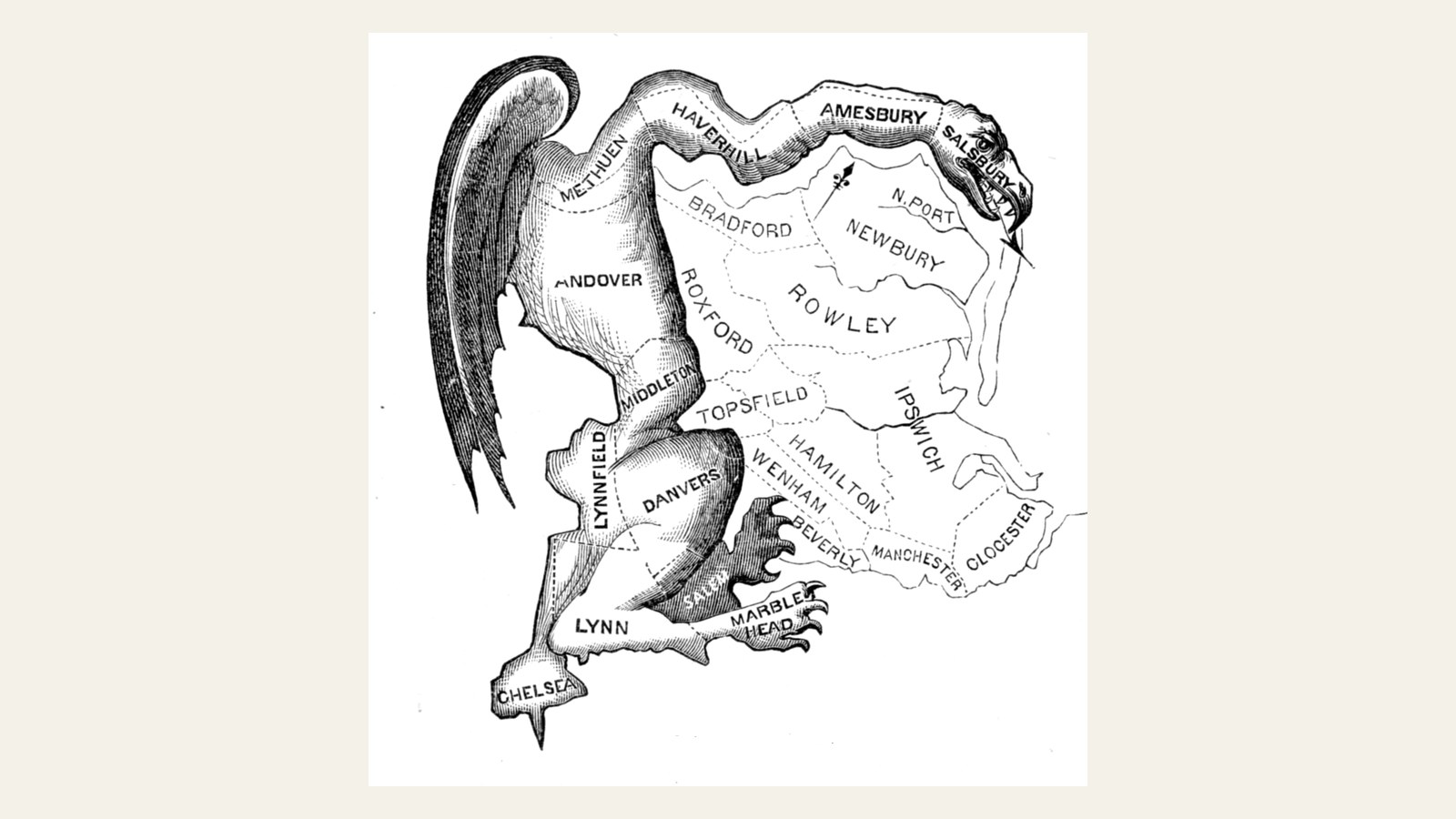
Both teams brought a knife to this one. Republicans used statehouses and court rulings to add safer seats in Texas, Florida, Ohio, and North Carolina, among others. Democrats answered where they could, most of all in California, where voters passed Proposition 50; Virginia tried the same and watched its own supreme court throw the new map out. Analysts spent 2026 arguing over the net, something like ten new Republican-leaning seats if every line holds, with California’s five pushing back the other way. The scoreboard will move again before 2028. The habit will not.
What “power” buys when the lines are yours
Start with the seat itself. A safe district is a job with tenure. Primary voters become the electorate that counts, and the general election turns into a parade. That changes who a member fears. The person who can end a safe career is not the grocer on Main Street; it is the loudest slice of the member’s own party, plus the donors who like a sure thing.
Money follows sure things. Older studies of slanted seats found winners out-raising their challengers many times over. PACs prefer incumbents. Free mailings, paid staff, easy local-news hits, and a name voters already know: all of it compounds once the other party has been packed into a different shape on the map. You do not have to be a cynic to see the loop. Draw a district you cannot lose. Collect the checks that assume you will not lose. Spend those checks reminding people you are inevitable. Repeat after the next census, or sooner if your party has the statehouse and the nerve.
The bigger prizes
The grown-up prizes are committee gavels and the phone call that can move a plant or a highway. A majority in the House is the bigger one. The mid-decade war this cycle exists because a handful of seats is the difference between writing the calendar and watching it. Trump urged Republican states to redraw early so any midterm wave would have to climb a wall. Democrats tried to build one of their own. Both moves are about holding the gavel, and the gavel is appointments, investigations, the budget, and the ability to do nothing while calling it strategy.
At the state level the same game writes the voting rules and the maps for the next decade, and it picks who sits in the room when congressional lines come back. Win the legislature and keep the pen. That is why 2010, and every cycle after it, got treated like a land war. Power is not a mood. It is a pen.
How that thins out your representation
A district is supposed to be a place. A county. A city and the farms that feed it. A coast. A river valley. People who share a hospital, a school board, a flood, a plant closing. When the map is honest, your member has to answer for that place even if the national party wants a different speech.
Gerrymandering breaks the place on purpose, usually with one of two cuts. Packing crams as many of the other party’s voters as possible into as few districts as possible; they get a landslide in one seat and lose everywhere else. Cracking slices a city or a region so thin that no piece is big enough to pick its own person. The downtown gets stapled to three suburbs that vote the other way. The farm county gets stapled to a metro it does not shop in. Everyone still has “a representative.” Almost nobody has a neighbor.
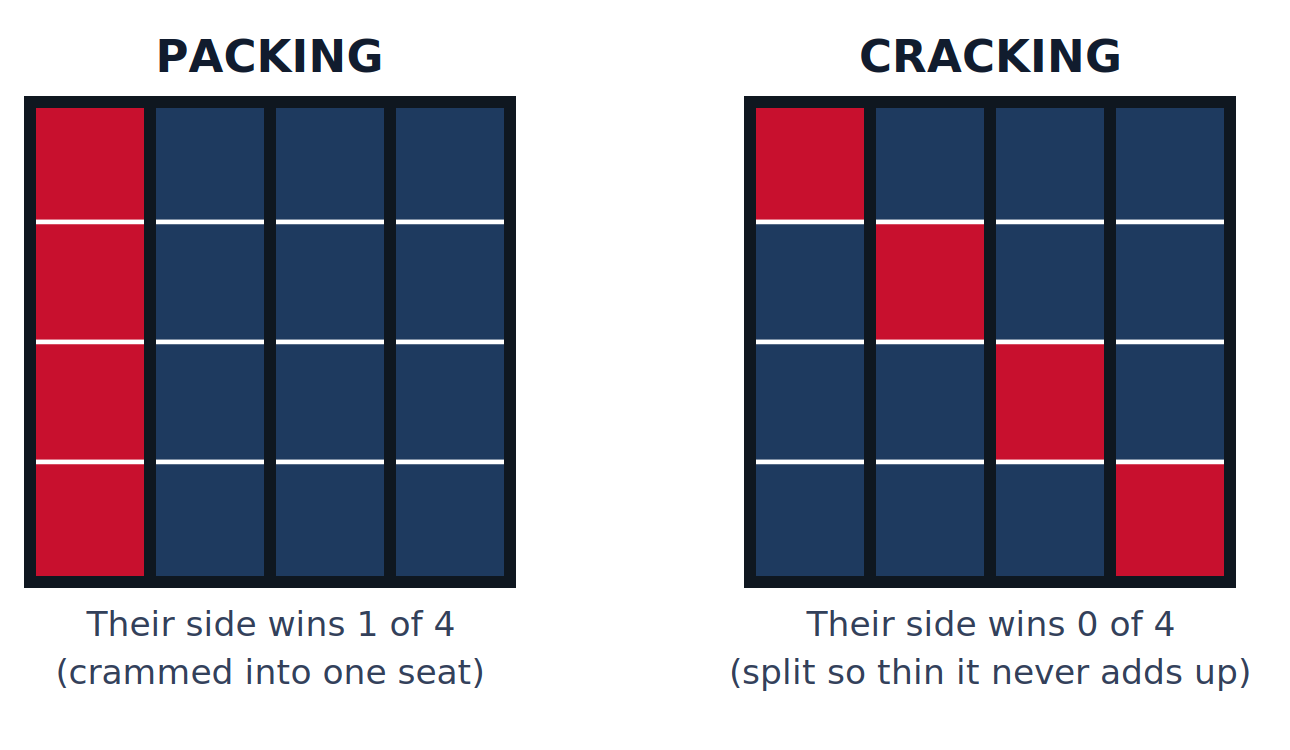
The result is dilution. You still vote, and the vote is real. But the person who wins may spend the term talking to a coalition that does not include your street. Local fights become national brands. A flood bill becomes a loyalty test, and a factory becomes a talking point in a district drawn so the workers who need it cannot assemble a majority. You did not lose the right to speak; you lost the geometry that made speaking matter.
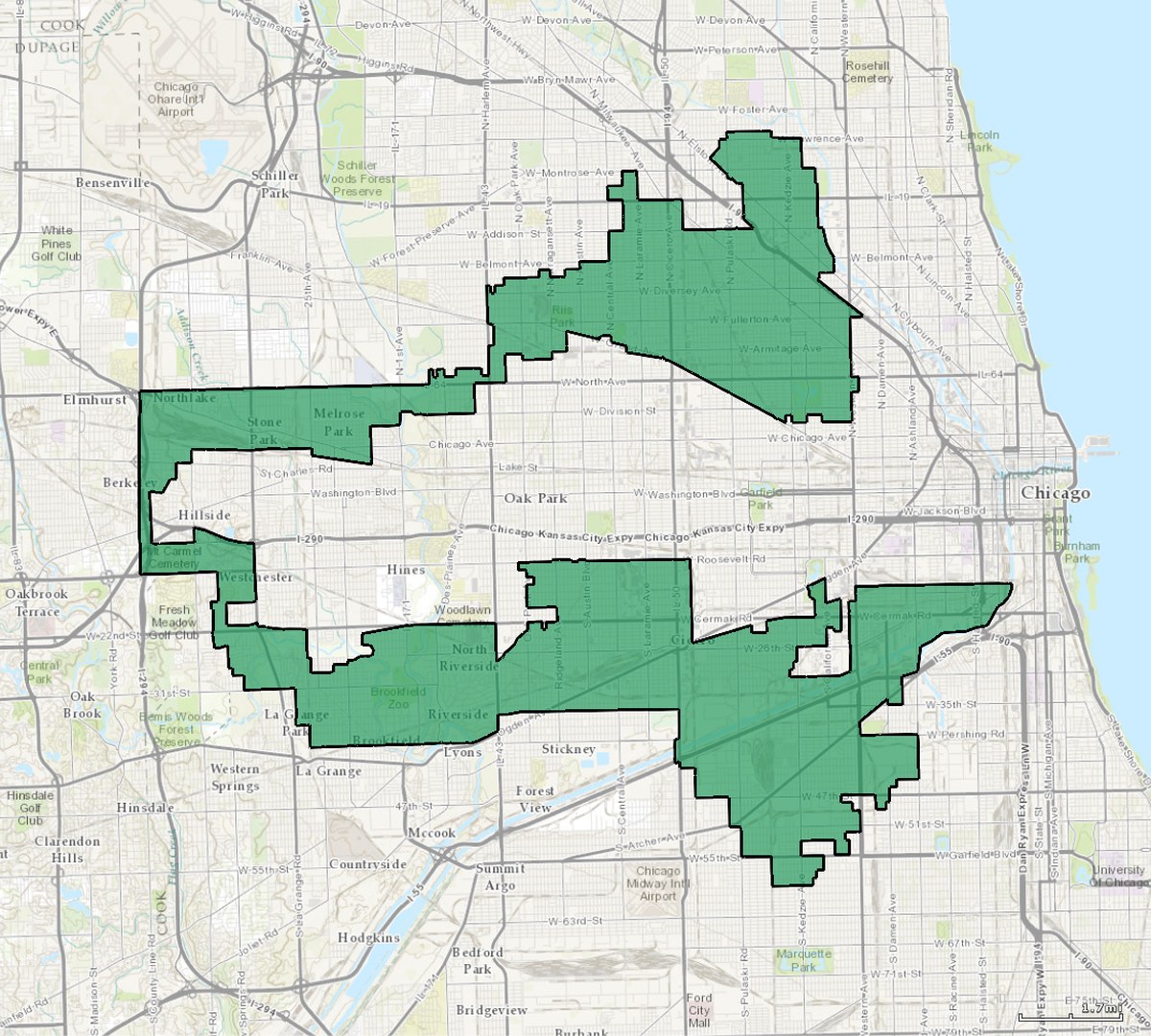
Safe seats also make a member freer to ignore the middle of their own town. The real risk is the primary, not the general. Extreme maps line up with members who sound like their primary voters, because that is the only exam they still have to pass. Americans then say Congress is broken. The map is part of why the room sounds like two radios left on.
Why both sides keep doing it
Because the other side will. That is the grown-up excuse, and it is not fake. Unilateral virtue in a system this tight looks like surrender. The uglier reason is that power feels like survival: careers, staff, the donor list, the chance to make a law instead of a press release. Once you have held the pen, giving it back feels like letting the other team write you out of the next decade.
Courts sometimes interrupt. Independent commissions sometimes interrupt. Voters sometimes pass a reform and then watch the legislature crawl around it. This year’s Supreme Court ruling in Louisiana v. Callais narrowed the Voting Rights Act and changed the Southern math again. I will not relitigate that case here. My point is simpler: the beast adapts. When one tool breaks, the parties pick up another. Mid-decade redraws used to be rare. They are now a tactic, and 2028 is already being sketched.
The plain version is quieter than the cable version. Gerrymandering does not steal your ballot; it just rearranges the room so your ballot is worth less to the person who wins. Politicians get time, money, a calmer general election, and a shot at the gavel. You get a representative whose real constituents may be a party list and a donor file. Both parties will call that democracy when they hold the pen and a crisis when they do not.
If you want a test that does not care about jerseys, ask one question of the next map. Does this line follow a place people actually live, or does it follow a spreadsheet of who somebody needs to win? Places make neighbors. Spreadsheets make power. We have been living in the spreadsheet.
- 2025-2026 mid-decade redistricting: 10 states redrew U.S. House maps (Texas, Florida, Ohio, Missouri, North Carolina, Tennessee, Louisiana, Alabama on the Republican side; California via Proposition 50, plus a Virginia map later struck down by its state supreme court). Roughly two of every five Americans live in a state with new districts; estimates of the Republican net ranged up toward ten seats before California’s five. PBS NewsHour; Cook Political Report; 2025-26 redistricting overview.
- President Trump publicly urged Republican-led states to redraw mid-decade to protect the narrow House majority (summer 2025). PBS NewsHour.
- The Supreme Court’s 2026 ruling in Louisiana v. Callais narrowed Section 2 of the Voting Rights Act and its protection for majority-minority districts, reshaping Southern maps. Congressional Research Service; Harvard Kennedy School.
- Classic mechanics of packing and cracking, and the incumbency and fundraising advantages of safe seats (PAC preference for incumbents; franking, staff, and name recognition as built-in edges). The term traces to Massachusetts Governor Elbridge Gerry and an 1812 salamander-shaped district.
- Why parties fight for statehouses: the legislature holds the pen for congressional maps unless a commission or a court takes it.