Houthis Strike Saudi Tankers in the Red Sea: Two Chokepoints, One Bill for Households
A confirmed strike, a blockade threat, and a second chokepoint under pressure. The transmission from the Red Sea to your fuel bill is not in dispute.

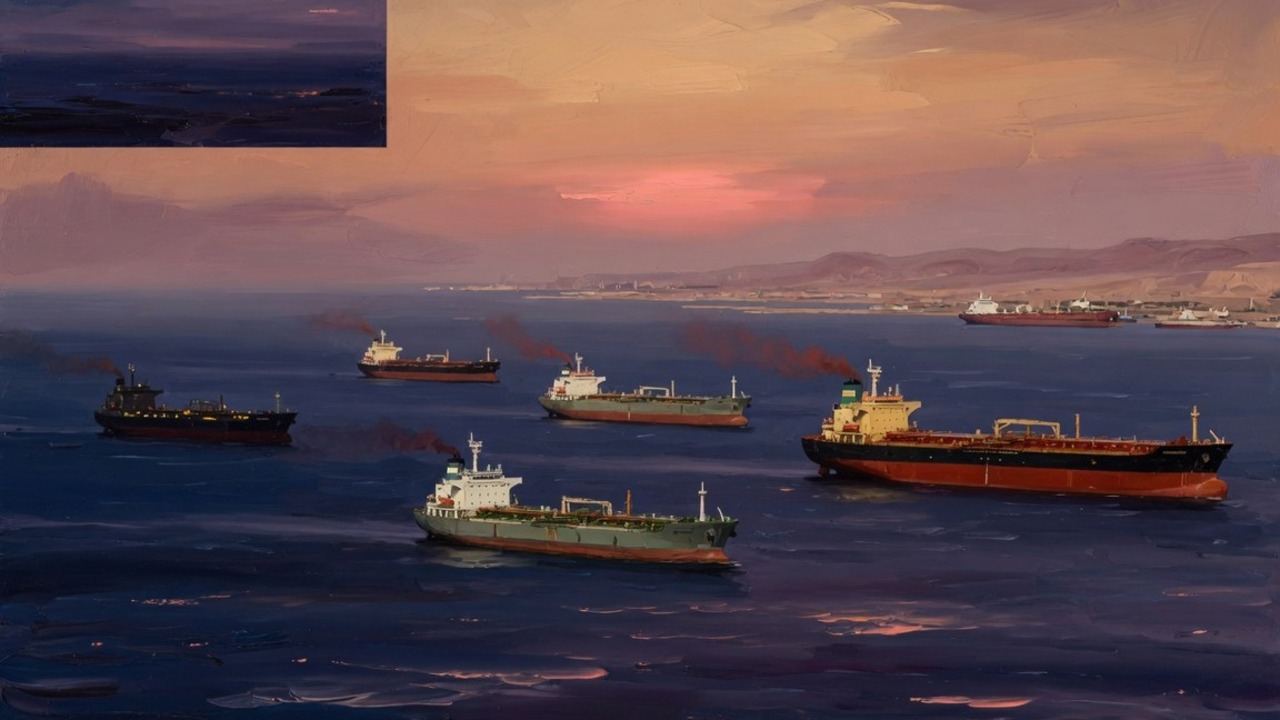
Credit: AI-generated illustration. · HeadLines Decoded LLC
Illustration generated with AI (Grok).
On July 23, 2026, Yemen’s Houthi movement claimed it had struck two Saudi-linked oil tankers in the Red Sea with missiles and drones. Saudi authorities confirmed that one vessel, the Encelia, was hit and caught fire at the bow, with no casualties reported in the initial accounts. The second vessel the Houthis named, the Layla, remained less fully verified.
The claims came days after the group announced a naval blockade aimed at vessels loading or unloading at Saudi ports. Shipping data already showed multiple tankers altering course or turning around in the southern Red Sea. The incident adds pressure to an energy export system already strained by months of disruption in the Strait of Hormuz.
- Houthis claimed missile and drone strikes on two Saudi oil tankers on July 23. Saudi media confirmed a fire on the Encelia near Jizan, with no deaths reported.
- The attacks followed a Houthi declaration of a blockade on Saudi-linked shipping through the Bab el-Mandeb Strait, a route that had gained importance after the Hormuz disruptions.
- Oil prices moved higher in the surrounding days, with Brent crude trading in the mid-$90s per barrel amid supply-risk concerns at both chokepoints.
- Higher crude and shipping costs reach American households mainly through gasoline, diesel, airfares, and the price of transported goods, even though the United States is a net oil exporter.
- Official statements have focused on military pressure and warnings of further action. The measurable household cost is a separate and ongoing fact.
Sequence of events
Earlier in the week the Houthis said they would target ships tied to Saudi ports. Commercial vessels responded quickly. Tracking data showed at least three tankers that had loaded Saudi crude for Asian destinations reversing course rather than proceeding toward the Bab el-Mandeb, and additional ships altered routes to avoid the southern Red Sea.
On July 23 the group said its forces had struck the Encelia and the Layla. UK Maritime Trade Operations reported a tanker hit by an unknown projectile roughly 70 nautical miles southwest of Al Shuqaiq, consistent with the location of the confirmed Encelia incident, with crews reported fighting a fire. Saudi state media confirmed the Encelia strike and said there were no casualties. Independent confirmation of the second vessel was still limited in early reporting.
These events did not happen in isolation. For months the Strait of Hormuz has faced severe disruption amid the broader military confrontation between the United States and Iran. Saudi Arabia had shifted a larger share of its exports toward the Red Sea route by way of the East-West pipeline and the Yanbu terminal. The Houthi blockade threat and the claimed strikes therefore targeted a workaround that had become more important precisely because of the Hormuz problem.
The dual-chokepoint problem
Global oil trade leans heavily on two narrow waterways at opposite ends of the Arabian Peninsula. The Strait of Hormuz handles a large share of seaborne crude leaving the Persian Gulf. The Bab el-Mandeb Strait is the southern gateway between the Red Sea and the Indian Ocean, and therefore a key link for cargoes that would otherwise use the Suez Canal.
When risk rises on both routes at once, the remaining options shrink. Ships can sail around the Cape of Good Hope, but that adds substantial distance, fuel, and time. War-risk insurance premiums rise. Daily charter rates for tankers climb. These higher costs are not abstract. They show up in the landed price of crude, in refined-product markets, and eventually in the prices paid by end users.
In the days around the Houthi announcement and the claimed strikes, Brent crude moved into the mid-$90s per barrel, reflecting the combined supply-risk premium from both waterways. Market commentary noted the chance of further upside if the Red Sea route became reliably dangerous for Saudi-linked cargoes while Hormuz stayed constrained.
How the costs reach American households
The United States is a net exporter of crude oil. Research from the Federal Reserve Bank of Dallas earlier in 2026 found that the sensitivity of U.S. real GDP growth to a large geopolitical oil-supply shock is far lower today than in the 1970s or 1980s. Domestic production growth and a less energy-intensive economy have reduced the macroeconomic effect.
That finding does not erase the household experience. Retail gasoline and diesel prices stay linked to global crude benchmarks. Higher crude raises the cost of jet fuel and therefore airfares. It raises the cost of trucking, rail, and maritime shipping of consumer goods. It affects the petrochemical feedstocks used in plastics, packaging, fertilizers, and a wide range of intermediate products.
Households already managing high costs for housing, food, insurance, and credit feel an added increase in energy and transportation prices more sharply when those items take a larger share of the monthly budget. Lower- and middle-income households typically spend a higher share of income on necessities, so the same percentage rise in fuel and goods prices lands harder on them.
Businesses face the same input-cost pressure. Trucking firms, airlines, manufacturers that rely on timely imports, and retailers that move high volumes of goods all see higher operating costs when energy and freight rates rise. Some of those costs are absorbed and some are passed through. The burden falls unevenly across sectors and income groups.
Official statements and the policy debate
President Trump has addressed the Red Sea situation in public remarks, saying the Houthis had not yet closed the Bab el-Mandeb and that the United States would act if they did. He has also framed the broader campaign against Iranian targets in terms of the costs being imposed on Iran and the pressure meant to change its behavior.
The administration’s approach has combined direct military strikes with public warnings about further escalation in the Red Sea. One view holds that letting Iran and aligned groups constrain major energy arteries would produce larger long-term economic and strategic costs, and that sustained pressure is needed to restore freedom of navigation. Another view holds that the cumulative effect of the conflict, meaning higher energy prices, elevated shipping costs, and prolonged uncertainty, imposes measurable burdens on American households and businesses that get less emphasis in messaging focused on military objectives.
Both views work from the same underlying facts. Shipping disruptions are occurring. Oil prices have risen. Those prices affect fuel and goods costs inside the United States. The disagreement is about the right duration of elevated costs, the weight given to short-term household impact versus longer-term geopolitical outcomes, and how effective the current military and diplomatic tools will prove.
What remains uncertain
Several variables will decide how large and how lasting the economic effects become.
First is the Houthis’ ability to sustain and widen attacks against more vessels. A single confirmed strike with a contained fire is different from a pattern that forces most commercial traffic to avoid the southern Red Sea for weeks or months.
Second is the capacity of Saudi Arabia and its partners to protect or escort tankers on the Red Sea route. Effective protection could limit the practical impact of the blockade declaration even if threats continue.
Third is the path of the United States and Iran military exchanges and any resulting change in Hormuz transit conditions. Improvement at one chokepoint would ease the overall pressure even if the other stays difficult.
Fourth is how quickly alternative supply, whether increased output from other producers, inventory releases, or weaker demand, can offset delayed or lost volumes from the Middle East.
Fifth is the behavior of commercial shippers and insurers. Many operators have already shown a low tolerance for elevated risk. Once a route is priced as dangerous, traffic can stay depressed long after the immediate threat fades.
For American households the near-term channel is fuel prices and the cost of transported goods. For the broader economy the channels include inflation expectations, corporate input costs, and any secondary effect on interest-rate decisions if energy-driven price pressure proves persistent.
The practical picture for the weeks ahead
At the time of the initial reports, the physical damage appeared limited to a fire on one tanker that crews were addressing, with no confirmed deaths. The strategic significance lies less in any single vessel and more in the demonstration that both major export pathways from the Arabian Peninsula now carry elevated risk.
Markets have already begun pricing that dual risk. Households will meet it in the weeks that follow through the ordinary mechanisms of fuel prices, shipping costs, and goods inflation. Whether the pressure intensifies or eases depends on the variables above. The transmission from chokepoint risk to consumer prices is not in dispute. The duration and the policy response remain the open questions.
For the longer arithmetic underneath energy shocks like this one, see The Day the Planet’s Invoice Came Due.
- Saudi Press Agency and UK Maritime Trade Operations reports on the Encelia incident, July 23, 2026
- Houthi statements via affiliated media claiming strikes on the Encelia and Layla and announcing the Saudi-focused blockade
- Shipping-tracking data showing tanker course changes in the southern Red Sea after the blockade announcement
- Oil-price data and market commentary on Brent crude in mid to late July 2026
- Federal Reserve Bank of Dallas analysis on U.S. GDP sensitivity to geopolitical oil-supply shocks (2026)
- Public statements by President Trump regarding the Bab el-Mandeb and the broader campaign
E.G. v4.12 · I.R.G. v1.10 · L.R.G. v1.8 · P.L.G. v1.9 · S.E.O. v1.2
Editor written. AI used for spelling and grammar only.