New Dental Tools: Longer-Lasting Care or a More Expensive Tool Belt?
Implants are a real advance. Same-day crowns and lasers often change the experience and the bill more than they change how long the work lasts.

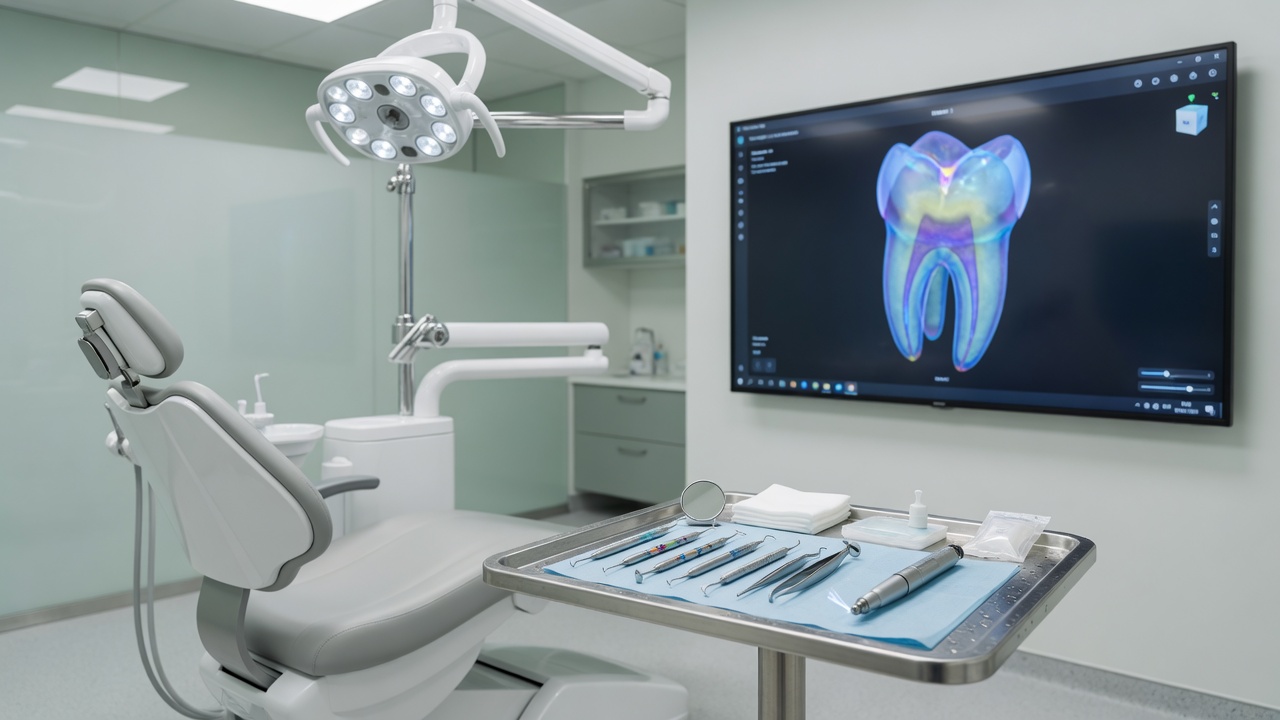
Credit: AI-generated illustration. HeadLines Decoded. · HeadLines Decoded LLC
Illustration generated with AI (Grok).
Modern dentistry offers implants that can last decades, same-day ceramic crowns milled in the office, lasers that reduce the need for needles, digital scanners that eliminate gooey impressions, and clear aligners that replace metal braces for many patients. The marketing is straightforward: these tools are more precise, more comfortable, and more durable than what came before.
Patients and payers still face a practical question. Do the newer techniques deliver meaningfully better long-term health outcomes, or do they mainly expand the menu of higher-fee procedures while raising the cost of opening and running a practice? The evidence shows a mix of genuine clinical advances, incremental improvements, and clear financial incentives that shape what is offered.
- Dental implants show 10-year survival rates around 95 percent or higher and often last 25 years or more. They preserve jawbone and avoid grinding down healthy neighboring teeth. Traditional bridges typically last 10 to 15 years and require preparing the teeth on either side.
- Same-day CAD/CAM crowns and traditional laboratory crowns show broadly comparable longevity, commonly 10 to 15 years when well executed. The main difference is convenience and workflow, not a dramatic leap in durability.
- Lasers reduce pain and anesthesia needs for some procedures but have not been shown to improve long-term restoration survival or pulp vitality over conventional methods in the strongest available reviews.
- Opening a modern dental practice in 2026 commonly costs $650,000 to $950,000 or more. Advanced imaging, scanners, mills, and lasers add substantial capital expense and support higher-fee services.
- Some new techniques offer clear biological advantages. Others mainly improve patient experience or practice efficiency while increasing the overall cost of care.
Implants versus traditional bridges
The strongest evidence for a genuine advance sits with dental implants. Contemporary data consistently show 10-year implant survival rates in the mid-to-high 90s percent range for healthy patients. Many fixtures function for 25 years or longer. The titanium or zirconia post itself can last a lifetime, while the crown on top may need replacement after 10 to 15 years of wear.
Traditional fixed bridges show lower survival. Systematic reviews place 10-year survival roughly in the 85 to 90 percent range, with a typical functional lifespan of 10 to 15 years. Bridges require preparation of the adjacent teeth, which removes healthy structure and creates future risk of decay or root canals on those support teeth. Bridges also do not stimulate the jawbone under the missing tooth, so bone loss continues.
Implants avoid both problems when successful. They replace the root, maintain bone volume through normal chewing, and leave neighboring teeth untouched. The trade-offs are higher upfront cost, a surgical procedure, healing time measured in months, and the risk of peri-implantitis, an inflammation and bone loss around the implant. For patients who are good candidates and maintain excellent hygiene, the long-term biological and durability advantages are well documented.
Same-day crowns and digital workflows
Chairside CAD/CAM systems, often marketed under names such as CEREC, let a dentist scan a prepared tooth, design a restoration on a screen, mill it from a ceramic block, and cement it in a single visit. Traditional crowns still rely on impressions, digital or physical, sent to a laboratory, a temporary restoration, and a second appointment.
Longevity data show the two approaches are largely comparable for most single-tooth cases. Both commonly last 10 to 15 years with proper care, and marginal fit measurements in modern systems are similar. Failure modes differ slightly: milled ceramics may be more prone to bulk fracture or debonding in some studies, while older porcelain-fused-to-metal crowns more often chip or develop recurrent decay at the margins. Neither method has demonstrated a decisive long-term advantage across broad patient populations.
The practical gains are convenience for the patient, meaning one visit and no temporary, and workflow control for the practice. The capital cost of the scanner and mill is significant. Practices recover that investment through higher throughput, reduced laboratory fees, and the ability to keep the full fee in-house. Whether that produces better oral health or simply a different cost structure depends on the individual case and the quality of the work.
Lasers and minimally invasive claims
Dental lasers are used for soft-tissue surgery, cavity removal, gum treatment, and some root-canal cleaning. Systematic reviews and meta-analyses find that lasers can reduce the need for local anesthesia and lower patient-reported pain during hard-tissue preparation compared with conventional rotary drills. Restoration survival and pulp vitality, however, are not clearly improved, and procedures often take longer.
Lasers work as useful add-ons for specific situations and for patients who prefer less injection or drill noise. They have not replaced conventional methods as the default for most restorative work on the basis of superior long-term outcomes. The equipment adds cost. The clinical benefit is real but narrower than some marketing suggests.
The cost of the modern tool belt
Starting a dental practice from scratch in 2026 typically requires $650,000 to $950,000 or more once build-out, equipment, technology, working capital, and soft costs are included. Digital imaging, especially cone-beam CT, along with intraoral scanners, chairside mills, lasers, and practice-management software, forms a large share of the technology budget. These items are not optional for practices that want to offer the full menu of current procedures and stay competitive for patients who expect digital workflows.
The same technologies that raise the barrier to entry also support higher-revenue services. Implants, full-arch rehabilitations, same-day ceramics, clear-aligner therapy, and complex restorative cases carry higher fees than routine fillings and traditional crowns. Practices with cone-beam CT and advanced surgical capability keep more implant and complex cases in-house rather than referring them out, and case acceptance tends to rise when patients can see 3-D images and same-day results.
Overhead in established practices commonly runs 55 to 65 percent of collections, and net margins after all expenses often fall in the 20 to 35 percent range for well-run offices. New technology is therefore both a major capital outlay and a pathway to the procedures that generate the higher end of those collections. The financial incentive to adopt and promote the newer tool belt is structural, not accidental.
Health outcomes versus revenue incentives
Some of the newer techniques deliver clear health advantages. Implants that successfully fuse to bone preserve that bone and avoid damaging adjacent teeth. Digital diagnostics can improve treatment planning and reduce some over-treatment when used carefully. Minimally invasive approaches and better adhesives have shifted many restorations toward less aggressive drilling.
Other changes mainly improve comfort, speed, or appearance while the underlying longevity stays similar to older methods. Same-day crowns make the point: the convenience is real, the durability is roughly equal to good laboratory work, and the economics favor the practice that owns the mill. Lasers reduce discomfort for certain procedures without clearly extending the life of the resulting restorations.
The tension for patients is that the same tools that can produce better biological results also expand the set of high-fee options. A practice that has invested heavily in implant systems, scanners, and mills has both the capability and the financial motivation to recommend those services. That does not make every recommendation inappropriate. It does mean patients benefit from understanding the evidence on longevity, the alternatives, and the cost differences before consenting.
What the evidence supports in practice
For a missing tooth in a healthy patient with adequate bone, an implant is generally the longer-lasting and more conservative option for the surrounding teeth, provided the patient can maintain excellent hygiene and accept the surgery and higher initial cost. For crowns, modern ceramics, whether milled chairside or made in a laboratory, perform similarly when the preparation, fit, and bite are correct. Lasers are reasonable add-ons for comfort and selected soft-tissue or cavity work but are not required for durable results in most restorative cases.
Traditional materials and techniques have not disappeared because they failed. Gold restorations, well-made fillings, and conventional bridges continue to function for many patients. The shift toward the newer tool belt reflects a combination of better biology in some areas, better patient experience in others, and an economic model that rewards capital-intensive, higher-fee care.
The health question and the money question are linked but not identical. Some of the new tools clearly last longer or protect more natural structure. Others mainly make the same clinical endpoint more convenient or more profitable. Telling the two apart remains the practical task for anyone evaluating a treatment plan or the cost of modern dental care.
For the wellness end of the same spending question: Nervous System Care Is the New Daily Essential.
Insurers make the same argument about a much larger bill: Insurers Say They ‘Can’t Afford’ Ozempic and Zepbound. What the Data on Healthier Patients and Cost Savings Actually Shows..
- Systematic reviews and cohort data on implant survival (10-year rates commonly 95 percent or higher; long-term function of 25 years or more in many studies)
- Bridge survival data from systematic reviews (roughly 85 to 90 percent at 10 years; typical lifespan 10 to 15 years)
- Comparative studies of CAD/CAM versus laboratory crowns on marginal fit and medium-term survival
- Meta-analyses on laser-assisted cavity removal and soft-tissue applications (pain and anesthesia reduction; limited effect on long-term restoration survival)
- 2026 dental practice startup-cost analyses ($650,000 to $950,000 or more for new offices; technology as a major component)
- American Dental Association and industry benchmarking on practice overhead and margins
E.G. v4.12 · I.R.G. v1.10 · L.R.G. v1.8 · P.L.G. v1.9 · S.E.O. v1.2
Editor written. AI used for spelling and grammar only.