How to Audit Your Medical Bill Before You Pay It
Research ranks seven causes of rising health costs. This guide shows how to check your own bill against the explanation of benefits your insurer sends, under federal and Florida rules.

Credit: U.S. Department of Agriculture (USDA Rural Development)
To audit a medical bill, get the itemized bill, line it up against the explanation of benefits (EOB) from your insurer, check both against your medical record, and ask about financial assistance before you agree to any payment plan. Many errors a patient can spot show up in that comparison, from a service billed twice to a hospital fee nobody explained.
Americans spent $5.3 trillion on health care in 2024, or $15,474 per person, according to the Centers for Medicare & Medicaid Services. A 2017 JAMA study led by Joseph Dieleman found that yearly U.S. health spending grew by $933.5 billion between 1996 and 2013, and no single cause explains the whole climb. The audit is the part a household can do this week, under federal rules and, in Florida, a 2024 state law. Two of the five prices in Part 3 of Healthcare Costs, Decoded show up on your paperwork: the posted charge and the allowed amount.
Seven causes of rising costs, ranked by the evidence
The table lists seven causes, roughly from the largest effect the research has measured to the smallest. The studies measure different things in different years, so the rows overlap, do not add up, and cannot tell you what one employer plan pays in one county.
| Rank and driver | Main evidence | Who it reaches | Years | What it cannot show |
|---|---|---|---|---|
| 1. Price per service | Joseph Dieleman and colleagues, JAMA, November 7, 2017: a higher price per service and more or costlier services per visit were tied to $583.5 billion of a $933.5 billion rise in yearly spending. Irene Papanicolas and colleagues, JAMA, March 13, 2018: prices help explain why the U.S. outspends 10 rich peers. | Everyone, through premiums and taxes | 1996-2013; 2013-2016 | Whether the same service cost more or each visit included more. |
| 2. Population need | Dieleman: more people added $269.5 billion and an older population $135.7 billion. Shifts in disease rates cut $28.2 billion. | Medicare most, as people age into it | 1996-2013 | Why the U.S. spends more than other rich nations. |
| 3. Drug mix | CMS: drug spending rose 7.9 percent to $467.0 billion in 2024. Papanicolas: $1,443 per person a year here in 2016 against $466 to $939 abroad. Part 7 covers drug prices. | Every payer, and anyone paying coinsurance at the pharmacy | 2024; 2013-2016 | How much is price increases and how much is newer drugs. |
| 4. Administrative work | Papanicolas: running and managing the system took 8 percent of U.S. spending, against 1 to 3 percent elsewhere. | Everyone, mostly through premiums | 2013-2016 | Which part of that work could be cut without losing something useful. |
| 5. Market power | Government Accountability Office, GAO-25-107450, September 22, 2025: at least 47 percent of physicians were tied to hospital systems in 2024, up from under 30 percent in 2012; studies link this to higher spending and prices, with quality generally unchanged. Zack Cooper and colleagues: monopoly hospitals charged 12 percent more than those with four or more rivals. | Mostly people with private insurance | 2012-2024; 2007-2011 | Whether your own local system raised its prices. |
| 6. Site of care | Medicare Payment Advisory Commission (MedPAC), June 2023: Medicare paid 194 percent more in 2023 for a heart ultrasound in a hospital outpatient department than in an office. MedPAC estimated equal rates for 66 service groups would have cut patients’ own share of the cost by $1.5 billion in 2021, but the law would have raised rates for 103 other groups. | People on Medicare | 2021, 2023 | What private plans pay for the same shift. |
| 7. Amount of care | Papanicolas: U.S. use of care was “largely similar” to peers, though MRI and CT scans ran higher. Dieleman: the change in use, about $27 billion less, was not statistically significant. | Everyone | 1996-2016 | Overuse of one test in one town. |
Turned into shares, the Dieleman figures say that of every $100 added to yearly U.S. spending on personal health care from 1996 to 2013, after inflation, about $62.50 was tied to higher prices and more care per visit, $28.90 to population growth and $14.50 to aging. Falling disease rates took $3.00 back, and changes in how much care people used took another $2.90 back, a change the authors found not statistically significant. The five pieces add to $100. Our method: each cause’s dollar figure divided by the $933.5 billion total rise, so $583.5 billion divided by $933.5 billion is 0.625, or $62.50 per $100. The use-of-care piece is what is left after the other four, about negative $27 billion. HeadLines Decoded did the division on October 21, 2026.
Market power and site of care show up together in one charge on many bills: the facility fee, a separate hospital charge for its building and staff, added when a hospital owns the office you visit. MedPAC reported that as hospitals buy physician practices, billing shifts to Medicare’s hospital outpatient payment system, which usually pays more, even when the office and the care stay the same. The place-of-service code shows it. On the CMS code list, code 11 means an office. Codes 19 and 22 mean a hospital’s outpatient department, off the main campus or on it. Since the Bipartisan Budget Act of 2015, Medicare pays many newer off-campus departments less, MedPAC notes, so the gap varies.
Reading a sample EOB
An EOB is the statement your insurer sends after it processes a claim. It is not a bill. Every number on the provider’s bill should trace back to it. The sample below uses invented round numbers.
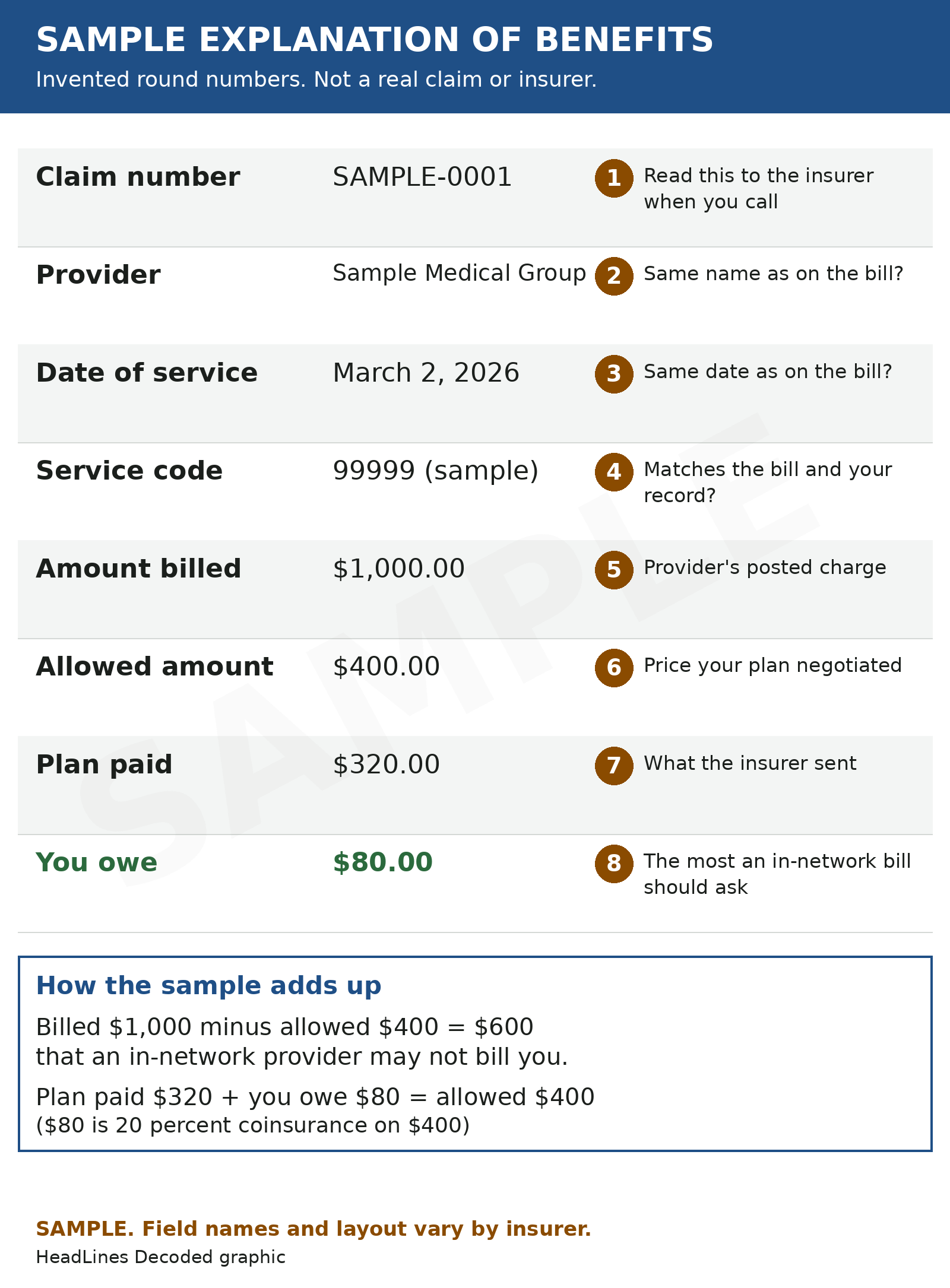
HealthCare.gov says an in-network provider may not bill you the difference between the billed and allowed amounts on a covered service. The sample assumes you have already met your deductible, the yearly amount you pay before the plan starts sharing costs. A bill asking for more than the “you owe” line, $80 here, is the first thing to question.
The audit, in order
Keep copies and note the date of every call.
- Request the line-by-line bill. An account total gives you nothing to check. In Florida, a hospital or surgery center must send an itemized statement within 7 days of your request or discharge, whichever is later.
- Match each line to the EOB: date, provider, code and your share. The CMS guide to bill errors says the “your share” amount should be the same on both.
- Compare the bill with your medical record. “You shouldn’t get a bill for anything that isn’t documented in your records,” CMS says. Florida facilities must make the records needed to verify a bill available within 10 business days, though copies can carry a fee.
- Check codes, quantities and place of service. CMS says double billing is especially common when more than one provider cared for you, and a code 19 or 22 on what felt like an office visit points to a facility fee.
- Get the denial reason and the appeal deadline in writing. For plans under the Affordable Care Act’s appeal rules, HealthCare.gov gives 180 days from when you receive the denial notice for an internal appeal. Medicare Advantage plans allow 65 days, and in Original Medicare the deadline is on your Medicare Summary Notice, the statement Medicare mails you.
- Apply for financial assistance before signing up for financing. Ask for the policy and its application, and for the list of providers it covers. At a nonprofit hospital, a complete application pauses collection while the hospital decides.
- Use the federal protection that fits how the care was paid for, since insured and uninsured patients have different rules.
Federal protections under the No Surprises Act and IRS rules
If you used insurance, the No Surprises Act, in force since January 1, 2022, limits what you can be charged for emergency care, for out-of-network care at an in-network facility, and for out-of-network air ambulances, according to CMS. For anything else, your route is the plan’s appeal. The federal dispute process is for the uninsured: “If you used health insurance, you don’t qualify to dispute a bill,” CMS says.
Patients without insurance, or who chose not to use it, are owed a good faith estimate before the care. When one provider’s or facility’s bill comes in at least $400 above its own estimate, you can file a federal dispute if the initial bill is dated within the last 120 calendar days. The fee is $25, and the bill cannot go to collections while the dispute is open. A surgery center that estimated $1,200 and billed $1,650 is $450 over and qualifies. Each provider’s bill is measured on its own, so two doctors each $350 over do not.
Nonprofit (tax-exempt) hospitals must follow IRS rules: a written assistance policy for emergency and medically necessary care, a plain-language summary, free paper copies and a list saying which other providers in the hospital the policy covers and which it does not. Until 120 days after the first post-discharge bill, such a hospital cannot report you to credit bureaus, place a lien or sue. Selling the debt in that window counts as one of those collection actions too, unless a written contract binds the buyer to the protections the IRS rule lists, including a ban on the buyer’s own collection actions and return of the debt to the hospital if you are found eligible. You have at least 240 days from that bill to apply.
Florida’s 2024 medical debt law
Florida’s House Bill 7089 took effect July 1, 2024, and was amended in 2025. Its billing rules cover every hospital and ambulatory surgical center licensed under chapter 395 of state law, for-profit or nonprofit. A bill from a doctor’s own office falls outside them.
Under section 395.3011, such a facility may not sell your debt, report it to credit bureaus, sue, file a lien or garnish wages until it has ruled on your assistance eligibility, sent an itemized statement, billed your insurer and let the claim be decided. It must then wait 30 days after written notice sent by certified mail or another traceable method. Collection also stops during a grievance or appeal, and while you negotiate in good faith or keep up a payment plan.
Ask a question about the bill and the facility has 7 business days to answer under section 395.301, and a first response to a formal grievance is due in 7 business days. Each itemized bill must explain in bold how to file one.
Once a Florida hospital or surgery-center debt goes to a collector, a lawsuit to collect it must be filed within three years of the referral. In that lawsuit, your interest in one vehicle up to $10,000 is shielded, plus up to $10,000 in other personal property if you claim no homestead exemption.
The law sets no interest cap. Senate Bill 1222 would have limited interest on medical debt, and it died in the Senate Health Policy Committee on March 13, 2026. The 2025 amendment lets a facility sell a debt without the 30-day notice only if a contract bars the buyer from adding interest or fees or taking other collection steps and requires the buyer to send the debt back to the facility if you qualify for assistance.
Medical debt on credit reports in 2026
No federal rule keeps medical debt off credit reports. The Consumer Financial Protection Bureau (CFPB) wrote one, but on July 11, 2025, the U.S. District Court for the Eastern District of Texas threw it out at the joint request of the CFPB and the plaintiffs in Cornerstone Credit Union League v. CFPB. On October 28, 2025, the CFPB issued an interpretive rule, its official reading of the law, saying the Fair Credit Reporting Act “generally preempts State laws that touch on broad areas of credit reporting,” meaning federal law overrides them. State limits on reporting medical debt are now in question.
What remains are the credit bureaus’ own policies. In an April 11, 2023 announcement, Equifax, Experian and TransUnion said paid medical collections had been off credit reports since July 1, 2022, and that medical collections with an original balance under $500 were removed. Under those policies, an unpaid medical collection waits a year, up from six months, before it can appear. We found no announcement ending these voluntary policies as of October 21, 2026.
Florida’s law bars a hospital from reporting you to the credit bureaus until it has finished the steps described above. We found no court ruling on whether the CFPB’s position overrides that.
Deadlines for a bill dated November 3, 2026
Each clock starts on a different day. The table assumes a first bill, a denial and a Florida collection notice all dated and received on November 3, 2026, counting calendar days.
| Rule | Who it covers | Counts from | Sample date |
|---|---|---|---|
| Florida 30-day notice | Florida hospital and surgery-center patients | Written collection notice | December 3, 2026 |
| Medicare Advantage appeal, 65 days | Medicare Advantage members | Denial notice date | January 7, 2027 |
| IRS 120-day collection hold | Nonprofit hospital patients | First bill after discharge | March 3, 2027 |
| Federal dispute, 120 days | Uninsured or self-pay, $400 or more over one provider’s estimate | Initial bill date | March 3, 2027 |
| Internal appeal, 180 days | Plans covered by the Affordable Care Act appeal process | Receipt of the denial | May 2, 2027, a Sunday; file by Friday |
| IRS assistance application, 240 days | Patients of a nonprofit hospital | Its first post-discharge bill | July 1, 2027 |
| Florida lawsuit limit, three years | Florida facility debts sent to collectors | Referral to a collector | November 3, 2029 |
Our method: the sample date plus the days in each rule, computed October 21, 2026. A nonprofit hospital may accept assistance applications after day 240, the IRS says, but it need not.
The appeal packet
Put these in one folder, with copies, before you call or write.
- A one-page cover letter that gives the claim number and says what you are asking for
- The itemized bill, questioned lines circled
- The EOB for that claim
- The page of your record showing what was or was not done
- Any good faith estimate or written quote
- The plan’s denial letter
- The hospital’s assistance application, filled out
- A dated call log of who you spoke with and what they said
- Appeal deadline: ______________________
If a provider or plan stops answering, the federal No Surprises Help Desk takes calls at 1-800-985-3059. In Florida, every itemized hospital bill must also list a patient liaison’s phone number for billing disputes.
About this information. This article explains how health care costs and coverage rules work. It is general information. Nothing here is medical, insurance, legal, tax or financial advice. We do not recommend any plan or product. Prices and rules change, so check any figure with the source named here, your plan or a licensed professional before you make a decision. No insurer, hospital, drug company or health plan named in this article paid for it or reviewed it before publication.
- NHE Fact Sheet, historical 2024 (accessed October 21, 2026) · Centers for Medicare & Medicaid Services
- Factors Associated With Increases in US Health Care Spending, 1996-2013 (JAMA, November 7, 2017) · Dieleman et al.
- Health Care Spending in the United States and Other High-Income Countries (JAMA, March 13, 2018) · Papanicolas, Woskie and Jha
- Health Care Consolidation: Published Estimates of the Extent and Effects of Physician Consolidation, GAO-25-107450 (September 22, 2025) · U.S. Government Accountability Office
- The Price Ain’t Right? Hospital Prices and Health Spending on the Privately Insured, Working Paper 21815; published in the Quarterly Journal of Economics (2019) · Cooper, Craig, Gaynor and Van Reenen
- Aligning fee-for-service payment rates across ambulatory settings, June 2023 Report to the Congress, chapter 8 · Medicare Payment Advisory Commission
- Place of Service Code Set · CMS
- Balance billing (glossary) · HealthCare.gov
- Check your medical bill for errors · CMS
- Surprise billing and protecting consumers · CMS
- Patient-provider dispute resolution and good faith estimates · CMS
- Dispute a bill · CMS
- Internal appeals · HealthCare.gov
- Appeals in Medicare health plans · Medicare.gov
- Appeals in Original Medicare · Medicare.gov
- Financial Assistance Policies (FAPs) · Internal Revenue Service
- Billing and Collections, Section 501(r)(6) · Internal Revenue Service
- HB 7089 (2024), Transparency in Health and Human Services, Chapter 2024-183 · The Florida Senate
- CS/HB 547 (2025), Medical Debt, Chapter 2025-98 · The Florida Senate
- Florida Statutes 395.3011, Billing and collection activities (2026) · The Florida Senate
- Florida Statutes 395.301, Price transparency; itemized patient statement or bill (2026) · The Florida Senate
- Florida Statutes 395.002, Definitions (2026) · The Florida Senate
- Florida Statutes 95.11, Limitations other than for the recovery of real property (2026) · The Florida Senate
- Florida Statutes 222.26, Additional exemptions from legal process concerning medical debt (2026) · The Florida Senate
- SB 1222 (2026), Medical Debt, died in Health Policy March 13, 2026 · The Florida Senate
- Prohibition on Creditors and Consumer Reporting Agencies Concerning Medical Information (Regulation V), status · Consumer Financial Protection Bureau
- Fair Credit Reporting Act; Preemption of State Laws (October 28, 2025) · Federal Register
- Equifax, Experian and TransUnion Remove Medical Collections Debt Under $500 From U.S. Credit Reports (April 11, 2023) · Experian
- Further reading from HeadLines Decoded: Insurers Say They ‘Can’t Afford’ Ozempic and Zepbound
E.G. v4.18 · I.R.G. v1.14 · L.R.G. v1.9 · P.L.G. v1.10
Produced under the HeadLines Decoded Editorial, Image & Rights, Legal & Risk, and Production & Layout guidelines at the versions shown.
Editor written. AI used for spelling and grammar only.