The data center water fight the neighbors already lost
A hyperscale campus is a land deal first. What it drinks, where the used water goes, and why disclosure is the whole fight.
 Todd Ruffner-Schoenfeld
Editor in chief. A knack for the fine print, and likes it.
Todd Ruffner-Schoenfeld
Editor in chief. A knack for the fine print, and likes it.
What the building drinks
Cooling is what sets the water number. An evaporative system throws heat away by boiling water off into the air, which is cheap on power and expensive on the aquifer. A closed-loop or air-cooled system keeps the water and spends electricity and equipment instead. A large wet-cooled campus can drink more than a million gallons a day, about what a town of ten thousand people uses. Companies now advertise air cooling and recycled, non-potable loops in their announcements, because at some point in the last two years the gallon count stopped being an engineering footnote and became a political object.
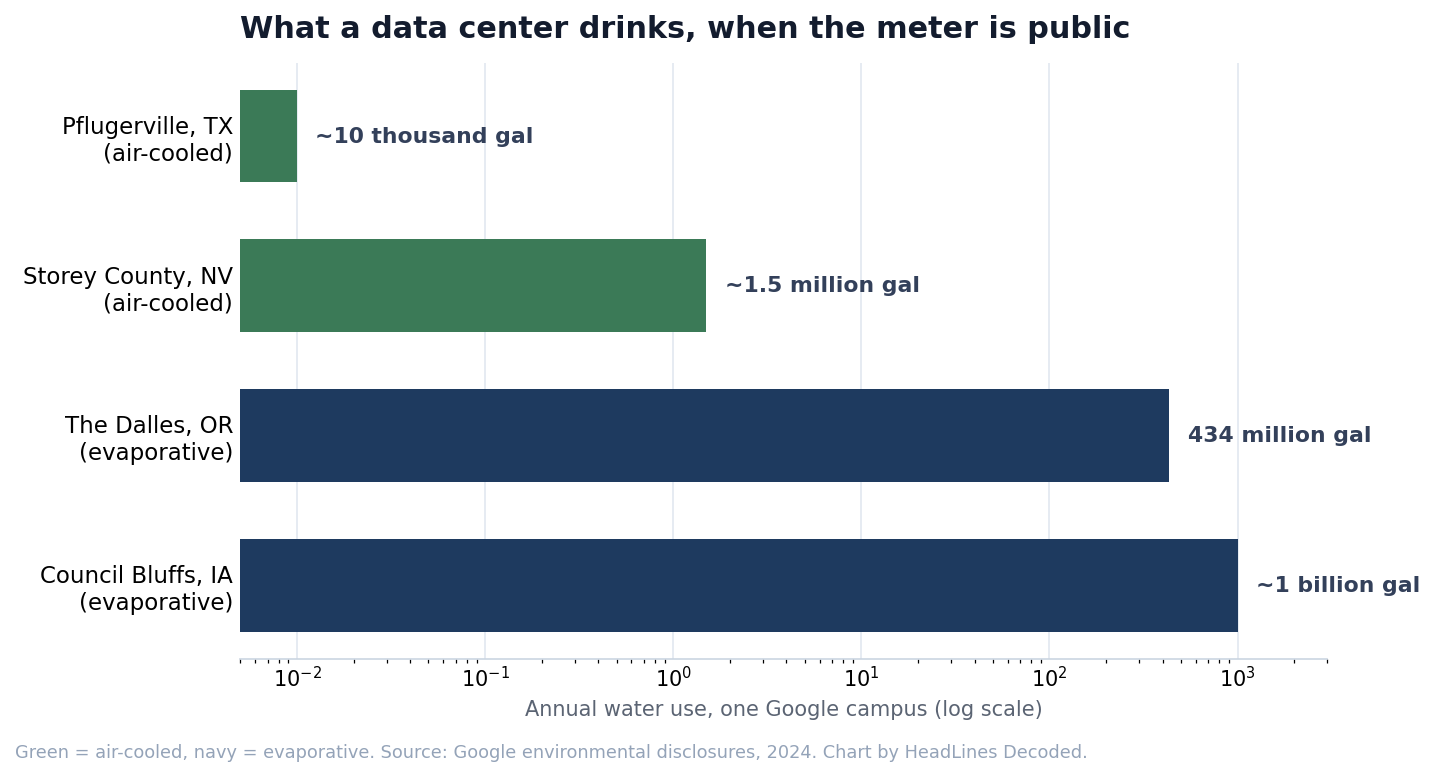
The spread between the two designs is enormous, the difference between a rounding error and a reservoir. Google’s own 2024 disclosures show it plainly: an air-cooled site in Pflugerville, Texas used about ten thousand gallons of water for the entire year, while a wet-cooled campus in Council Bluffs, Iowa used on the order of a billion. Same company, same business, a hundred-thousand-fold difference in what the neighbors’ water table felt. When a developer will not say which cooling design is going in, assume it is the wet kind.
What the records actually show
Plenty of viral gallon counts are wrong. The ones that survive a public-records fight are the ones to trust, and prying them loose is where the real fight happens. Google’s campus in The Dalles, Oregon drew 434.4 million gallons in 2024, roughly a third of the whole city’s water, and the city spent a thirteen-month legal battle trying to keep the ledger sealed until an Oregonian lawsuit forced it open. A dispute in Fayette County, Georgia over a QTS campus produced a smaller but verified figure, about 13 million gallons over six months on a single unmetered connection, after early headlines had guessed at fifteen to thirty million a month. If the county cannot tell you the meter, you do not have a deal. You have a press packet.
Where the used water goes
Water going in is only half of it. Cooling loops concentrate whatever was already in the water, and the blowdown has to go somewhere. In March 2026 Amazon agreed to pay $20.5 million to settle claims that its Oregon data centers contributed to nitrate in the groundwater of the Lower Umatilla Basin, an area where tens of thousands of people draw from private wells. Amazon denies the allegations, and a settlement is not an admission of anything. In Georgia, Flint Riverkeeper and a group of homeowners filed a notice of intent to sue a QTS site over sediment washing off hundreds of cleared acres toward a creek that feeds the Flint River. In California, an Imperial County judge issued a tentative ruling in early September that the county could not wave a 330-megawatt proposal through as a ministerial paperwork exercise, and ordered a full environmental review that takes in the 500,000-gallon water tanks and the 132 gas generators, not only the server hall.
The three answers a town gives
Santa Teresa, New Mexico watched Oracle’s Project Jupiter move, in public, from about a million gallons a day in early coverage to a recycled, non-potable figure once the scrutiny arrived. Oracle says the drop came from a change in how the site makes and cools power, closed loops and fuel cells, not from the politics; the people who fought it read the timing the other way. Tucson, Arizona rejected a project called Project Blue in 2025, and it simply moved to unincorporated Pima County, where it could draw up to 31 million gallons a year from groundwater wells while the region argues over its share of a shrinking Colorado River. Towns that said yes are living with the bargain: a tax base, a construction year, a hum that never stops, and a water ledger they may not be cleared to read. Towns that said no watch the developer refile one county over. Towns in court are living with delay, which is sometimes the only veto a planning board has left.
What to bring to the hearing
The questions a resident should carry into the hearing are plain and hard to dodge: how many gallons a day, drawn from where, potable or not, and where the used water goes afterward. If the answers are public and specific, a town can say yes and mean it. If they come back marked proprietary, the county is being asked to co-sign a water bill it is not allowed to read. The next part follows the jobs the ribbon-cutting promises, and counts how many are still there after the cameras leave.
- Google water disclosures: The Dalles, Oregon, 434.4 million gallons in 2024 (about a third of city water), released after a thirteen-month legal fight and an Oregonian lawsuit; air-cooled Pflugerville, Texas about 10,000 gallons and wet-cooled Council Bluffs, Iowa about 1 billion gallons a year. OPB.
- Fayette County, Georgia: about 13 million gallons over six months on one unmetered QTS connection, after hotter early estimates. The Citizen.
- Amazon Data Services agreed on March 31, 2026 to pay $20.5 million to settle claims of alleged nitrate contamination in Oregon’s Lower Umatilla Basin; the company denies the allegations. Oregon Capital Chronicle.
- Imperial County, California: a tentative ruling (September 1, 2026) ordering a full CEQA environmental review of a 330-megawatt data center, including 500,000-gallon water tanks and 132 gas generators. KPBS.
- Georgia Clean Water Act notice of intent to sue a QTS site (Flint Riverkeeper and residents) over construction sediment, August 2026. Atlanta News First.
- Oracle’s “Project Jupiter” in Santa Teresa, New Mexico: water figures and the company’s account of the change. Oracle. Tucson’s “Project Blue”: rejected by the city in 2025, up to 31 million gallons a year from wells in Pima County. KJZZ.