The U.S. Hit Canada With 50 Percent Tariffs, Decoded: What They Tax and Who Pays
Trade talks collapsed at the deadline. Washington reached for Section 338, a 1930 anti-discrimination law, and taxed about US$20 billion of Canadian goods. Ottawa will match it dollar for dollar the Tuesday after Labour Day. Here is the part the slogans skip.

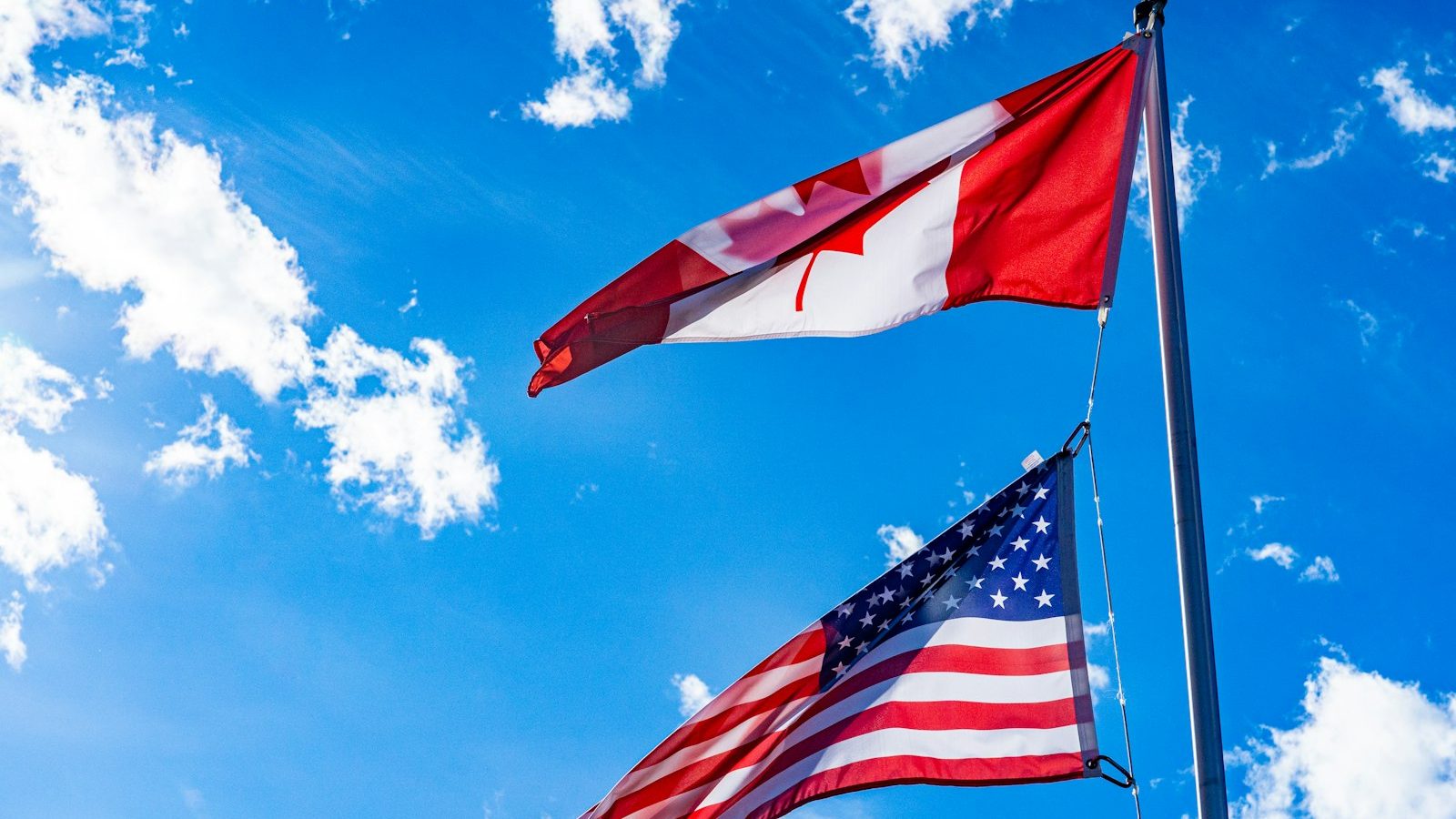
At one minute past midnight on Saturday, a bottle of Canadian whisky, a wheel of Ontario cheddar, and a Canadian-made hockey stick all got more expensive to sell into the United States. Each one now meets a 50 percent tariff at the border. Negotiators had worked right up to the deadline to head it off. Friday night, they quit.
If you’ve heard the word tariff and filed it under ‘some kind of tax,’ you’re basically right, and here’s the part that matters. A tariff is a tax the government charges on goods coming in from another country, paid at the border by the American company bringing them in. That company doesn’t just swallow it. It works the cost into its price, and the price is the one waiting for you on the shelf. So a 50 percent tariff on Canadian goods is, in plain terms, a tax that starts at the border and finishes in your cart.
And this one is big. It falls on about 20 billion dollars of Canadian goods, which Prime Minister Mark Carney counted in Canadian dollars as roughly 28 billion. Same pile of stuff, two currencies. That’s close to a nickel out of every dollar Canada earns selling to us. Sounds small, until it’s your job. If your paycheck comes from a company in that nickel, this isn’t a rounding error. It can be the whole year.
- A tariff is a border tax. The company importing the goods pays it, then works it into the price you see on the shelf.
- At 12:01 a.m. Saturday the U.S. put a 50 percent tariff on about US$20 billion of Canadian goods (roughly C$28 billion), after the talks fell apart Friday night.
- It runs on Section 338 of the Tariff Act of 1930, a nearly forgotten law for hitting a country the president calls unfair.
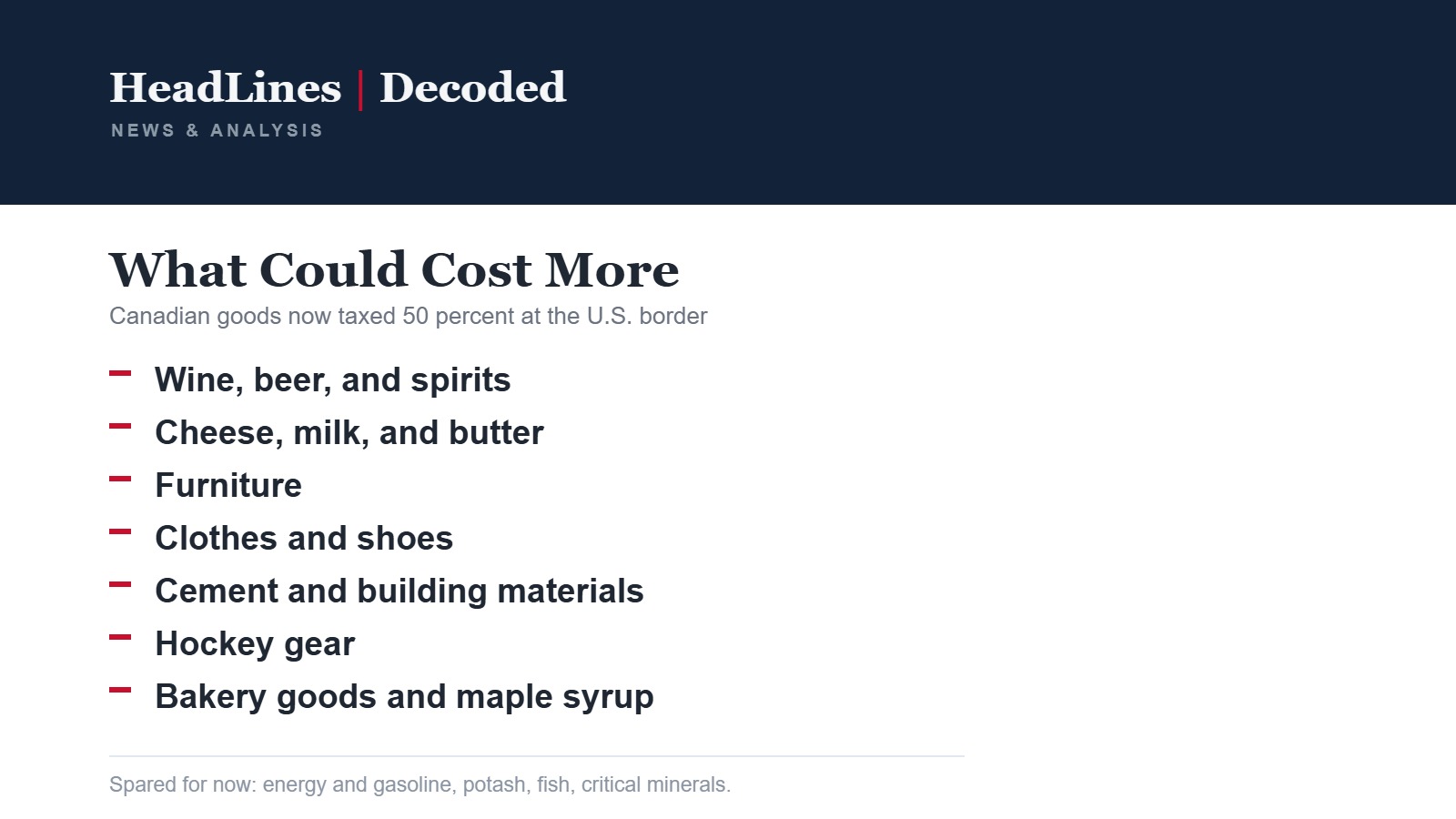
- It hits wine, cheese, furniture, clothes, building materials, hockey gear, and more, even goods that were supposed to be tariff-free under CUSMA. Gas, potash, fish, and critical minerals are spared.
- Canada suspended talks and will match it dollar for dollar starting September 8.
What got more expensive
Walk it through your own week. The tax lands on Canadian wine and beer, on cheese and butter, on the couch and the dresser, on shirts and shoes, on the cement and lumber in a kitchen reno, on hockey gear, and on the maple syrup that might as well be Canada’s flag in a bottle. It even hits things that were supposed to cross the border tax-free under CUSMA, the North American trade deal everybody already signed, and that’s the part that has Ottawa fuming.
What got left off says as much. Your gas and your heating oil are safe. So are potash and fish, along with the critical minerals that go into batteries and phones, plus the steel and aluminum that already get taxed under a separate rule. Washington kept its hands off the things that would jump your gas bill and your grocery total the fastest. Read that however you like, but somebody in that room was watching the same checkout line you watch.
Why a law from 1930?
Here’s where it gets a little sneaky, and it’s worth a minute. The president didn’t reach back to a law from 1930 by accident. That old law, Section 338, only lets him do this if he declares that the other country is playing dirty with American business. Playing dirty is the whole key that turns it. And that’s exactly what the White House has been saying about Canada for months: the provinces that pulled American liquor off the shelves, the dairy rules it says favor Europe over us, the fights over cars. So reaching for this dusty old law isn’t just paperwork. It writes the accusation right into the legal form. The law and the talking point end up saying the same thing, and that’s no coincidence.
Who’s spinning what
Both capitals are handing you a story, so here’s each one, and where it bends. They can’t even agree on how the deal died: each side says the other one changed the terms at the last minute. Washington says it’s simply answering real unfairness. The U.S. trade rep, Jamieson Greer, says America offered Canada “the best treatment of any major exporter,” cuts on steel, aluminum, cars, and lumber included, and that Canada torched a finished deal at the last minute with “new demands and walk backs.” The pitch is a level field and American jobs.

Canada says that’s nonsense, that a 50 percent tariff is just a tax you pay at the register, aimed at a friend for no real prize. Carney called the last-minute American terms “unfair, uneconomic,” then flat out a “miscalculation.” Democrats in Congress call the whole tariff habit chaos and are trying to claw back the president’s power to do it on a whim.
Here’s the part neither side will say out loud: both are a little bit true, and both are stretched. Canada really does shelter some of its own industries, and the pro-tariff crowd waves that around while going quiet on who actually pays, which is you. Canada’s side waves the chaos flag while pretending there’s no real complaint underneath. There’s a midterm coming, and “the sky is falling” and “nothing to see here” both travel better than the plain truth in the middle.
The people who feel it first
The folks who shout first in a fight like this are the ones running on the thinnest margins. Candace Laing, who runs the Canadian Chamber of Commerce, called it “a body blow” and said the quiet part out loud: Americans pay more, and Canadian small shops watch their customers disappear. The Canadian Federation of Independent Business went and asked its members. Out of 1,833 of them, two in five sell something on the list, and more than a third figure their revenue could drop by half or worse. “Few small firms can absorb a 50 percent tariff,” said its president, Dan Kelly, “and few can pass that cost on to customers while staying competitive.” On our side of the line, the American companies that buy Canadian lumber and parts and specialty food get two choices with the new cost. Eat it, or hand it to you.
What happens next
Canada isn’t talking anymore, and it says it’ll hit back dollar for dollar. That starts the Tuesday after Labour Day, September 8, with help for the hurt workers and businesses promised soon after. Almost none of this travels by ship, by the way. It rolls across the land border on trucks and trains, which is why the sting shows up fast and close to home. Until the 8th, the only sure things are higher prices and shorter tempers, plus a scheduled CUSMA review that turned cold.

What it means for your wallet
Turn the volume down and it’s smaller, and more honest, than either side wants it to be. Canada does protect some of its own. Washington does love a tariff, more so in an election year. And whoever’s more right, the bill doesn’t land on a podium. It lands on your grocery run and a Canadian family’s storefront. Want to know if it reaches you? Check the label on the wine, the cheese, or the two-by-fours at the lumberyard. If it says Canada, it may cost more soon. And circle September 8, because that’s when Canada’s answer, and your next round of price tags, starts to arrive.
- NPR – U.S.-Canada trade talks collapse just before deadline for tariffs
- CNN – Carney says US asked too much, offered too little
- Bloomberg – US Hits Canada With 50% Tariffs and Carney Vows to Retaliate
- Georgia Public Broadcasting / AP – U.S.-Canada trade talks collapse
- UPI – U.S.-Canada talks collapse, 50% tariffs begin
- Blakes – legal analysis of the Section 338 scope and exemptions
- Canadian Federation of Independent Business – survey of small exporters
Reported and edited to HeadLines Decoded newsroom standards. E.G. v4.17 · I.R.G. v1.14 · L.R.G. v1.9 · P.L.G. v1.10. This is news with analysis; every fact is sourced above, and the framing sections lay out the case each side is making without taking one.
Editor written. AI used for spelling and grammar only.