How to Decide What You Actually Need: Sizing, Hybrids With Solar and Batteries, and a Practical Framework for Florida Homes
The right answer depends on your critical loads, how long you can tolerate an outage, whether someone can manage a portable, and whether you already have solar and battery storage. Here is a way to work through the choice without the marketing noise.

Credit: AI-generated illustration (Grok), generated in-house. HeadLines Decoded. · HeadLines Decoded LLC
Illustration generated with AI (Grok).
The previous parts of this series covered why multi-day outages still happen in Florida, what portable generators can and cannot do, the safety rules that keep them from becoming killers, and what a permanent standby system actually costs and requires. This final part turns those pieces into a decision process.
There is no single best generator for every Florida house. There is a best fit for a specific set of loads, a specific tolerance for inconvenience, a specific budget, and a specific set of existing equipment.
Step 1: Write down the loads that cannot fail

Ignore the marketing language about whole-house coverage for a moment. List the things that, if they stop working for more than a few hours, create real harm or major cost.
- Refrigeration and freezers (food loss).
- Any medical device that requires power (CPAP, oxygen concentrator, nebulizer, powered mobility, refrigerated medication).
- Well pump or municipal water pressure if it depends on power.
- Sump or flood pumps.
- Minimum lighting and phone charging.
- One zone of air conditioning or a window unit if heat is a medical risk.
Find the running wattage and, if possible, the starting wattage for each item. Nameplates, manuals, and manufacturer websites are the sources. Add a margin. That list is the foundation for every later decision.
If the total continuous load on that critical list is under 3,000 to 4,000 watts, a quality portable inverter or conventional unit with a proper interlock or transfer switch can often handle it. If the list includes central air plus a well pump plus multiple other loads, the conversation moves toward a larger portable, a parallel pair of inverters, or a standby system.
Step 2: Decide how much human involvement you can accept
A portable requires someone to:
- Move the unit to a safe outdoor location.
- Start it.
- Connect the cord.
- Manage which breakers are on so the generator is not overloaded.
- Refuel it, sometimes every 6 to 12 hours under load.
- Shut it down and secure it when utility power returns.
If the household has a reliable person who can do those things, and if the critical loads fit within a portable’s capacity, the lower cost of a portable is often the rational choice. If no one can be present, if medical needs require automatic operation, or if the household simply does not want to manage fuel and loads during a multi-day event, a permanent standby system or a hybrid with battery storage becomes more attractive.
Step 3: Account for existing solar and battery storage
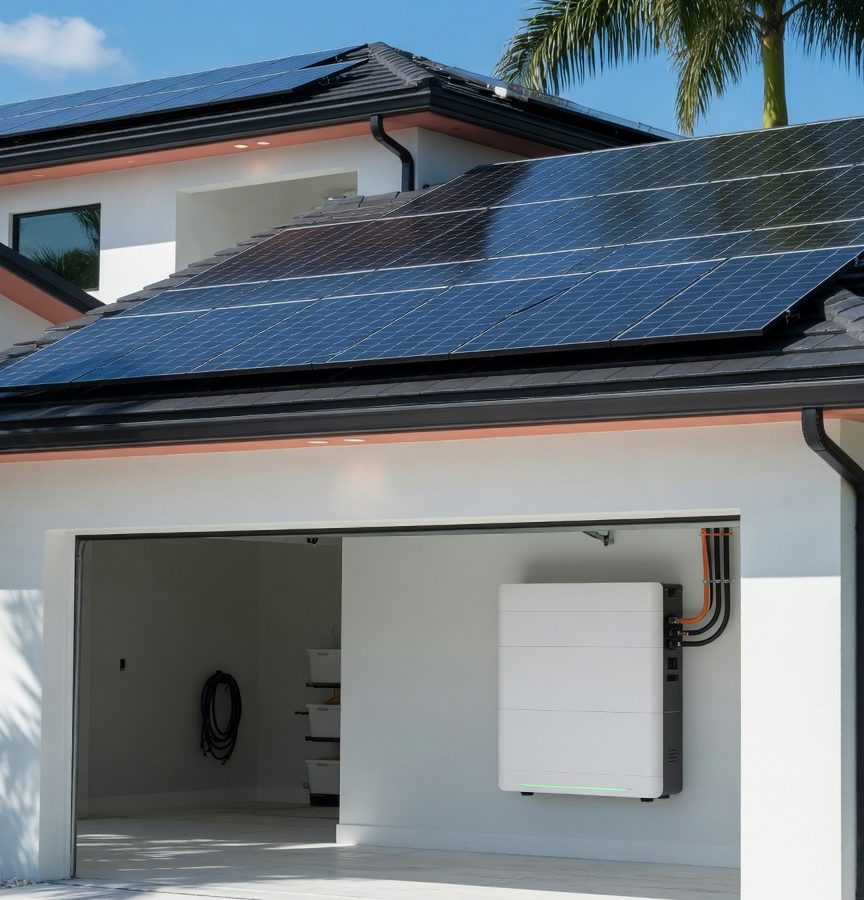
A growing number of Florida homes already have rooftop solar and battery systems such as Tesla Powerwalls or equivalent. Those systems change the generator calculation.
Batteries can carry critical loads for hours or more than a day depending on capacity, the loads, and whether the sun is available to recharge them. In a multi-day outage with heavy cloud cover or after the batteries are depleted, a generator can serve as a recharge source rather than as the primary power for the whole house.
In a hybrid setup, the generator is often smaller than a whole-house standby unit because it only needs to recharge the batteries and support the critical loads the batteries cannot cover. The automatic transfer and control logic become more complex and should be designed by someone familiar with both the battery system and generator integration. Manufacturer guidelines and qualified installers matter here. Improper integration can damage equipment or create safety issues.
Homes with substantial battery capacity and a modest critical load list may find that a portable generator used only for recharging during extended outages is sufficient. Homes with limited battery storage or high continuous loads will still look at larger permanent systems.
Step 4: Match the budget to the risk
Approximate 2025-26 cost bands for Florida:
| Option | Typical cost range | What you get |
|---|---|---|
| Quality portable + interlock or manual transfer switch | $1,500 to $4,500 total | Manual operation, critical loads, owner manages fuel and placement |
| Larger portable or parallel inverters + proper connection | $3,000 to $7,000 | More headroom, still manual |
| Standby, essential circuits, 10 to 16 kW installed | $6,000 to $10,000 | Automatic, limited circuits |
| Standby, most of a typical home, 18 to 22 kW installed | $9,000 to $14,000 | Automatic, broader coverage |
| Larger standby or complex hybrid | $12,000 to $22,000+ | Higher capacity or integrated battery systems |
These are not precise quotes. Site conditions, fuel line length, panel upgrades, flood elevation, and local labor move the numbers. The point of the table is relative scale. A portable-plus-interlock solution costs a fraction of a full standby installation. The difference buys automatic operation, higher capacity, and the ability to leave the house during an outage.
Insurance, financing, and possible incentives or tax treatment for certain energy systems can affect the net cost. Check current rules; they change.
Homeowners insurance is another big yearly bill on a Florida house. At many Florida-based insurers, part of every premium goes out as fees to companies that share the insurer’s owners, such as managing agents and claims handlers. A 2022 study for Florida’s Office of Insurance Regulation added up those fees. In September 2026, the Florida Senate’s general counsel, Tom Thomas, demanded that the Orlando Sentinel and the South Florida Sun Sentinel delete and shred their copies of the study. The papers refused and published what it found.
Step 5: Check the practical constraints
- Space and setbacks for a permanent unit, including exhaust clearances and HOA rules.
- Availability of natural gas versus the need for a propane tank.
- Flood zone elevation requirements.
- Whether a licensed electrician and, if needed, a gas contractor are available on a reasonable schedule before the next storm season.
- Noise tolerance of the household and the neighbors.
- Willingness to perform or pay for regular maintenance and testing.
A perfect technical solution that violates the HOA, cannot be permitted, or sits in a floodway is not a solution.
A simple decision path
If the critical load list is modest, someone can operate a portable, and the budget is limited: start with a quality inverter or conventional portable, a proper interlock or transfer switch installed by a licensed electrician, carbon monoxide detectors, and a fuel plan.
If medical needs, travel, or simple preference require automatic operation and the budget supports it: evaluate a standby system sized to the critical or whole-house load, with natural gas preferred where available.
If the house already has solar and battery storage: model how long the batteries last under the critical load, then decide whether a portable for recharging or a smaller integrated generator is the better supplement.
If the house is large, the loads are high, and outages are frequent or long: a larger standby unit or a carefully designed hybrid is usually the rational path.
In every case, the safety rules from Part 3 remain in force. Carbon monoxide placement, proper transfer equipment, fuel handling, and wet-condition awareness do not disappear because the system is automatic or because batteries are involved.
Before the next season
Florida’s hurricane season is predictable even when individual storms are not. The window for calm decisions is the months before June, or the quiet stretches between named storms. Waiting until the week after a major outage means competing for equipment, installers, and fuel with everyone else who had the same realization.
Write the critical load list. Decide how much human involvement is realistic. Look honestly at the budget and the existing solar and battery capacity. Then choose the tool that matches those constraints. A well-matched portable with proper setup will outperform an oversized, poorly maintained standby unit. A properly installed automatic system will outperform a portable that no one is available to start.
The grid is hardening. Storms still win for days at a time. The household that has already decided what it will power, and how, is the one that loses the least when the next long outage arrives.
- Part 1: Why Florida’s long outages still happen
- Part 2: Portable generators: power and limits
- Part 3: Setup and safety
- Part 4: Permanent standby systems
- Part 5: How to decide what you need (you are here)
One more thing before you buy: the machine is only half the decision. For how the sales process can quietly inflate a standby-generator quote, and what to demand in writing first, see the hard sell on whole-house generators.
- U.S. Energy Information Administration, hours without power in 2024
- U.S. Consumer Product Safety Commission, carbon monoxide fatality report
- Florida Building Code, 8th Edition (2023), including Residential Code flood and generator provisions
- National Electrical Code (NFPA 70), Article 702, Optional Standby Systems
- Manufacturer integration guidelines for solar-plus-storage and generator pairing
Reported and edited to HeadLines Decoded newsroom standards. E.G. v4.16 · I.R.G. v1.13 · L.R.G. v1.9 · P.L.G. v1.10. Part of our Power Through the Storm series.
Editor written. AI used for spelling and grammar only.